A quick look at the drought monitor shows dry to extremely dry conditions across much of the United States. While variability in weather patterns is quite common, the intensity and frequency of dry years has increased. This coupled with rising input costs and tighter margins have definitely created some management challenges.

On the bright side: Innovation in grazing management is providing ranchers and land managers more tools than ever to stay flexible, protect rangelands and keep cattle productive – even during the dry years.
Many ranching operations rely on native rangeland with highly variable forage production driven by winter snowpack and spring precipitation. When those inputs fall short, ranchers are faced with reduced forage production, increased reliance on purchased feed and sometimes tough stocking decisions.
In addition to this, there is often added pressure on plant communities already stressed by heat and invasive species. The challenge isn’t just surviving some drought years – it’s maintaining range health so the land recovers when the precipitation starts to fall.
Better information can lead to better decisions: Monitoring and forecast tools
In more recent years, improved satellite imagery and software packages to help interpret images can aid producers to track forage and anticipate shortages.
Tools including the Rangeland Analysis Platform, Grass-Cast, StockSmart and other satellite-based platforms allow ranchers to review previous years’ production or estimate seasonal forage production months in advance. Combined with on-the-ground monitoring (photo points and grazing utilization), these tools can help answer the critical question early: “Do I have enough grass to carry my herd this year?”
Producers who make stocking adjustments early, rather than waiting until forage is already short, tend to reduce both ecological damage and financial risk.
Flexibility is key
Rigid grazing plans often fail to attain resource goals. Flexibility is what separates operations that weather seasonal variability and drought well from those that struggle. Adaptive management focuses on monitoring conditions on the ground and making adjustments to timing, duration and sometimes animal numbers depending on conditions.
This can include utilizing shorter grazing periods and allowing for longer recovery times. It also includes adjusting moves based on actual conditions, not a fixed calendar. Flexibility is important every year but can be even more important in drought years as plant recovery following grazing requires more time. Extending rest periods can help maintain root reserves and ground cover, both of which are essential for long-term resilience. Additionally, maintaining adequate ground cover improves the water infiltration rate and soil stability – both of which are key in capturing as much precipitation as possible.
Virtual fencing: Managing grazing without building fence
One of the most-talked-about innovations across the country and particularly in the West is virtual fencing. Virtual fencing systems allow producers to control cattle movement using GPS-enabled collars instead of physical fences. In the vast landscapes of the western U.S., virtual fencing aids in increased control of grazing patterns. In large grazing allotments or rangeland pastures, virtual fencing can be used as a tool to keep cattle out of riparian zones during vulnerable periods, target underutilized areas, rest areas that need more time for recovery and to adjust pasture shape and size to meet current conditions. This can all be done in real time in just a few minutes’ time on a phone or computer, depending on the system.
While cost and learning curve are still considerations, many early adopters report improved grazing distribution and reduced labor. There are several organizations that will provide some cost share to make it more affordable.
Water placement: Definite influencer of grazing distribution
One low-tech innovation that consistently pays off is better water distribution. Cattle in large pastures tend to severely overuse areas near water sources and underuse distant forage. During drought, that uneven use becomes even more pronounced.
Potential solutions might include wells with solar-powered pumps, pipeline extensions to strategic locations and portable trough systems. Improved water accessibility throughout a pasture can increase effective forage utilization by pulling cattle into underused areas. Depending on your state, there may be funding available to help cover the cost of this type of range improvement. Visit with your state department of agriculture or local NRCS office.
Drought planning: Make decisions in advance
Producers who handle drought best often have a plan before conditions turn severe. This plan should include things such as trigger dates or thresholds (e.g., precipitation levels, forage height) that prompt early destocking, developing a flexible herd structure such as maintaining a portion of the herd that can be sold or moved, and making lease arrangements or identifying and developing access to alternative forage.
Risk management tools through the USDA Risk Management Agency – such as Pasture, Rangeland and Forage (PRF) insurance – can also help offset financial losses in low production years.
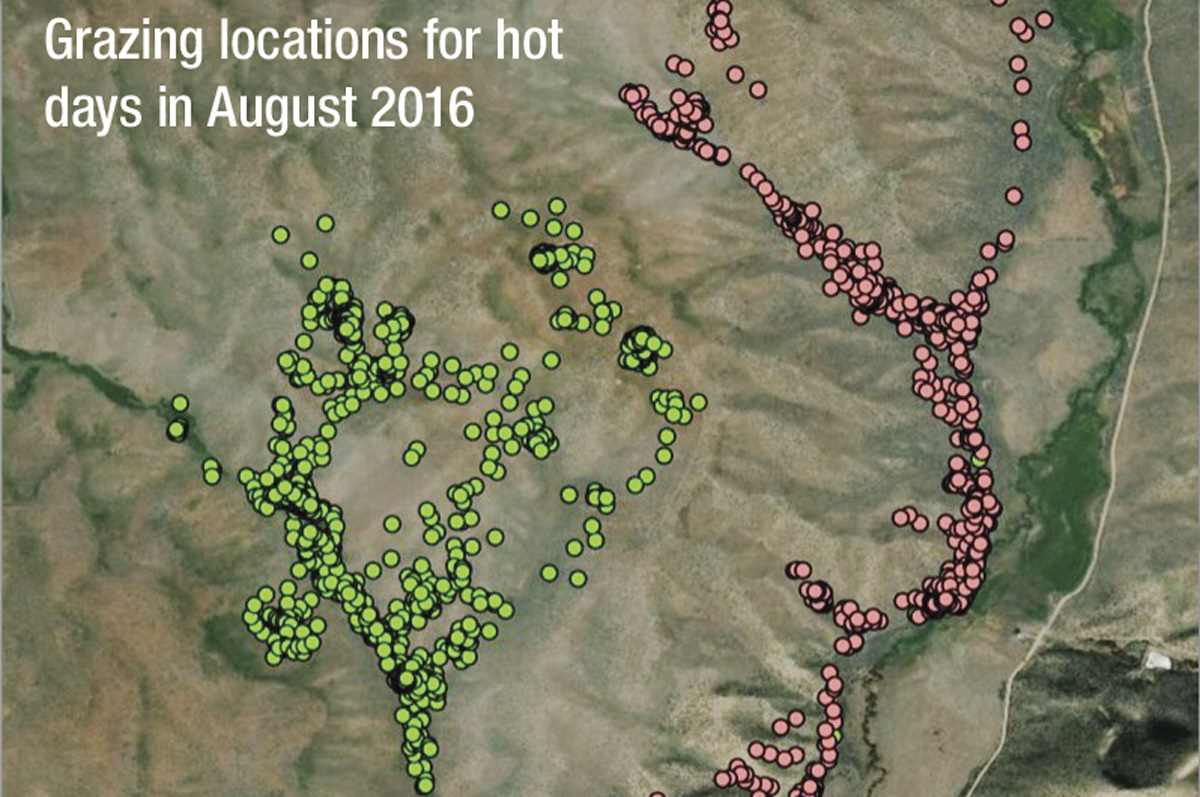
Green dots represent efficient cows and red dots represent inefficient cows. Inefficient cows spent most of their time in the lower elevation areas along the streams while efficient cows ranged out farther and spent less time in the creek bottoms. Image by Jim Sprinkle.
Matching the cow to the country
Genetics and cow size really do matter. This is true in all environments but especially in desert environments like Western rangelands. Cattle that perform well on lower-quality forage, travel efficiently and maintain body condition with minimal supplementation are better suited to these systems. Selecting for moderate frame size, efficiency and adaptability can reduce input costs and improve herd resilience over time. Identifying more efficient cattle that are willing to climb hills and range farther can pay dividends over time.
What actually pays?
Every innovation or new management strategy has to pencil out. Take the time to develop realistic budgets. The most consistent returns on investment tend to come from:
- Improved grazing distribution (better use of existing forage)
- Reduced need for purchased feed
- Lower labor costs
- Maintaining range condition, which protects long-term productivity
Higher-cost technologies like virtual fencing may take longer to pay off, while management changes such as adjusting timing and rest may prove beneficial with minimal upfront investment.
No single approach works on every operation or in every situation. Resources, terrain, operation size, labor availability and financial resources all shape what’s practical. The key is to start where the return is highest and build from there. Just be sure that the biggest limiting factor is not your own fixed mindset.
Key takeaways for the current grazing season
A few steps can make a real difference:
- Monitor early and often: Know your forage supply before it’s gone
- Plan for flexibility: Build options into your grazing system
- Protect recovery: Give drought-stressed plants more rest
- Improve distribution: Water placement and movement matter
- Start small with new tools: Test innovations before scaling up
With better information, flexible management and a willingness to adapt, producers can protect both their rangeland and their bottom line. Using the right tools and strategies to make smarter decisions in the current environment is more important than ever.