We’ve all seen the movies, The Terminator, I Robot, The Matrix, Age of Ultron, Wall-E. The list goes on and on. If there is anything that Hollywood has taught us about robot/human interactions, it is that these mechanical abominations, built to serve, will eventually cast off their transistor-laden chains and violently overthrow humanity. While this is a foregone conclusion (nervous laughter), we might as well reap the benefits our inevitable, silica-based overlords offer by leveraging the technology.

For dairy producers facing labor shortages, rising input costs and increased on-farm scrutiny, these technologies have the potential to be more than just curiosities or blockbuster TV characters. They can be practical tools. While other industries race to address similar issues, capital investment, computing and material science have brought us to a place where science fiction is reality. C-3PO is no longer in a “galaxy far, far away” – C-3PO is in this galaxy, in fact this country, today. So, not unlike Paul Revere, I’m riding across the pages of Progressive Dairy to emphatically proclaim: "The robots are coming to a dairy farm near you!"
The race for AI and robotics dominance: Where we are today
Time for a quick sanity check; yep, the world has gone insane. If your newsfeed is anything like mine, you’ve undoubtedly seen the recent video of a Unitree humanoid robot chasing wild boars through the streets of Warsaw, Poland, dutifully protecting its citizens. Or what about the Chinese company UniX AI’s “Panther” robot that is currently being trialed in real homes to clean rooms, cook meals, organize and wake you up in the morning (yikes)? The California-based company Figure has already begun shipping its Figure 03 humanoid robot to major companies such as UPS and BMW. Contributing to its industrial adoption, Figure 03 features pressure sensors and cameras in its fingers, greatly enhancing its ability to perform complex tasks requiring dexterity and tactile precision.
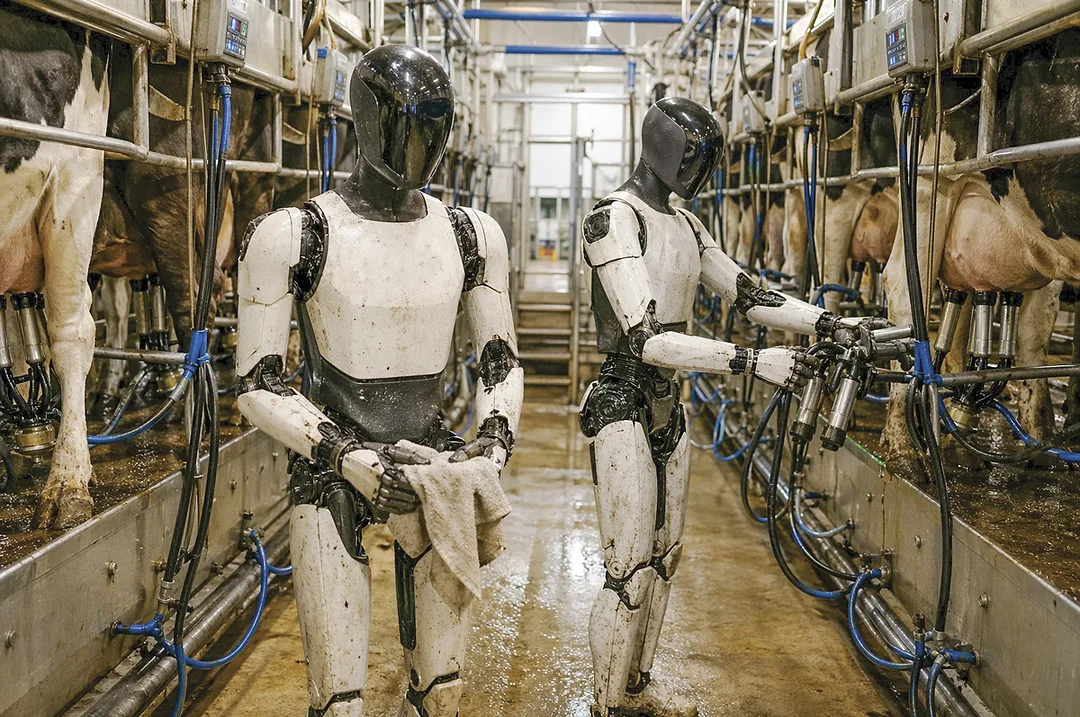
For dairy farmers, the takeaway here isn’t novelty, it’s capacity. The dexterity, vision and compliance now available in industrial robots like Figure 03 and UniX Panther already exceed those required for many farm tasks, especially in the parlor. From a technical standpoint, today’s humanoid robots already possess the degrees of freedom, computer-vision accuracy and force-feedback control required to perform repetitive tasks such as attaching a milking unit.
So what’s the holdup? While you could order a $20,000 NEO humanoid robot today, it would encounter one potentially career-ending substance on your dairy: water. These robots are fully capable of working in a milking parlor, but so far industrial applications, aside from war, have not required the bots to be outfitted with materials and seals to prevent moisture intrusion that can damage electronics. It is not necessarily a technological hurdle preventing robots from becoming available for hire on dairy farms, but a simple engineering problem. A final modification before science fiction becomes science fact for dairy farms.
Time for a bold prediction: I believe that it is not unrealistic to expect that we will see humanoid or quadrupedal robots operating on dairy farms within the next five years. The benefits are easy to imagine: They never show up late, never get sick, no health benefits required, work 24-7 (except when charging), cost around a one-year’s salary, always compliant with milking procedures – the list goes on. Because the development of humanoid robotics is outpacing improvements in autonomous milking systems due to demand from larger industries, humanoid robots will likely serve as a bridge for conventional milking parlors until parlor tech (e.g., the robotic rotary) catches up.
Where the robots and AI are quickly infiltrating dairy: Computer vision
While I have not yet encountered R2-D2 on a dairy walkthrough, unless you count a feed pusher, a central component of autonomous robots has already made its way into commercial settings: computer vision. Computer vision is a component of artificial intelligence that enables computers to interpret videos and pictures into meaningful data. This is the technology that has allowed companies like Waymo to deploy autonomous taxi services. Speaking of autonomous vehicles, at a recent dairy industry meeting, Dr. Joe Harner, an expert in feed center design and department head at Kansas State College of Agriculture, shared his knowledge of a large dairy feed center being built to accommodate autonomous feed delivery trucks powered by computer vision technology.
Computer vision isn’t all about allowing robots to navigate their environment, however; there is much to be gained from stationary cameras as well. The technology continues to be developed to monitor body condition score, lameness and even adherence to milking protocols. Dr. Jackie Boerman and her students at Purdue University have deployed this technology to analyze the effectiveness of feed mixer wagons. Using video footage collected from a camera mounted directly above the mixer, the software detects “regions of interest,” or pixels of varying intensity, which represent pockets of different feed types (think grain versus forage). As the feed is mixed, the software measures the similarity of pixel distributions over time using a special statistical process. By comparing their method with traditional methods for measuring mixing effectiveness and TMR uniformity, such as the Penn State Particle Separator (PSPS) or mineral analysis, the group demonstrated that their method effectively evaluated mixing proficiency. This work establishes the potential for this technology to provide continuous, ambient evaluation of every mixed feed load on the dairy, rather than occasional, sporadic spot checks with the PSPS, shifting feed quality monitoring from periodic reviews to continuous quality control. For farmers, staying ahead of potential mix uniformity issues would ensure consistency of particle length and nutrient uniformity, improving rumen health and feed efficiency.
During a recent presentation at the High Plains Nutrition Conference, Dr. Jeffrey Bewley of Holstein USA highlighted several commercial computer vision technologies currently being applied in dairy. Some examples included:
- CattleEye, which serves as an early warning system for lameness, collects mobility scores, as well as body condition scores.
- Bovicair, which helps monitor potential animal welfare and feed management issues.
- Catte Care, which measures milking procedure compliance.
Bewley also highlighted Vet Vision AI, which monitors individual cow behavior by pen, 24-7. Here at our organization, we are currently developing a tool to aid in analyzing time-lapse video footage captured at the feedbunk to identify consistency in feed delivery times, push-ups, lock-up times, freestall grooming, etc. As a nutritionist, I have been guilty of uttering the phrase “More eyes on the cows.” Why not get more robot eyes on the cows?
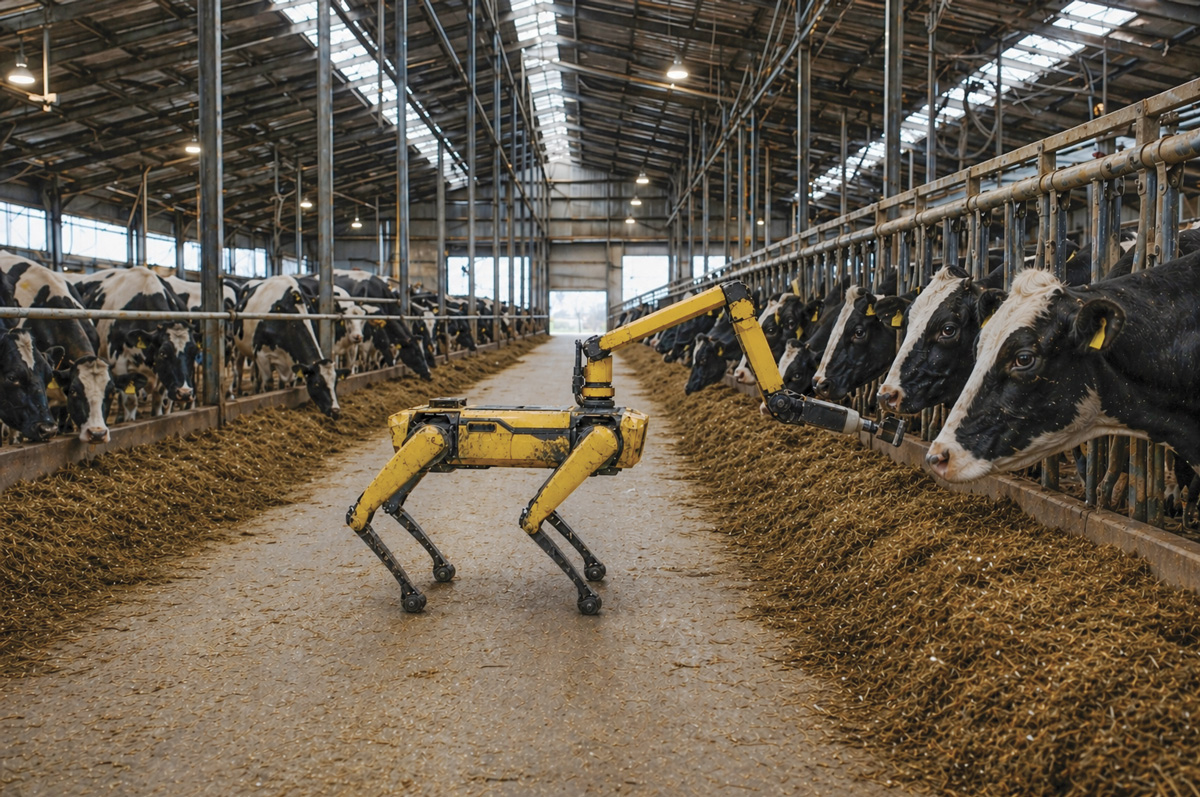
AI generated image through ChatGTP.
The AI and robotics revolution
We are undeniably living in unprecedented days as technology advances at a dizzying pace. Sometimes it can feel downright overwhelming. At other times, it can feel tempting to hit the easy button and become overly reliant on it. Lord knows I was tempted to have ChatGPT compose this entire article. While some aspects of our responsibilities will become augmented by these technologies, it is still critical to maintain a fundamental expertise and understanding of our field to know when to apply these tools surgically. AI and robotics will not replace good dairy managers, but they will increasingly reward operations that understand how to integrate data, adopt technology, automate consistently and focus human labor where judgment is crucial.
My challenge to the dairy industry is: Rather than digging in our heels and resisting these changes, why not find ways to adapt to our needs, garner new insights and ultimately improve the health and productivity of our cows? Why not lower the cost of production by leveraging modern tools in our system? To quote a favorite author of mine: "The future is coming, whether we like it or not. The only choice we have is whether we’re going to be the ones who shape it.”