Dairy farms in the U.S. have changed a lot since 2003. Even looking solely through the lens of reproductive strategy, the shifts are significant. Sexed semen has gone from a developing tool to a consistent component of herd mating strategies, especially as genomic testing and then the use of beef semen also earned popularity. Estrus synchronization programs have gained hold as protocols became more important and farms grew. And as cows have become higher and more persistent producers, farmers have chosen to wait longer to start breeding after calving.

Why set a comparison point to 2003? That’s when the first genetic selection tool for reproductive performance, Daughter Pregnancy Rate (DPR), was introduced. At that time, the national trend in days open showed how dairy cow reproductive performance had been continually declining as selection pressure was focused on boosting milk production. But profitable dairy farms also need to breed cows back in a timely manner, and the industry saw a pressing question to address.
Since producers have been able to genetically select for reproductive performance, farms have made remarkable progress in this area. Better management, resulting from more understanding of animal biology and new technologies like those mentioned above, has also made a big difference in improving reproduction. Two decades ago, a 40% pregnancy rate would have sounded impossible; today, herds can regularly meet this mark.
Yet DPR has not changed as this revolution has taken place. Additional traits – Cow Conception Rate (CCR) and Heifer Conception Rate (HCR) in 2009 and Early First Calving (EFC) in 2019 – provided context and options while the foundational measure remained the same. More recent evaluation patterns indicated opportunities to improve the stability of these traits and better separate genetic signal from management effects. So, in 2024, a team from the Council on Dairy Cattle Breeding (CDCB) and the USDA’s Animal Genomics and Improvement Laboratory (AGIL) began a review process to understand what was happening and find a way to modernize the traits to make sure genetic ability was being accurately measured.
Ten adjustments made
To do so, the team spent a few months detailing the existing processes for these evaluations, documenting areas of question and identifying potential solutions. Numerous approaches were tested to refine how the traits performed. Ultimately, 10 updates to calculations and data were determined to stabilize and improve the evaluations. Details on all the changes can be found online.
One significant revision was utilizing herd-year and lactation group-specific voluntary waiting periods (VWP) in the calculation of DPR. Previously, DPR used a fixed 50-day VWP with a 20-day grace period, but VWP is much more nuanced today. This update will account for herd-level changes in VWP and differences between lactation groups (first lactation or later) to better capture true reproductive ability instead of management choices.
Service sire breed and short cycling (when an animal is bred 10 to 17 days after a previous service) will also now be accounted for in CCR and HCR to remove more external biases that could affect reproductive performance. Mating type, such as the use of sexed or conventional semen, was already included in these calculations for the same reason.
Variance components were also re-estimated. This can be understood as recalibrating the parameters of the model to make sure the relationships between traits, which impact things like heritabilities and genetic correlations, reflect the current population.
It is important to recognize that none of the updates change the definition or interpretation of the four existing traits. Rather, the models used to determine them have been enhanced. The traits still represent the same things:
- DPR (%) measures genetic ability for daughters to become pregnant after calving and is derived from days open
- CCR (%) measures genetic ability for daughters to conceive during lactation and is derived from insemination success
- HCR (%) measures genetic ability for daughters to conceive as maiden heifers and is derived from insemination success
- EFC (days) measures genetic ability for daughters to calve for the first time at a younger age
These updates do not affect the weights of these traits in the lifetime merit indexes, including Net Merit $. Shifts in the indexes seen upon implementation of these revisions will be due to changes in an animal’s Predicted Transmitting Ability (PTA) because of the adjustments to the trait calculations, not because the traits have new weights in the index formula. Weights in these indexes are based on economic values, which have not been updated in this process.
Introducing FSC
In the review process, the need for an interval trait measuring reproductive performance once breeding begins was identified to fill the gap between DPR and CCR. First Service to Conception (FSC) was developed as this solution. It measures time rather than a proportion and predicts the expected difference, in days, from an animal’s first service to when she conceives. Conception is defined as the day of a successful insemination. FSC is oriented so that higher PTA values are favorable and correspond to fewer days from first service to conception. For example, daughters of a bull with a FSC PTA of +5 would be expected to average five fewer days between their first service and conception than the breed mean (Table 1).
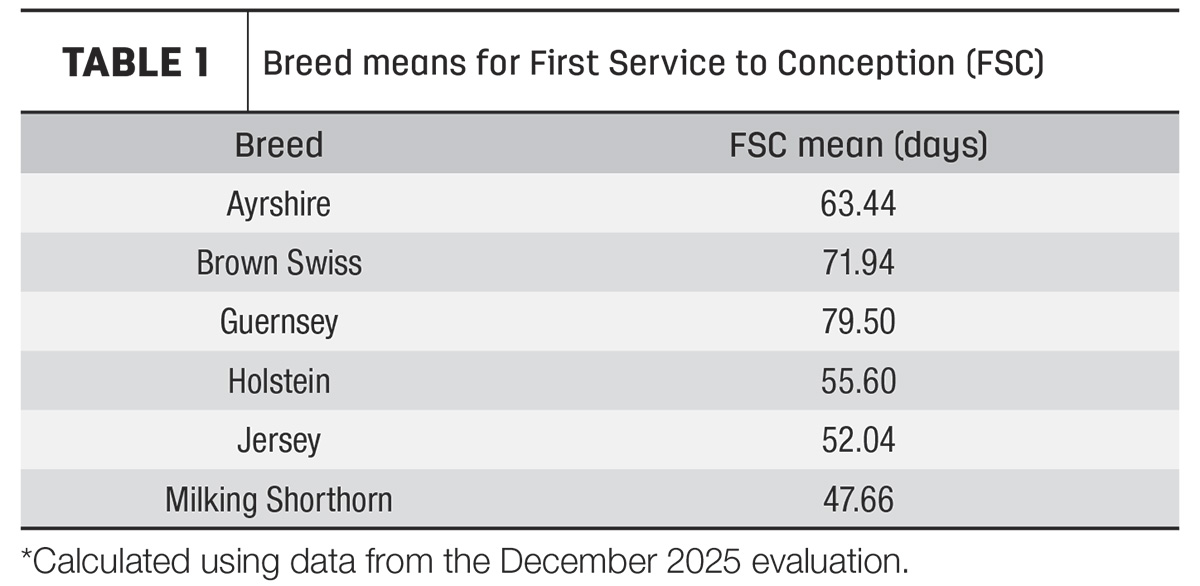
FSC is highly correlated with DPR and CCR, but that only means they share some underlying biology. Each captures a different piece of the reproductive puzzle. FSC is best used in herds where VWP or mating strategies are highly individualized. Farms with a more consistent approach will still benefit from DPR. CCR is best for improving the success rate of each service.
Approved for August
After all internal testing was complete, these updates and the development of FSC were validated by Interbull, an international organization that offers third-party review of genetic evaluations calculated by national evaluation centers like CDCB. They were also discussed with and reviewed by the CDCB Genetic Evaluations Methods Group and the Dairy Evaluation Review Team. With this support, the CDCB board of directors approved these updates for implementation in the August 2026 official evaluations. As a new trait, FSC will not be incorporated into the lifetime merit indexes at launch.
These updates will improve the usability and stability of reproductive performance selection traits so producers can be confident in their selection decisions. They don’t suddenly change the animals’ biology. Instead, they do a better job of accurately measuring the genetic progress that’s already been made so that reproductive improvement can continue.