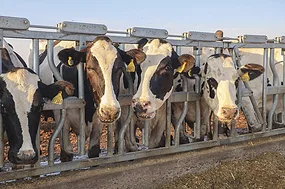
I’ve always admired barn cats for their savvy. At any one time, we’d have between 10 and 20 cats making a home of sorts in our old tiestall barn. We’d pour milk from a treated cow into a dish once a day, but otherwise, it was up to them to navigate the world. They had to keep themselves from cattle hooves, tractor tires and the attention of coyotes. The cats that didn’t know enough not to crawl into the back of the skid steer or jump through a barn fan didn’t make it. I’d call it needing “street smarts,” but the term wouldn’t quite fit.

In negotiating our Christmas plans last year, my wife declared that she wanted to go somewhere warm, and I insisted it be somewhere cheap. Flights to Turkey (from Ireland, where we live) were only $200 round trip. She found a nice (but economical) hotel in the town of Kaş, along the south coast. The hotel was on a hill, looking out to the sea. When we pulled up in our rental car, however, it wasn’t the ocean we found ourselves staring at but the roofs of all the houses below us.
“There are cats everywhere,” she said.
They were perched on gables, sitting on walls, lying in the shade of bushes and licking themselves in the corner of every open-faced building. No matter where we were, at any given time there were five or six pairs of eyes watching us pass. If you didn’t keep your lap covered at a restaurant – indoors or outside – you were in danger of finding a feline in it, purring and feeling very much at home. It was a cat lover’s paradise. (And probably very ironic, in the least, for dog lovers.)
As a matter of fact, the Turkish have long had an intimate relationship with cats. The Ottomans, who ruled what is now modern-day Turkey from 1299 to 1922, had wooden houses that were often prone to rat infestations. Stray cats were integral, especially in cities, in keeping the rodent population under control. They were so important in preventing diseases and protecting food stores that the official job of being a cat sitter, or mancacı, was created. Additionally, cats are considered a “ritually pure” animal in Islam. In Muslim doctrine, they are esteemed for their cleanliness and thought to be able to bestow blessings.
For such a large cat population, it was impressive how robust all the cats looked. Very few seemed to have “cat flu,” and every one of them was well nourished. As it turns out, this isn’t by accident. Not only are they fed by the locals, but a state veterinarian service neuters and health checks the cats regularly. There are even public feeders where tourists can put coins into a machine to feed them. Such solid care is even more impressive when considering its scope: Istanbul alone is home to an estimated quarter of a million stray cats, earning it the nickname “Catstanbul” among tourists. If a national tally was ever taken, I’m sure it would be an impressive figure.
As a tourist, admittedly, it takes a while to adapt to the tolerance allotted to cats in Turkey. They linger around the buffets of well-regarded restaurants, with waiters absently shooing them as they pass, or in the lobbies of expensive guesthouses. I’ve read that they’re even allowed in mosques. Toward the end of our trip, one cat left feces on our terrace, but it was cleaned up quickly by the hotel. When it also occurred the next day, it was cleaned again. I suppose because she’s Italian and takes food very seriously, my wife hates being stared at by any creature while eating. Therefore, it was amusing – for me, anyway – to find a few cats at our feet every meal.
I’ve heard it said that you can tell a lot about a culture by the way they treat their animals. The Turks are scoring high on that front. I’m still left with a lot of questions. (Does everyone in Turkey have toxoplasmosis? Who disposes of the cats that get run over? If the street cats are neutered, how is there still so many of them?) However, there’s something comfortable about a place where kindness to stray animals is on display everywhere. It speaks to a general sense of decency and therefore puts a visitor at ease. Admittedly, I am a little jealous on behalf of barn cats and how much harder they have to work to stay alive. Still, it’s nice to see a symbiotic relationship remain honored throughout the centuries.