Postpartum ketosis, or hyperketonemia, is defined as an excessive increase of ketone bodies in the blood and is a common metabolic disorder of dairy cows.
Ketosis develops when cows are in energy deficit during the first few weeks postpartum due to the rapidly increasing demands for milk production that are often not met by nutrient intake.
Ketosis is costly to the producer due to the direct costs associated with treatments, as well as the higher risk of developing subsequent diseases, such as displaced abomasum (DA) or metritis. In addition, ketotic cows are 30% less likely to get pregnant at first insemination.
Despite efforts to prevent ketosis from happening in the first place, it is still a common problem in early lactation cows. To diagnose hyperketonemia, ß-hydroxybutyrate (BHB – a ketone) can be easily measured cow-side using handheld meters designed for simple testing of blood.
Producers identify cows that need to be checked for ketosis using different mechanisms, such as targeting cows that are down in milk, appear depressed, have decreased rumination times or are sampled during routine fresh cow screening programs. Once identified as having hyperketonemia, it is recommended that cows are treated to aid in the recovery from this metabolic disease.
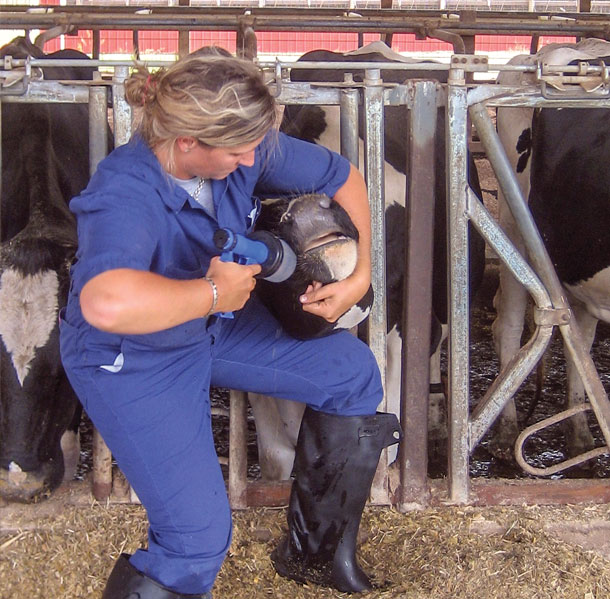 Oral administration of 300 milliliters propylene glycol (PG) is given to a fresh cow using a drenching gun. Courtesy Image.
A number of different treatments are commonly used on dairy farms, including drenching with a glucose precursor, propylene glycol (PG), and direct infusion of dextrose intravenously. Research results show that treating cows with PG is beneficial for cows with hyperketonemia, as it decreases the risk for DA and early culling and improves milk production.
However, although commonly used in the industry, few studies are available to describe the health and production effects of intravenous dextrose, or of dextrose in combination with PG, and if such effects make this a better treatment option for cows identified with hyperketonemia.
In a controlled study of early lactation hyperketonemic cows (defined as BHB concentrations in blood of 1.2 millimoles per liter and greater), we compared the effects of drenching with PG alone, intravenous dextrose alone or both in combination to an untreated control group.
Cows (34) were randomly assigned to each of the four possible groups, and blood samples were collected immediately before treatment as well as 10 times during the following 72-hour period and three times per week afterwards.
Treatments were given once daily at the same time each morning for three consecutive days and consisted of 300 milliliters (10 ounces) of PG given with a drenching gun, 500 milliliters of 50% dextrose given in the jugular vein or both. Treatment effects on blood concentrations of BHB, glucose, insulin and fatty acids (NEFA) were of interest.
Results of this study showed that the combined treatment with dextrose and PG lowered BHB concentrations to the greatest extent during the treatment period compared with dextrose or PG alone (Figure 1A).
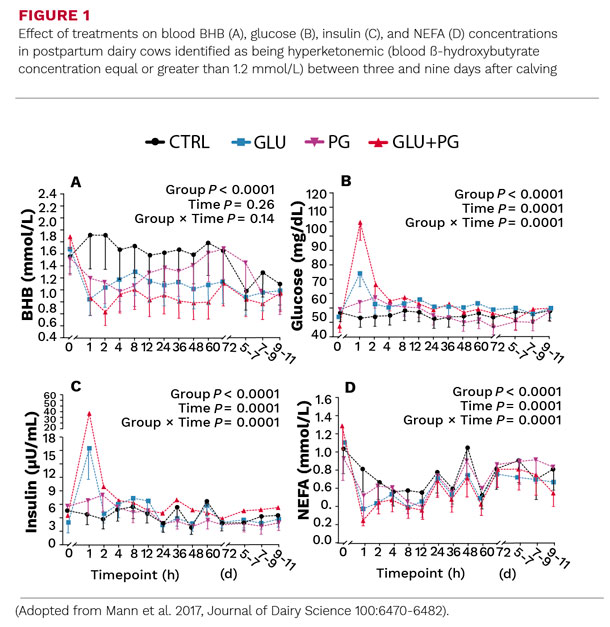
The increase in glucose and insulin concentrations due to intravenous dextrose was short-lived, as was the decrease in NEFA concentrations (Figure 1B-D).
Differences in the effects of the treatments on health outcomes, intakes and milk production could not be described due to the small sample size and short duration of the study. Follow-up studies of a larger scale are planned to compare disease and production effects for these parameters and to assess the economic cost and benefit of each treatment strategy.
Sabine Mann is an assistant professor in the ambulatory and production medicine clinic at Cornell University College of Veterinary Medicine. Email Sabine Mann.
Jessica McArt is an assistant professor in the ambulatory and production medicine clinic at Cornell University College of Veterinary Medicine. Email Jessica McArt.
This article appeared in PRO-DAIRY’s The Manager in July 2018. To learn more about Cornell CALS PRO-DAIRY program, visit PRO-DAIRY Cornell CALS.