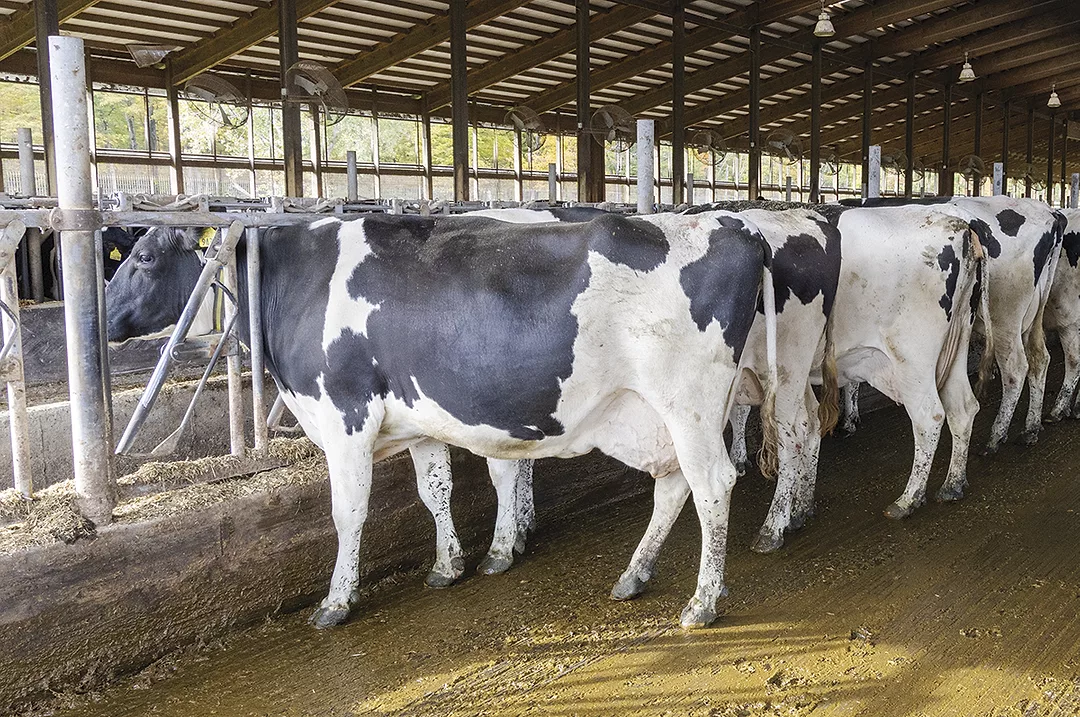
Which traits make an efficient dairy cow? To answer that question, it is useful to carefully think about what a very efficient dairy cow looks like. One definition of an efficient dairy cow is a cow that maximizes milk production while maintaining good health and fertility, thereby optimizing profitability for the producer.

In the ideal world, the most efficient dairy cow produces a lot of high-quality milk, remains healthy, produces the calf when we want and eventually returns a high market value when she is sold. This cow does that with low feed intake, little work and under ideal and not-so-ideal conditions. She is easy to milk and handle and stays out of the hospital pen. She has a small environmental footprint and is comfortable. If she does all of this, she will be as profitable as possible for the producer and acceptable to society. The terms efficient and profitable are virtually synonymous in this context.
Today, many traits are evaluated and can be included in selection to make a more efficient dairy cow. Examples include traits measuring milk components and quality, fertility, productive life, disease, bodyweight and functional traits. How much emphasis should we put on individual traits? If we select too heavily for one trait – take fat for example – we get a lot of progress in fat yield but may get reduced fertility because a negative genetic correlation exists between these traits.
According to Hazel and Lush, godfathers of animal breeding, selection for an index of traits that gives proper weight to each trait is more efficient than selection for one trait at a time. This is also true for several traits with an independent culling level for each trait. A “proper weight” is the marginal economic value of a unit additive genetic merit of that trait. The marginal value is the increase in the cow’s lifetime profitability if we change one unit of that trait, say 1 more kilogram (kg) of fat, keeping all other traits constant. In the U.S., Net Merit selection index puts a value of US$4.18 per pound of fat in a lifetime of 2.69 lactations. This marginal value includes the expected market price of fat minus the additional feed cost to produce that fat.
Another example is bodyweight. Larger cows eat more to maintain their larger bodyweight. The current estimate is that a cow eats 3.4 kilograms of dry matter per kilogram of bodyweight per 365-day lactation. A cow that is 50 kilograms heavier eats about 170 kilograms more dry matter in a year, just to maintain her bodyweight. Therefore, the marginal value for bodyweight is negative in the Net Merit selection index because smaller cows are now preferred, if they produce the same. All traits have marginal values which then determine how much emphasis improving each trait to breed a more profitable or efficient cow gets.
Determining the marginal value of a trait is both a science and an art. It is an art because it involves forecasting what the market prices for milk, feed, replacement heifers, etc., will be several years into the future when the cows that start producing are the result of the breeding decisions we make today. Marginal values in Canada and the U.S. will be different because the markets and cost of production are different. For example, the cost to raise a heifer should affect the marginal value of extending productive life.
In the U.S., the marginal values are free from production limitations. For example, if a cow produces more fat, then the assumption is that that fat can be freely sold at the open market for the same price as all fat.
Production limitations, such as a fat quota, affect the marginal values and thus the importance of improving a trait. A lot of science was done in the late 1980s and the early 1990s because it was (is) not immediately clear how production limitations affect marginal values. For example, increasing fat yield per cow given a fixed amount of fat quota implies that the number of cows must be decreased to not overproduce fat. It is reasonable to assume that the cost per kilogram fat with fewer but higher-fat-yielding cows decreases, and therefore the trait fat yield in a quota system would have a positive marginal value. But it would be lower than in a system where there are no production limitations. The marginal value of fat also depends on the value of other traits such as protein and the market value of culled cows.
In the U.S., the marginal values for 17 traits in the lifetime Net Merit index are a direct indication of the importance of improving each trait to make a more profitable cow. Three similar indexes, Fluid Merit, Cheese Merit and Grazing Merit, have the same marginal values for many traits, but they vary for some traits. For example, in a cheese market, milk is primarily paid by the fat and protein yields. In a fluid market, the milk price does not depend on the protein content. Therefore, the marginal value of protein is $0 in a fluid market but high in a cheese market.
New traits become available for selection when they add to the selection of more efficient cows. A good example of a new trait is Feed Saved, a trait that predicts how much less a cow eats than expected based on her milk production and because she weighs less.
Other new traits being developed include the production of methane, a greenhouse gas. Cows that produce less methane, all other traits equal, are preferred and help with improving the environmental efficiency of milk production.
New traits often require special data collection and collaboration between the dairy industry and academia. Together, we continue improving the old and defining traits that make dairy cows more efficient.