The dairy community is not only concerned by the review of Canada-United States-Mexico Agreement (CUSMA) or the boom in protein consumption, the war in the Middle East is also a reminder that supply management is only a partial bulwark against international geopolitics. The effect of this conflict on fuels and fertilizers may have partially faded, but the chapter is far from over.

For a long time, we've been wondering when the region would burn and what would spark it. In an abhorrent denial of its promises of non-interventionism, the Trump administration has engaged the U.S. in very unpopular military action. One should now expect everything, as the comments made without direction in recent weeks show a conflict that has ended many times, a so-called “ceasefire” under bombs, an apparent peace agreement that is nothing other than a commitment to discuss contentious issues such as nuclear programs and access to Hormuz. The military lull is good news. But let's not fool ourselves: Despite ongoing talks, risks on markets for various agricultural inputs remain high.
Oil and grains: Very different effects than the war in Ukraine
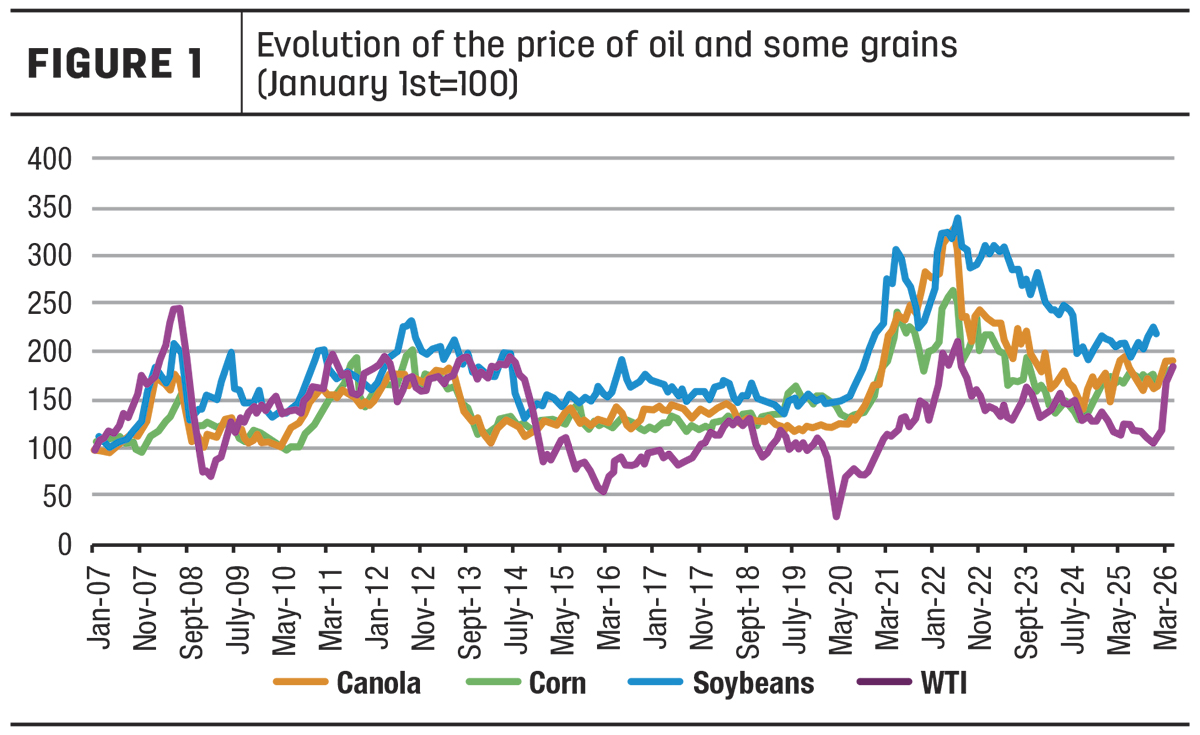
The impact of the war in the Middle East on agriculture differs greatly from the conflict between Russia and Ukraine, two major grain exporters. Since the Middle East is an importer, the grain market has not exploded as it did in 2022. On the other hand, the increase in the price of oil increases production costs. Any price forecast based on the evolution of the conflict would be presumptuous, but it should be noted that the prices of oil and that of several grains are historically correlated (Figure 1).
Fertilizers: Rapid increase, rapid descent
The Canadian agricultural community had a lucky escape in 2026, since most of the fertilizers were already purchased when hostilities in the Middle East began. The price of nitrogen fertilizers (primarily urea) rose from the first rounds. The seasonal drop in demand was the main factor behind their return to prewar levels.
The price at the main hubs – New Orleans (NOLA) in the case of urea – differs from the one that prevails here. NOLA prices are currently attractive, and the market is ready to rebound at any time. Buying fertilizers almost a year before using them would although mean supporting inventory for a very long time, with the effects we imagine on cash flow and insurance costs among other things.
In such a volatile and unpredictable geopolitical context, the challenge of buying fertilizers for the 2027 season is major. Inventories will be there, but at what price? If NOLA prices remain at the current level until the end of the summer, let's expect the interest in buying early to prevail.
Interest rates
The rise in the price of oil stemming from the blockage of a strategic route such as the Strait of Hormuz is having a considerable impact on the global economy and is fuelling inflation. Future rate movements by central banks – both in the U.S. and Canada – are expected the upper way toward the end of 2026 or early 2027. Long-term rates, which reflect market expectations, have increased since the beginning of the year.
Any affect on the annual milk price adjustment?
The National Pricing Formula for adjusting milk prices involves a calculation based on 50% inflation and 50% production costs. Certain items in the production cost have increased, which the data entry process will capture. However, the sharp increase in the value of small dairy calves and cull animals has a lowering effect on this calculation. To what extent will these forces balance each other and what will be the result? Expectations must remain modest.
What to expect next?
The midterm elections in the U.S. are a major milestone in the U.S. political landscape. As they approach, the Republican camp is on the brink, reinforcing its desire for the price of a barrel of oil to drop and remain low. However, despite the recent decline, its price remains above the prewar price. Damage to production facilities was reported, and the traffic in the Strait of Hormuz remains very shy.
Oil prices are ready to rebound at any time, depending on the hesitation of the peace talks. The same applies to fertilizers (especially nitrogen), which are probably at a floor level, further to the slowdown in spring demand. These markets still have a lot of surprises in store. Similar to a roller coaster, we could still be in the ascending portion, hearing the tac-tac-tac and apprehending the next steps.