Soil health is a key focus of corn growers who are working towards sustainability goals and safeguarding their operation against increasingly challenging growing conditions. Understanding the contributing factors that lead to resilient cropping systems in the Northeast is important for farmers to meet those goals. With funding support from the New York Corn Growers Association Corn Research and Education Program, soil health data was collected from the Cornell PRO-DAIRY’s NY Corn Silage Hybrid Evaluation Program in 2023.

The annual hybrid evaluation program offers the opportunity to compare the same hybrids in different growing environments. Measuring key soil health parameters at each location with the Cornell Assessment of Soil Health (CASH) test offered additional insight into the role of soil health in the overall performance of the crop grown at each location.
LOCATION CHARACTERISTICS
The Oakfield and Madrid locations represent a common dairy rotation (corn silage in rotation with perennial hay crops) including manure inputs.
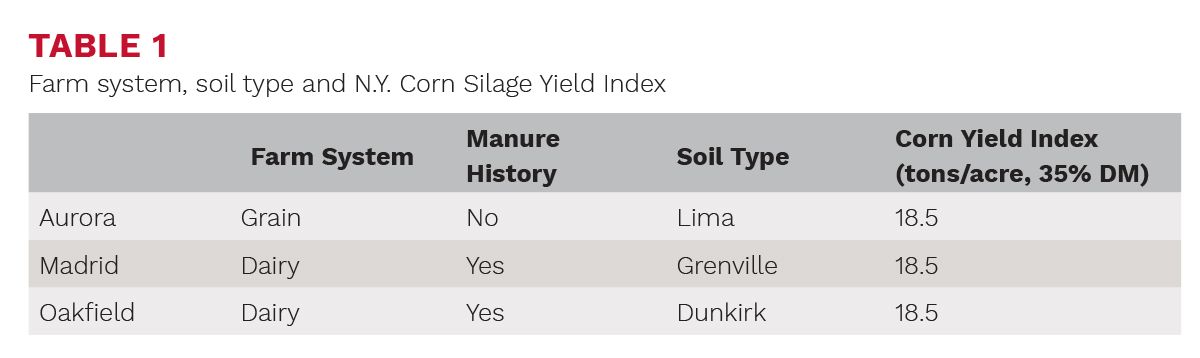
In contrast, the Aurora location has a history of row crop rotation with no manure inputs. The soil type differed by location; however, all three have the same corn silage yield index according to the Nitrogen Guidelines for Field Crops in New York (Ketterings and Workman, 2023) (Table 1).
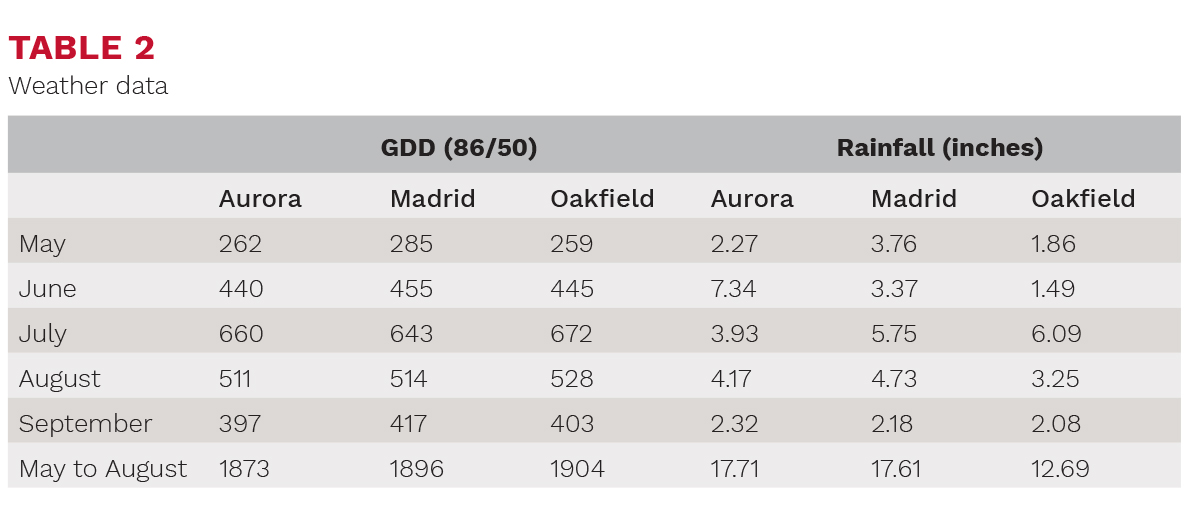
Growing Degree Day (GDD) patterns and totals were very similar (Table 2). Rainfall patterns varied more by month; however, totals were similar between Aurora and Madrid (Table 2). Oakfield received significantly less rainfall; however, given the strong yields (Table 3), it is unlikely the rainfall had a negative impact on crop performance.
CROP PERFORMANCE
Given the limited number of locations and uncontrolled variables between locations, this project does not definitively link correlation or causation between specific soil health parameters and crop performance. However, the trends observed do offer insight into the broader impacts of soil health.
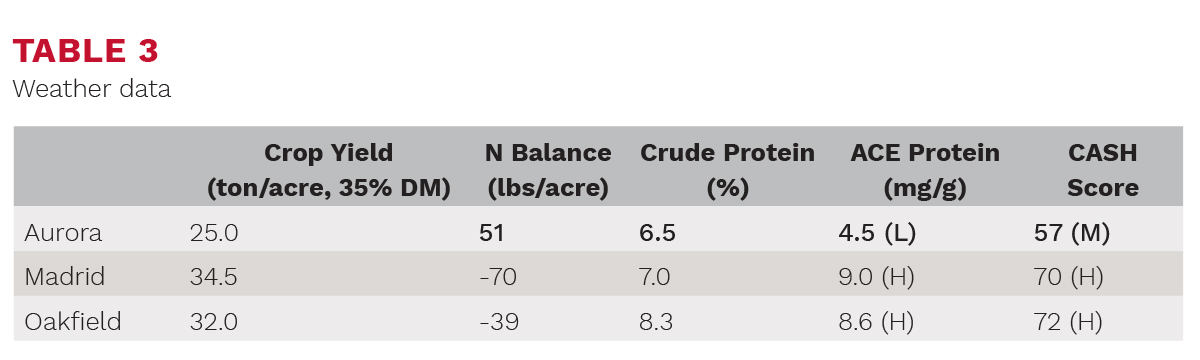
Yield performance was similar at Oakfield and Madrid, with both averaging significantly higher yields than Aurora (Table 3). While it is possible for rainfall patterns to impact yields, weather data from the season suggest that overall rainfall was not a limiting factor at Aurora (Table 2). Additionally, soil chemical analyses show that soil fertility and nutrient inputs were not limiting at that location, suggesting other factors were impacting overall yields.
Location to location differences in key forage nutritional parameters (starch content, fiber digestibility) were observed; however, there was no trend between these parameters and soil health scores.
NITROGEN DYNAMICS
While the factors that affect the exact amount of nitrogen (N) supplied by a soil remain elusive, qualities related to soil organic matter levels and manure inputs are associated with higher N supplies. Nitrogen balances (N available to the crop from all sources minus N uptake by the crop) were calculated for each location in this project to understand the N-supplying potential of the soil beyond measured N inputs (Table 3 and Figure 1).
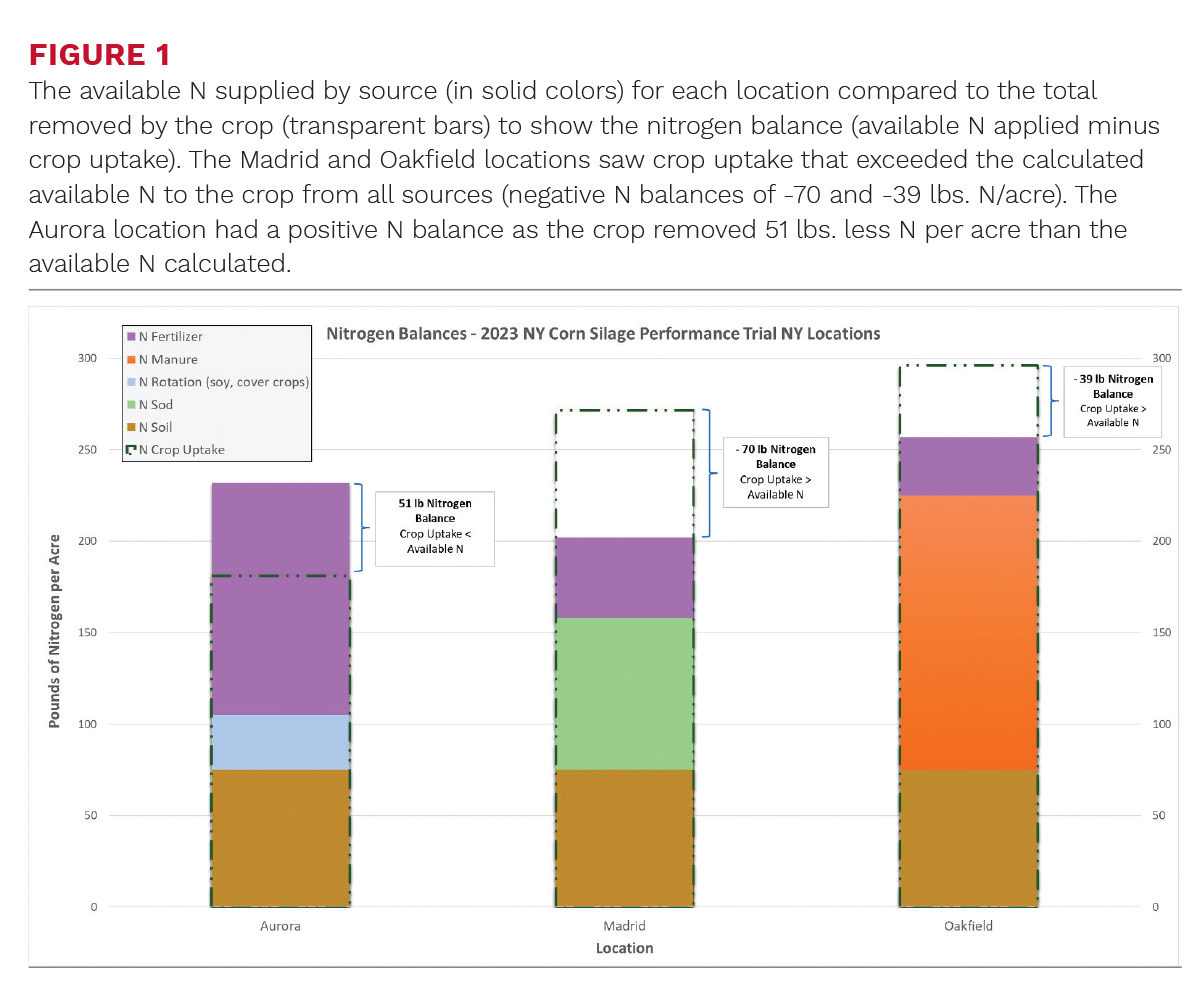
The two locations (Oakfield and Madrid) located on fields with manure histories reported the highest yields and forage crude protein contents while having negative N balances (Table 3). This indicates that the N taken up by the crop exceeded the calculated amount supplied to the crop. However, the high yields and forage crude protein levels confirm that N was not limiting to the crop, indicating these fields’ ability to supply N beyond the calculated inputs.
In contrast, the Aurora location, which does not have a manure history, reported a positive N balance (more N was supplied than was used), while yield and forage crude protein levels were lower. While corn silage is not considered a significant source of diet crude protein for dairy cows, and fertilizing with additional N to increase forage crude protein is not an economically or environmentally effective practice for this crop, the trend towards higher forage crude protein values with improved soil health can be viewed as an auxiliary benefit to enhance overall forage nutritional value.
While more work is needed to validate this trend, the results observed in the CASH test related to soil protein offer a potential explanation for the trend observed. In the manured locations (Oakfield and Madrid), higher soil protein was measured by the autoclaved citrate extractable (ACE) protein index analysis included in the CASH analysis (Table 3).
Soil protein content is well-associated with overall soil health status as an indicator of biological and chemical soil health, particularly the quality of the soil organic matter. Sustained manure applications build soil protein content and thereby also build larger pools of slower-release forms of N as manure is made up of compounds that are, “relatively stable, rich in N, and microbially degradable” (van Es, 2017).
This could explain why these sites had negative N balances (higher nitrogen use efficiency) and were able to yield above and beyond the available nitrogen we calculate when doing traditional measures of available N inputs.
SUMMARY
The negative impacts of growing season extremes on crop performance has increased in recent years, with this trend expected to intensify. This is leading to increased volatility in corn production that impacts growers’ economic sustainability and ability to reliably meet the forage needs of livestock. Soil health is recognized as an important factor to protect crop resiliency in the face of these growing challenges.
While location-specific interactions affect year to year crop performance, evidence continues to build that improved crop performance stability is associated with characteristics of soil health. The crop response will not always come in the form of higher yields, but more often is likely to be a mitigation of growing season events that prevent the crop from reaching its full potential.
This project added to the growing dataset pointing to the addition and management of organic inputs, namely manure, as a key practice to enhance soil resiliency and provides growers with further confidence in the return on investing in these inputs.
ADDITIONAL INFORMATION
- Cornell Assessment of Soil Health (CASH) Analysis
- New York Vermont Corn Silage Hybrid Evaluation Program
- Ketterings, Q.M., and K.C. Workman. 2023. Nitrogen Guidelines for Field Crops in New York. Cornell University, Ithaca NY.
- van Es, H. et al. 2017. Soil Health Manual Series, FS-16-09, Soil Protein. Cornell University School of Integrative Plant Sciences, Ithaca NY.
 |
This article appeared in PRO-DAIRY's The Manager in March 2025. To learn more about Cornell CALS PRO-DAIRY, visit PRO-DAIRY. |