Sometimes diving deeper into a topic simply serves as a reminder to focus on the basics. The findings of a recent project largely align with this lesson.

Corn silage yield is subject to many of the same factors as any other grain crop, including growing environment (soil characteristics and weather), soil fertility, pest management, plant genetics, and more.
The nutritional value of the silage is affected by many of these same factors, with a growing body of evidence that growing environment is a leading factor for fiber digestibility, a key nutritive metric.
Among non-BMR hybrids, growing environment, particularly precipitation, has a greater influence on fiber digestibility than hybrid genetics. Growing seasons with higher rainfall totals show a trend towards lower fiber digestibility. Starch content is also impacted and is linked to ear-to-stover ratio of the corn plant, kernel development (weather during ear fill), and plant maturity at harvest.
With this information in mind, a project funded by the New York Farm Viability Institute sought to measure potential differences in crop performance based on management and environmental interactions. The same two hybrids were planted on farms in northern N.Y. in the 2022 and 2023 growing seasons. Two planting dates were used to reflect early planting (early May) and late planting (early June) for the region. This combination of planting dates and hybrid relative maturities (RM) resulted in each hybrid-planting date combination (Table 1) experiencing a different set of growing conditions (weather events at different stages of plant development).
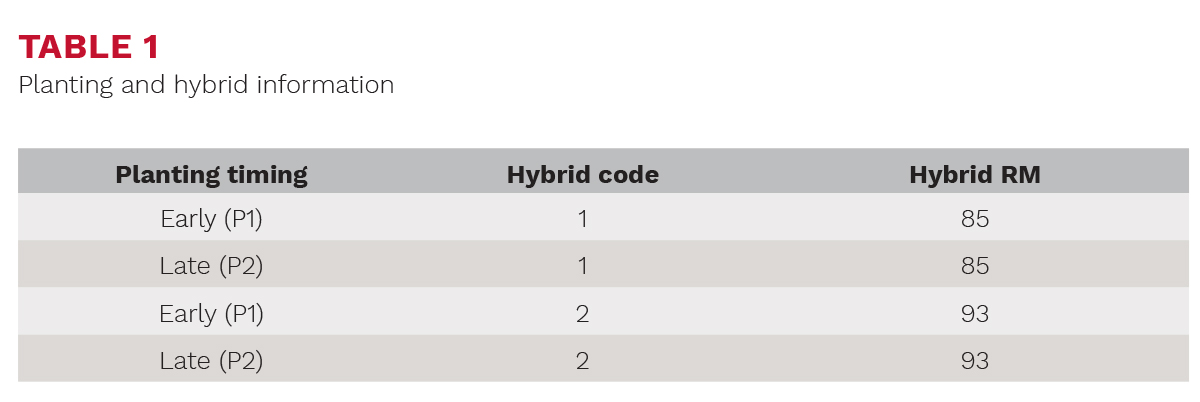
Each hybrid-planting date combination was harvested at four different time points ranging from approximately 30 percent whole plant dry matter (WPDM) to 40 percent WPDM. This allowed for measurements of crop yield and forage nutritive values at different stages of silage maturity. Furthermore, in addition to whole plant silage samples, separate ear and stover samples were collected for forage analysis, providing data on how these plant components individually contribute to the overall quality of the whole plant forage.
PLANTING DATE
A long-standing rule of thumb for planting corn is, “earlier is better”, so long as field conditions permit. In other words, try to get the crop in early but do not “mud it in.” In this project (where the growing seasons allowed the crop to reach target maturity), there was no consistent advantage or disadvantage of planting date on yield or nutritive value for either hybrid (Table 2). Furthermore, there was no consistent differences in performance between the 85- and 93-day RM hybrids.
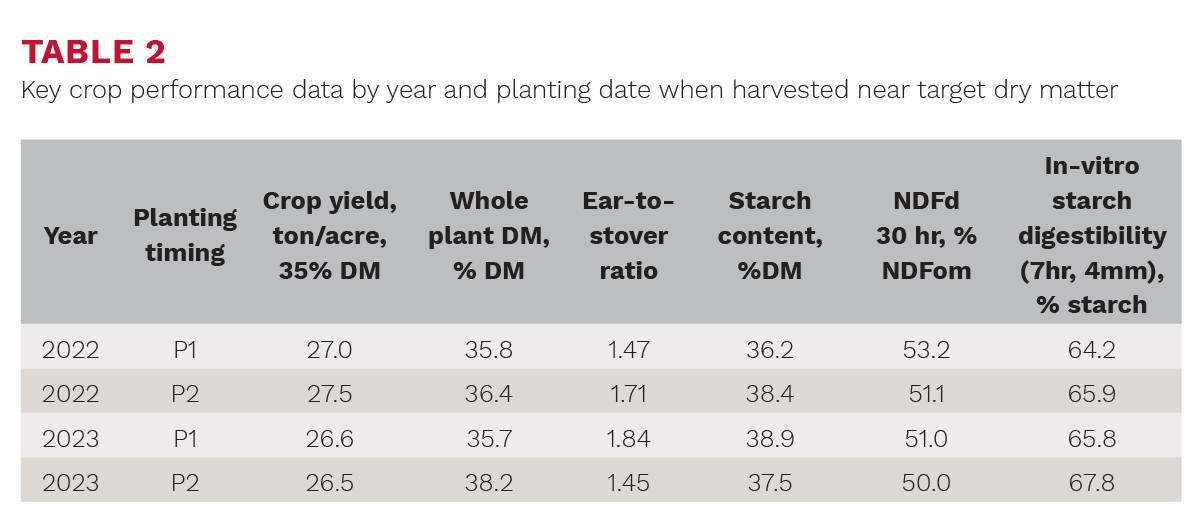
It is worth reiterating both growing seasons provided adequate moisture and growing degree days to support plant development and maturation, and hybrid relative maturities matched the growing environment. All is not lost when planting is delayed, as the data suggests high performance is possible regardless of planting date; however, the same old risk of late planting persists. A growing season with below average growing degree day accumulation or an early frost increases the odds a late planted crop will not achieve target maturity, negatively impacting forage value.
Back to the basics. Strive for early planting when field conditions permit, select hybrids that match your season, and spread out risk associated with adverse weather around pollination timing by planting a range of relative maturities across planting dates.

HARVEST TIMING
Data from the four-harvest timings (ranging from approximately 30 to 40 percent WPDM) reinforced the critical impact of harvest maturity on forage value, with a WPDM in the mid-30’s striking a good balance. While planting date alone did not result in a significant impact, harvesting immature corn did reduce the forage value of the corn silage, regardless of planting date.
Starch content and digestibility followed previously established patterns; starch content continued to increase as the crop matured (dried down from 30 to 40 percent WPDM), while starch digestibility saw a slight decline as the plant progressed toward grain maturity (black layer).
In the context of relatively good plant health from both seasons, fiber digestibility of the stover component saw a very small downward trend as the crop matured; however, this was offset by the ear digestibility, resulting in no change in whole plant fiber digestibility during dry-down. These results reinforce that when corn plants are healthy, fiber digestibility is not a concern when waiting for the plant to reach a target WPDM in the mid-30’s. While it was not measured in this project, there is data to suggest a negative impact on fiber digestibility when the crop is stressed or otherwise unhealthy leading up to harvest. However, even in this scenario, the worst of the effects are observed at WPDM greater than 35 percent, suggesting harvest should be completed slightly, not drastically, earlier when unhealthy.
BALANCING DAIRY COW DIETS
The data from this project was used in an exercise to balance a diet for dairy cows using the Cornell Net Carbohydrate and Protein System (CNCPS) model. From this exercise, differences in milk production and income over feed cost (IOFC) could be compared based on the nutritional profile of the corn silage from different planting dates and harvest maturities.
While some differences in milk production and IOFC were observed when modeling the impact of each corn silage on the diet, the larger take-home message was that routine re-balancing of any of the diets with commonly available ingredients led to larger improvements in IOFC than the differences found between the original diets. These finding are both a testament to the cows’ ability to produce when supplied with the proper balance of nutrients and the fundamental benefits of properly managing the resources available to us.
This project reinforces that when we recognize and focus resources on the aspects of forage production and utilization that are within our control, the gains are greater than when we expend resources and focus on aspects of the system that are largely defined by the growing environment.

Western Bean Cutworm and Planting Date
Western Bean Cutworm (WBC) lays its eggs in pre-tassel corn with the resulting larvae feeding on the developing corn kernels. Studies on the impact of WBC injury to corn silage have shown mixed results and generally small effects. However, the pest does destroy kernels and leaves open wounds which can increase the chances for pathogens to infect the plant.
Studies also show late-pollinating corn fields are at an increased risk as WBC egg laying can occur after the pollination period for earlier-pollinating fields. In this study, data was collected in 2023 highlighting the potential impact of planting date and the resulting pollination timing on incidence of WBC. WBC ear damage and visual ear mold were documented. In the early planted corn, six percent of ears had WBC damage while seven percent of ears had visual mold. In contrast, 51 percent of ears had WBC damage and 33 percent had visual mold in the late-planted corn.
 |
This article appeared in PRO-DAIRY's The Manager in March 2025. To learn more about Cornell CALS PRO-DAIRY, visit PRO-DAIRY. |