For decades, neonicotinoid-coated seeds have been used to manage soil-dwelling insect pests in field crops. However, recently passed legislation in New York will ban the sale of neonicotinoid-coated corn, soybean, and wheat seeds beginning on January 1, 2029, unless a waiver is issued by the N.Y. Department of Environmental Conservation. As a result, the management options available to growers for soil-dwelling insect pests will change. Therefore, alternative management strategies will be necessary for future integrated pest management plans.
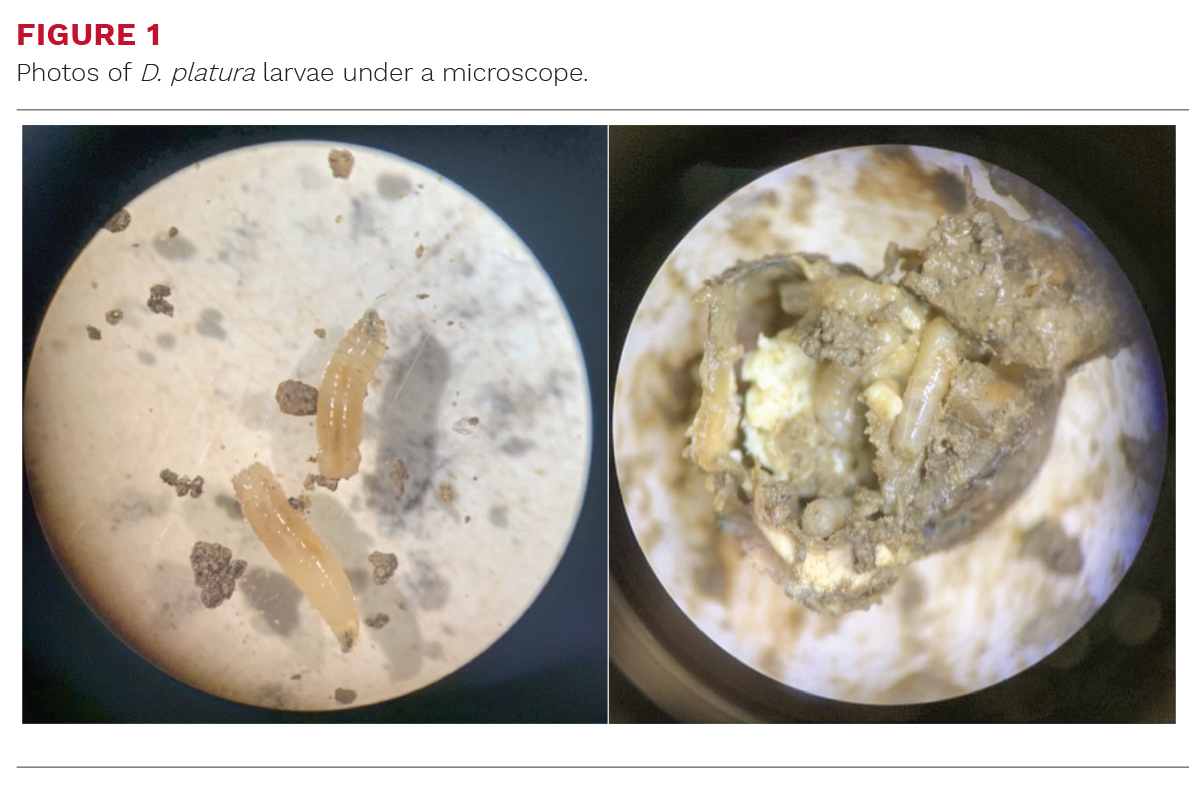
In N.Y., a key pest managed by neonicotinoid-coated seeds is the seedcorn maggot (Delia platura). Delia platura is a common fly that affects large-seeded crops, such as corn and beans. The larvae (Figure 1) feed on decaying organic material and germinating seeds, which can prevent germination and damage young plants. This damage can lead to stand loss, especially in early-season crops, where seeds spend longer periods in cool, damp soil before germination, increasing their risk of damage. Since D. platura larvae are found in low numbers, using insecticides preventatively may not be necessary. Our preliminary data show that the proportion of seeds damaged by D. platura larvae is low, at less than 0.3 percent (3 of 1,000 seeds) for corn and less than 0.4 percent (4 of 1,000 seeds) for soybean (unpublished data). Given the low abundance and that D. platura only causes damage during a short time frame, predicting when and where D. platura might become a pest can better inform if the use of insecticides or other management strategies is necessary.
DEGREE DAY MODELS
Degree day models have been used as a management tool to predict the spring emergence of many pests. Knowing when overwintering pupae will emerge as adults and begin laying eggs is important to determine when the risk of damage starts in the season. D. platura overwinters as pupae and predicting the emergence time early in the spring could help predict when crops should be planted early in the season. Degree day models calculate insect growth based on daily temperatures starting January 1 and the lower development threshold of an insect species. If the daily temperature is warm enough for insect growth, degree days are accumulated, and emergence is expected once a minimum value for a species has been reached.
Previous models have used 360-degree days as the emergence threshold for D. platura adults in the United States. However, a single value is unlikely to be accurate across the entire country, and preliminary data show that emergence in N.Y. is earlier. Here, we define a degree day threshold for the first spring emergence of D. platura in N.Y. Raising awareness of emergence timing and recording regionally specific thresholds is important for informing pest management practices.
ADULT SPRING EMERGENCE
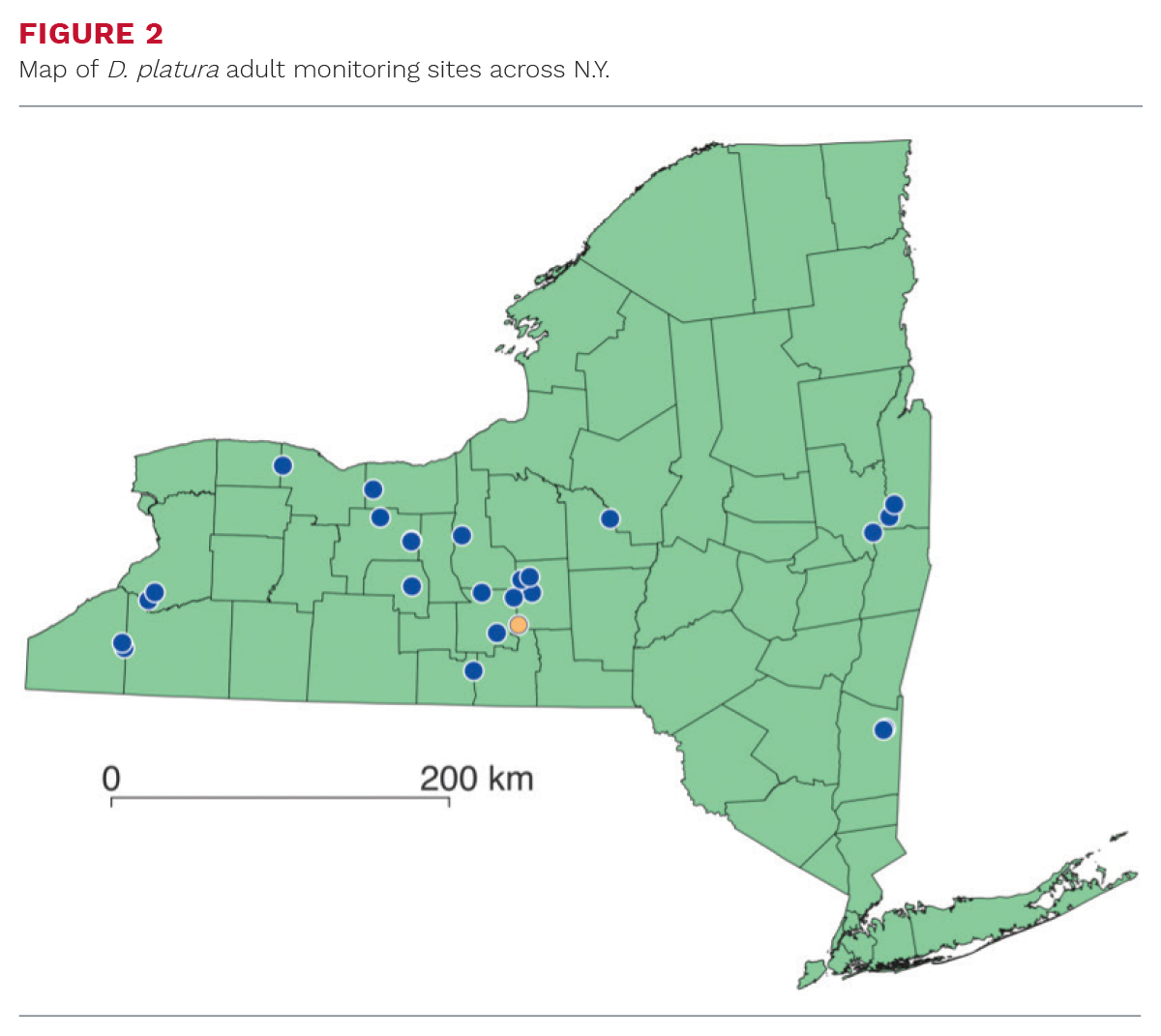
We monitored D. platura adult activity on 29 farms (four in 2023 and 25 in 2024) in N.Y. (Figure 2) using blue sticky cards. We calculated the accumulated degree days when we first caught adult flies for each site. Across 29 sites, the first emergence occurred between 52- and 197-degree days, with an average of 98-degree days. The dates associated with these days ranged from March 8 to April 2, 2024, with an average date of March 16, 2024. The first emergence of adult D. platura in N.Y. is earlier than previously reported and management recommendations, such as planting prior to emergence, are no longer sufficient. Updated degree day models based on this information for D. platura can be found online on the Network for Environment and Weather Applications website.
AUTUMN AND WINTER ADULT ACTIVITY
In addition to monitoring spring activity, we tracked autumn and winter activity. We captured adults weekly on sticky cards until mid-November. We also caught a single adult male D. platura in mid-December and an adult female in late December. These captures coincided with a warmer-than-average period, when 18-degree days were accumulated. This suggests that if the weather is warm enough during winter months, D. platura can undergo development (and accumulate degree days), or even emerge. As a result, pest management strategies may need to account for even earlier spring emergence.
FUTURE DIRECTIONS
Ongoing research aims to improve the accuracy of predictive models for D. platura. The wide range of degree days on the date of first emergence across our sites suggests that factors beyond temperature influence emergence timing. Milder winters could make temperature-based models less reliable. Additionally, because degree days can accumulate in the autumn and winter, a January 1 biofix may no longer be the best approach.
Future models will incorporate variables including farm management, soil conditions, and landscape composition and test the use of alternative biofix dates. These updated models will be used to predict when D. platura emerges and the risk of crop damage. This work represents the first step in improving pest management and developing more effective strategies for controlling D. platura without the use of neonicotinoid-coated seeds.
FUNDING AND ACKNOWLEDGEMENTS
This research received funding from the New York State Department of Agriculture and Markets through New York State Integrated Pest Management (NYSIPM) at Cornell University under the Special Projects Initiative #143575 and by the intramural research program of the U.S. Department of Agriculture, National Institute of Food and Agriculture, Hatch Project Nr 7003547.
Thank you to all our collaborators with New York State Integrated Pest Management and Cornell Cooperative Extension (Aaron Gabriel, Abby Seaman, Erik Smith, Hannah Tolz, Janice Degni, Katelyn Miller, Ken Wise, Marion Zuefle, and Mike Stanyard) who collected samples and to the generous growers across N.Y. who hosted our sticky card traps. Thank you to Alejandro Calixto at NYSIPM for his guidance and support. Additionally, thank you to the technicians and undergraduate researchers who helped process sticky cards (Shea Crowther, Alexa Stratton, Laura MacKenzie, Sophie Nasrallah, and Tim Williams).
 |
This article appeared in PRO-DAIRY's The Manager in March 2025. To learn more about Cornell CALS PRO-DAIRY, visit PRO-DAIRY. |