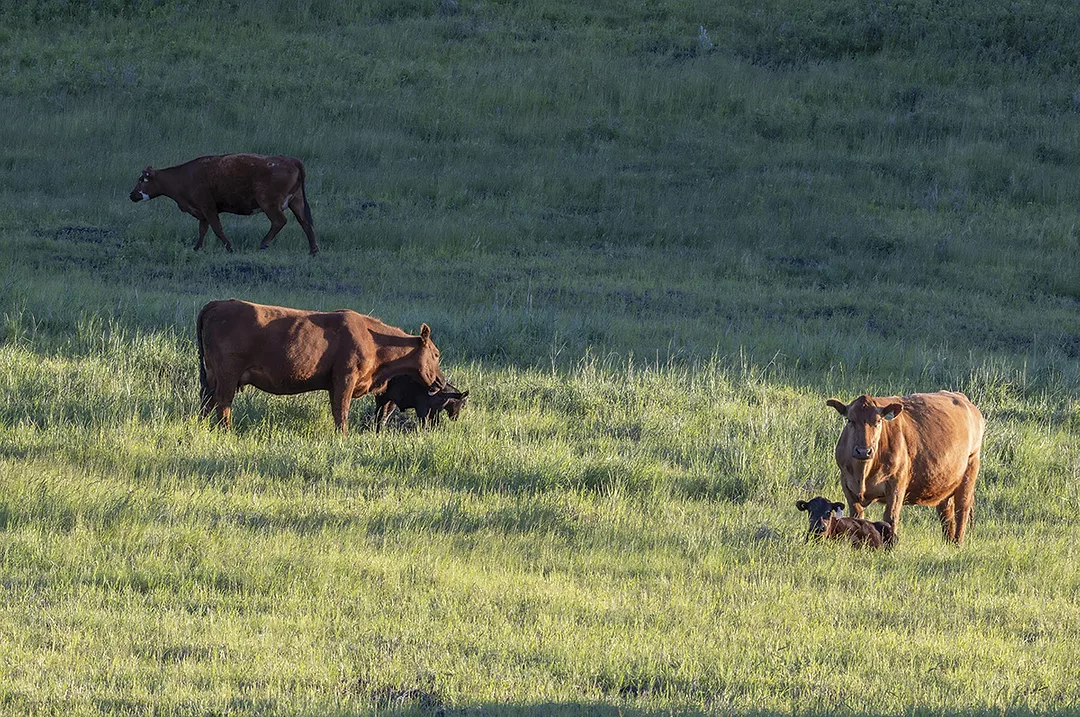
The calendar never lies. While it may feel like New Year’s celebrations have scarcely fizzled, the calf crop is on the ground, the winter feed supply is dwindling, and patches of green grass are beckoning.

It’s nearly time to send the pairs to pasture, but are they prepared?
Nutritional considerations
Body condition holds the key
“Body condition is one of the greatest determining factors of conception rates,” says Abby Redman, a nutritionist with Blue Rock Animal Nutrition in Innisfail, Alberta. “The highest conception rates occur when females are at a BCS [body condition score] of 2.5 and on an increasing plane of nutrition, or at a score of 3 and maintaining condition. If they’re over 3, whether increasing or decreasing, conception rates will decline.”
The time to start BCS strategies was long before yesterday
Producers should assess their herd’s body condition with a critical eye multiple times annually. While it can be difficult to notice small changes when cattle are seen daily, Redman recommends examining specific points including the pin bones, hook bones, tailhead and brisket to make an accurate judgment.
“A good time to look is in the fall when they’re coming off pasture,” she says. “The calves are weaned and it’s the cheapest time to make adjustments. In a perfect world, put hands on when they’re running them through a chute, but eyeballing is better than nothing.”
Testing, testing … for milk production
Weight gain and growth depend largely on high-quality milk production. Redman recommends a solid feed testing protocol beginning in the fall to confirm cows are providing the required nutrients to their calves.
“The earlier, the better,” she says. “Lactating females need around 65 percent total digestible nutrients, so complete testing and make supplementation available.”
Don’t jump the gun with grass
Although pasture quality isn’t controllable, it varies greatly. The earliest (“washy”) grass is extremely high in moisture, and animals must consume large amounts to maintain energy and protein levels.
“This early grass contributes to declining performance, plus the forage stands will take a hit,” says Redman. “Try not to jump the gun. Feed long enough to ensure better grass quality is available.”
The money’s in the minerals
“Minerals are incredibly important for every body process,” Redman says. “Enzymes need minerals to work, and nothing happens without enzymes. Trace minerals should be provided year-round and will help cows bounce back faster, heal quicker from parturition and return to estrus earlier.”
Redman prefers a loose mineral, as it’s easier to gauge consumption. She says the typical red mineral blocks have changed, and producers should ensure they contain higher trace minerals and selenium.
“The liver stores trace minerals, but I describe it as a cup with a hole in the bottom,” Redman says. “Minerals drip out into the blood and are used daily by enzymes. Eventually, the cup will run dry if we’re not putting something back in it.”
Vitamins are on the clock
Stored feed oxidizes and deteriorates, resulting in progressively lower vitamin contributions as time passes.
“When cattle eat this vitamin-lacking feed all winter without supplementation, they’re extremely deficient by spring,” she says. “The body doesn’t store water-soluble vitamins for long, so offer them throughout the winter, especially when close to pasture turnout.”
A tip many producers might not know is that stored minerals and vitamins deteriorate and oxidize over time. Ingredient levels won’t be at their original amounts after sitting unused.
Health considerations
“In my world, I don’t see them as pairs,” says Terry Goslin, a veterinarian who owns Peak Veterinary Health in Moose Jaw, Saskatchewan. “The treatments and protocols for cows and calves are very different. For example, cows should get a pre-breeding shot to help increase reproductive rates and reduce abortion risks. For the calves, we’re trying to prevent pneumonia, coccidiosis, scours and parasites.”
Setting up the cows
Goslin recommends a pre-breeding shot to cover infectious bovine rhinotracheitis (IBR), bovine viral diarrhea (BVD), leptospirosis and vibrio. He likes core vaccines to be a 5-way, modified-live with fetal protection (FP) for IBR, BVD, bovine respiratory syncytial virus (BRSV) and parainfluenza-3 (PI3).
If lice control wasn’t sufficient through the winter, a medication dose should be administered in the spring.
Depending on location, producers should consider a multivalent clostridial vaccine.
“Typically, if the cows were dewormed adequately in the fall, they shouldn’t need it again in the spring,” Goslin says. “Ask your veterinarian if a topical treatment or oral safeguard is warranted.”
Ready the calves
“When calves hit the ground at birth, I suggest an intranasal vaccine, whether the full viral and bacterial pneumonia components or just viral,” Goslin says. “This gets them off to the best start in life.”
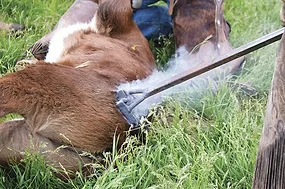
If castrating, a product containing tetanus and a painkiller is required. Pain medication can be handled either by using lidocaine-infused castration bands or an NSAID called meloxicam.
“The best way to deal with horns is genetically,” says Goslin. “If you must dehorn, do it at birth and provide an anti-inflammatory.”
Goslin warns that later in the spring, coccidiosis might appear. Some newer products not only treat coccidiosis but work well in infected calves without clinical signs.
When calves are to be turned out to summer pasture, he recommends an injection to cover BVD, BRSV, PI3, IBR and Mannheimia haemolytica for viral and bacterial pneumonia. A clostridial shot is also wise.
Random tips
“Handling has come a long way, but increased stress will increase sickness, so make a conscious effort to use low-stress handling for improved health,” Goslin says.
Diarrhea can be a problem, especially if calves aren’t sent to grass quickly enough.
“If they’re staying commingled in a tiny corral environment for too long, the amount of feces exposure is huge,” he says. “Those newborns will be poorer doers, and even if the females were scour-vaccinated in the fall, the calves will likely get sick and spread respiratory disease to their penmates. Try to get them on a bigger grass area as soon as possible.”
Goslin says producers often view veterinarians as too expensive and try to cut health corners.
“I strongly suggest we interact with one another,” he says. “When we as vets know their situation, their operation and their families, we can deal with animal health better. If you don’t have a good relationship with a veterinarian, please find one and get it started.”