In November 2024, the USDA released their final decision detailing changes to milk pricing under Federal Milk Marketing Orders (FMMO). In a subsequent producer referendum, these changes were approved for all 11 FMMOs, and the new pricing will become effective in June 2025, shortly after this magazine arrives in your mailbox. This will complete the lengthy administrative process to evaluate the need for pricing changes that began in March 2023.

There are multiple changes to the pricing formulas, including the following.
- Increased make allowances. Make allowances are estimates of manufacturing costs subtracted from a wholesale product price to calculate component values for farm milk. Make allowances will be increased from 5 cents to 7 cents per pound for the four dairy products used to calculate component values (butter, cheddar cheese, dry whey and nonfat dry milk).
- Increased Class I differentials. Class I differentials are the amounts paid by fluid processors above a Class III or Class IV milk value for milk used in beverages. Class I differentials are specified for each county in the U.S. where farm milk is first received. The values of Class I differentials were increased by up to $2.40 per hundredweight (cwt) in areas of the Southeast, with an average nationwide increase of $1.24 per cwt.
- Changes in milk composition used in formulas. Reported classified milk prices are determined based on component values for butterfat, protein, other solids (Class III milk), butterfat and nonfat solids (Class IV milk) and a standard milk composition. Reflecting higher solids content in milk, the composition factors for protein will increase from 3.1% to 3.3%, the other solids factor from 5.9% to 6% and nonfat solids from 9% to 9.3%.
- Class I mover will return to the “higher of” Class III and Class IV. In addition to the differentials mentioned above, the Class I price is set based on the values of Class III and Class IV skim milk. The current formulas use the “average of” Class III and Class IV skim milk prices plus 74 cents per cwt to set the base Class I skim price. In June, the base Class I skim price will be set as the “higher of” the Class III or Class IV skim price.
- Removing barrel cheese prices from the Class III pricing formulas. The value of components in farm milk is based on the monthly averages of four wholesale product prices as reported by the USDA. Beginning in June, only the prices of 40-pound blocks (and not 500-pound barrels) will be used to calculate the protein value for milk used to make cheese.
- Provisions for pricing extended shelf life (ESL) milk. ESL milk is heated to a higher temperature, resulting in longer shelf life of 65 to 120 days, and at present about 10% of the U.S. beverage milk market is ESL. The new formulas that become effective in June will adjust the Class I price for milk used in ESL adjustment equal to the difference between the higher-of and average-of plus a 24-month rolling adjuster with a 12-month lag.
What are the likely impacts of these changes on farm milk prices?
Given the numerous changes that will occur in June, what are the likely impacts on farm milk prices when the new pricing rules begin? The largest potential impacts of the price changes will likely result from changes to the make allowances and the Class I differentials (Table 1).
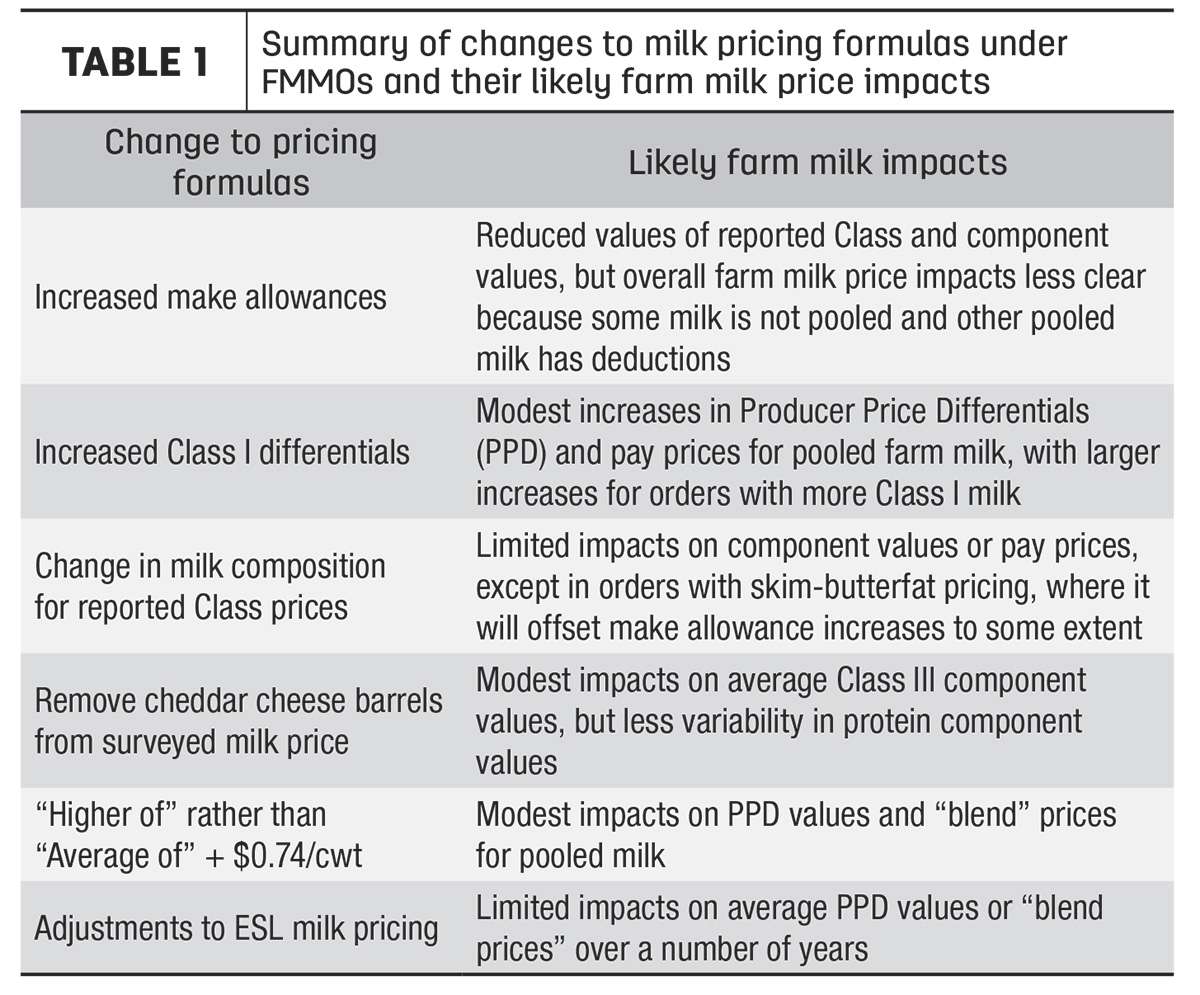
Increases in the make allowances will mean that component values in June will be lower with the new formulas, which could lower pay prices to producers in orders with pricing based on components. In the four FMMOs that use butterfat-skim pricing, lower values of components will be offset to some extent by the changes in milk composition.
Changes to the Class I differentials will increase the value of Class I milk in all orders, contributing to higher values of pooled milk and producer price differentials (PPD). Increases in prices paid for farm milk due to the proposed changes in Class I pricing will be larger in regions with larger increases in location-specific differential values and higher utilization of Class I milk (such as the southeastern U.S.).
Impacts on component values and reported class prices may not always reflect the likely impact on farm milk prices. Farms pooling milk and receiving the full regulated minimum Class III price would see reductions in milk prices due to make allowance changes ranging from 32 cents per cwt to 91 cents per cwt. However, not all milk is pooled, and some pooled milk may receive less than the minimum regulated price due to deductions by cooperatives. For those farms, any price decreases will likely be smaller than those based on reported prices or component values – and pay prices for some producers could actually be higher. Similarly, impacts on Class I prices and PPDs will vary by order. Increases in Class I differential values are similar in the Upper Midwest, Mideast and Florida orders, but the impact on farm milk prices will be larger in Florida due to a higher proportion of Class I milk.
Finally, changes in farm milk prices beginning in June will affect future production and the demand for farm milk. Dynamic economic modeling of these potential impacts indicates that any initial price decreases will result in somewhat lower milk production in the next couple of years, which in the future will affect the supply-demand balance for farm milk and mitigate some impacts of the changes that begin in June.
Producers whose milk is pooled and who have received full component values for milk will see lower component values going forward, which may imply that adjustments to feeding strategy are appropriate. Staying in communication with milk buyers and monitoring the evolution of component pricing going forward will be helpful for making other management adjustments to the new pricing environment.