Application drones are a very exciting advancement to the drone industry. Like any equipment, we want to see how this type of investment pencils out – starting with an understanding of the fixed/variable overhead costs to see if it fits on your operation and what the return on investment (ROI) is on a piece of equipment such as a spray drone.

Upfront costs
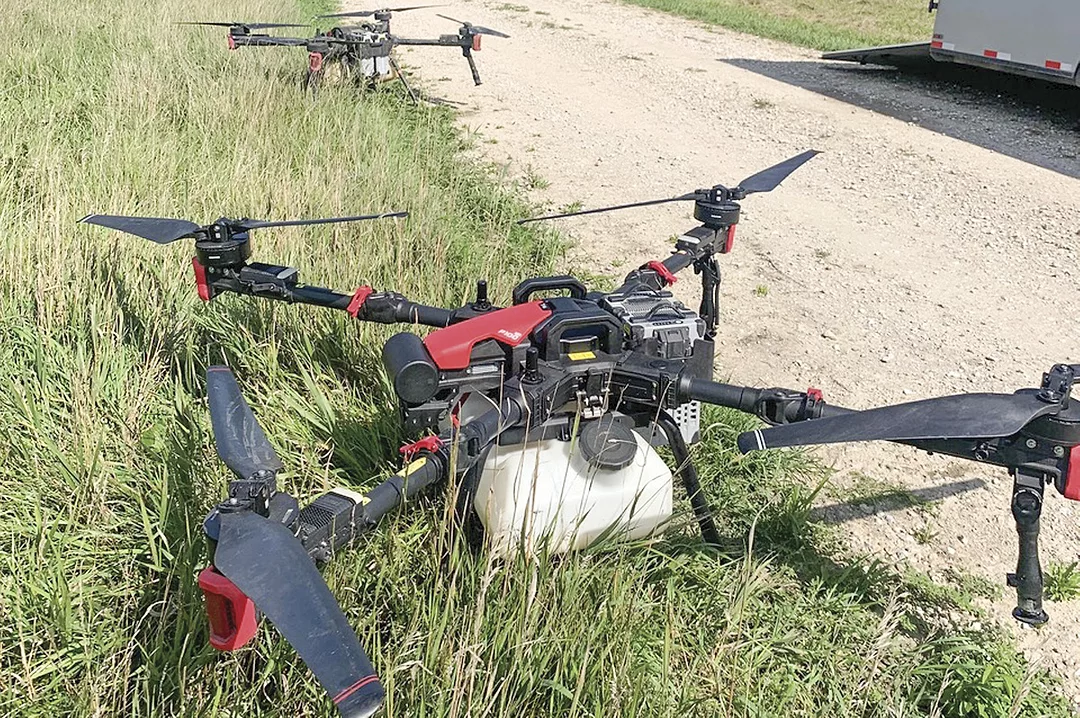
There are two main components that make up a drone operation. The first is the drone itself, and the second is the trailer or refill system to help you transport the drone and product. Drone packages for the mainstream drone manufacturers currently all seem to range around the mid- to low $40,000 mark. The main packages typically consist of the drone, a spray/spreader tank, three to four sets of batteries, a controller and chargers. Additional costs such as a generator, four-nozzle upgrade kit, extra batteries or a real-time kinematic (RTK) base station can add an additional cost depending on what you need.
The second component – the trailer set-up – is very variable, from using an old flatbed with some reused tanks to a $100,000 trailer that has an automated mix system and large-capacity water tanks to fly three drones. It is difficult to pinpoint a price on a spray trailer as everyone seems to do it their own unique way to fit them best. If you want a drone trailer that is fully equipped with tanks and a semi auto-fill system with an enclosed drone storage, then you’d be looking around the $35,000 to $45,000 mark.
Last steps to set up
Once you are set up with the drone and refill system, there are a few more components and formalities to complete: labour, training, current legal requirements and long-term maintenance. All these components intertwine slightly. Remotely piloted aircraft systems (RPAS) or drones are aircrafts. This means that as of June 2025, the operator must hold their drone pilot's licence and have a valid Special Flight Operating Certificate (SFOC) from Transport Canada.
For your advanced drone licence (needed for 25-kilograms-plus drones), there are two stages. First, the online exam costs $10 to take, which anyone can take without completing a prerequisite course. However, taking an online “at your own pace” class for around $250 to $450 is recommended to help gain a good understanding and knowledge base. The second part is an in-person flight review costing around $250 to $350 or more (typically) to show how you conduct yourself and make sure you are flying safely in your airspace.
Once both are completed, you have your licence and are halfway to be legally flying. The other component to be fully above board is getting your SFOC. You can get this written for you, which can cost anywhere between $2,500 to $5,000 or more, depending on the level of document needed. (Note, if you hire someone to write your SFOC, you must still know what is stated in that document and what the legal bounds are in which you are operating your aircraft.)
Lastly, adequate training should be completed for flying your drone, so that you have an adequate understanding of how to operate, but more importantly, how to apply. Flying a drone is the easier part, but understanding how to apply takes some practice; you can’t just expect to unpack, fly and expect good results with your expensive inputs. New regulations, which take effect as of Nov. 4, 2025, have also been posted to the Transport Canada website.
Long-term costs
Drones are like any other piece of equipment: Maintenance and other variable costs are inevitable. Your most worn parts are your moving parts and batteries. More parts on a drone mean more things to go wrong. Blades begin to wear from dust and debris or flying conditions. Motor bearings, pumps and any weight scales can get damaged if overloaded.
Major maintenance can always be mitigated with simple daily habits like making sure to pressure wash your drone (lightly if rated) and being aware of flight conditions to lessen the strain on moving parts. Additionally, batteries can only be charged and discharged (1 cycle) so many times (typically around 1,000 to 1,500 cycles). As for battery maintenance, small things such as placing them in cooling charging stations to help keep them cool, is essential. If proper care is taken, battery life is extended. Think about your phone battery: As it slowly declines in health, your phone is still usable; it just doesn’t stay charged as long. Charging batteries in a water or a misting system helps with a more efficient heat transfer to make sure batteries don’t overheat, degrading each cell.
Lastly, be aware of what you are applying. Acidic or corrosive products can have serious wear on seals, bearings and much more if not washed off or handled correctly. Another small thing to think about is tank size. A larger tank means less refill, less ferry time and getting more acres done per hour. It also means less time flying back and forth, adding unnecessary wear and tear on your drone, maintaining lower hours and higher productivity on your equipment.
ROI: Buy or hire?
Purchasing an application drone is a great technology to have in your toolbox. It gives you the option of a relatively cost-effective sprayer, which you can use in conditions where you can’t get the ground sprayer into the field. Another benefit is having integrated RTK base stations that you don’t need to pay monthly subscriptions for to have high levels of accuracy. When purchasing, just be aware of the type of drone you purchase to make sure you have the support when you need it.
On the other hand, hiring drone application services also brings huge value. It allows you to supplement your spraying application at crucial times without having to carry the overhead of a drone you may or may not use and get your return on investment with. Having an operator who is experienced and knows how to apply via aerial drones is crucial in order to keep efficacy high, especially considering the price of today’s inputs. Having a custom operator who is set up with drones may even be a good way to learn more about the technology if you are considering purchasing. Drones add extra variables into application, which can lead to exceptional results if the pilot knows how to control them.
At the end of the day, the decision to purchase a drone really depends on what works for you and your operation. Drones are not the end-all be-all, having their own purpose alongside a ground sprayer. They can accomplish many things, but you need to invest in research and education to see results. Whether you hire out or do it in-house, it is an amazing technology that has proven itself over and over if operated correctly. Being able to pencil it out depends on what you need and how you use it.
Author's note: The figures presented in this article are all rough. Please do your own research to get a full understanding of actual costs. In addition, pesticides are currently not legal from PMRA on cropped land. Feel free to contact me if you require more information.