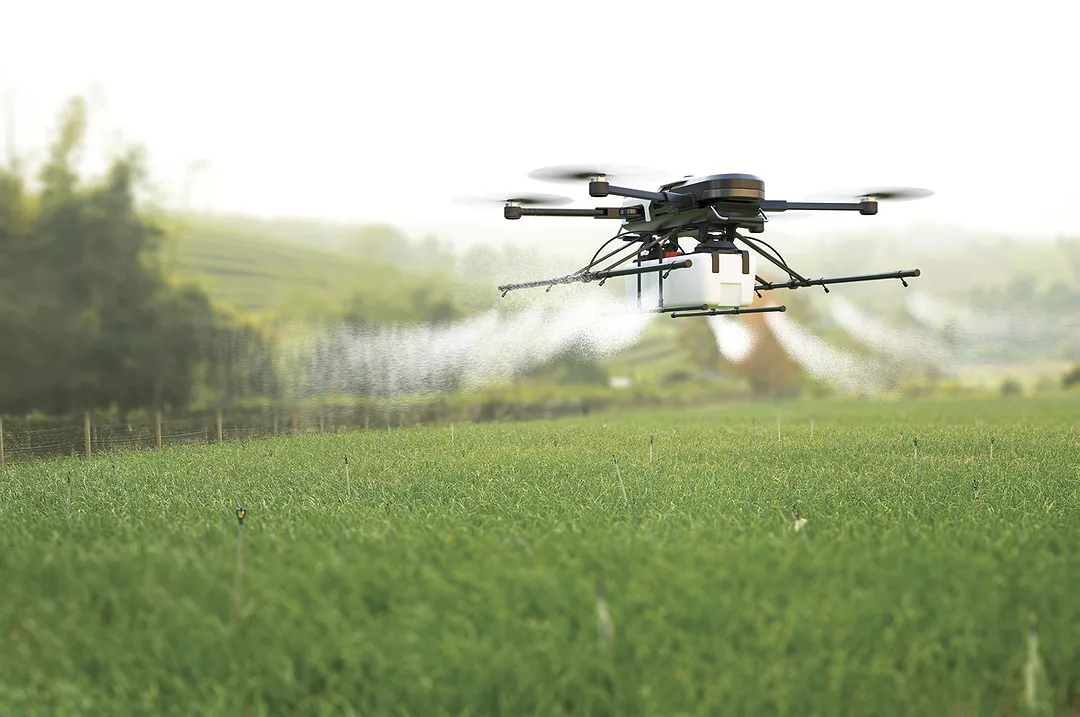
Application drones are now a part of normal agricultural practices, but with new modern farming tools like these available, there are often many misconceptions. Hearing what the sales rep pitches is one thing, but thoroughly understanding how drones can accomplish your particular spraying needs is another when purchasing a spray drone or hiring custom work. This technology requires practical thinking and a solid grasp on how it functions.

Can a drone replace a ground sprayer?
The short answer is technically yes, but it is not recommended for all applications. Being a custom operator myself, the truth is that knowing the limitations of application drones is crucial for success. The biggest limitation is the low tank volume capacity. In conventional farming practices, I have noticed that liquid nitrogen and products like it tend to not be suitable for spraying via drone due to its high-volume requirements.
At this point, the standard industry drone rate is 3 gallons per acre on mixed products, which can be increased to about 6 gallons per acre. After this point, you begin to start losing a major amount of efficiency. This standard rate has been found to gain the best efficacy-to-efficiency ratio in its ability to produce on par results with a ground sprayer. Increased rates of 4 or 5 gallons are also commonly requested and used. Higher drones rates only see a slight benefit, which raises the question: Is it worth the extra application cost? A good drone pilot with a 60-litre tank can realistically accomplish 50 acres an hour with the correct setup.
Understanding your operation’s application requirements are crucial to utilizing drones. For most conventional and organic farmers, spray drones serve as a tremendous and complementary tool on one’s farm. With that being said, they are also not the end-all-be-all for spraying.
Author’s note: Before spraying any product, please review product label to confirm it is legal to spray via aerial drone application.
Spray drones are only efficient on small fields
Spray drones excel at accessing hard-to-reach areas, making small awkward fields a prime area for showcasing the advantages of the spray drone. The drone’s versatility also means that large acres do not pose a threat. Today’s large drones are able to accomplish 150-acre fields without a problem. Small fields can sometimes require a smaller drone or only filling a larger drone half full because each fully loaded turn a drone has to make will eat up a lot of battery power. Applying on large fields in Ontario and Quebec typically requires a higher-capacity tank (ideally around 50 to 70 litres) to ensure it can fly to the end of the field and back without running empty.
Factoring in the right drone size for you is essential. Smaller drones are great in the small fields and for spot spraying, while full field applications would benefit from a larger drone.
Spray drones aren’t accurate
As I’ve emphasized before, a well-trained pilot can have tremendous accuracy with drones. Anyone can complete training that hones in on the theory of how drone application actually works and how to fly today’s industry standard drones, but understanding how to apply is the true skill.
Thinking through the nuances and factors that will affect function and application are very important. For example, remembering that hot days have more of an effect on evaporation as you are flying higher than a boom might reach, or thinking about spray width as we utilize down wash from different elevations. There is some thought behind applying on different crops to what product is being used to get the desired placement.
Spray drones can be very ineffective, but so can ground sprayers without the proper training. They hold a similar thought process, from choosing the correct nozzle and micron size to how much down pressure you need. This means that the real take-away is that training is more crucial than the equipment itself when it comes down to choosing which industry-standard drone to apply with.
Bigger is better
The idea that bigger is better is only true to a certain extent. It used to be that we wanted bigger drones to cover more land base, as the small 10-litre tanks just didn’t cut it. We have finally reached somewhat of a plateau, it seems: a point where bigger doesn’t mean necessarily better.
As I do research to upgrade drones, I’ve noticed that the new 100-litre drones that look super cool and are advertised as amazing have one crucial downfall: battery technology. Bigger blades, motors and tanks seem to be coming out quick, but how do we power these energy-hungry components? I am just not sure if it is there yet.
To put it into perspective: The current 60-litre drones use one or two batteries totalling around 40,000 mAh capacity, and with the new 100-litre drones, the capacity is now 41,000 mAh. Based on the research I’ve done, these large drones work for roughly three flights fully loaded, until you have to halve the load so the drone will fly. This has led to the 70-litre drones being more popular than the 100-litre drones in China.
As of this point, there is a middle ground for how large a drone can or should be before it gets to be too ambitious. The larger drones of 70 litres seem to be reliable and consistent in their delivery.
Another aspect that I must mention is the law. Transport Canada’s regulations as of Nov. 4, 2025, will still require a special flight operating certificate (SFOC) if drones are over 150 kilograms, potentially incurring application costs up to $2,000, depending on SFOC complexity.
This myth comes down to both technology limitations as well as what your farm needs. Should you be looking at 70-litre drones for full-field application or maybe only needing a 25-litre tank for spot spraying? Like any technology, there are kinks to be worked out when getting into a new territory.
Overall, drones are an amazing tool that many people have begun to explore through custom work or purchasing a unit themselves. There is so much potential in what this equipment can accomplish, while keeping in mind that everything has limitations and we must understand the realistic abilities of drone technology.