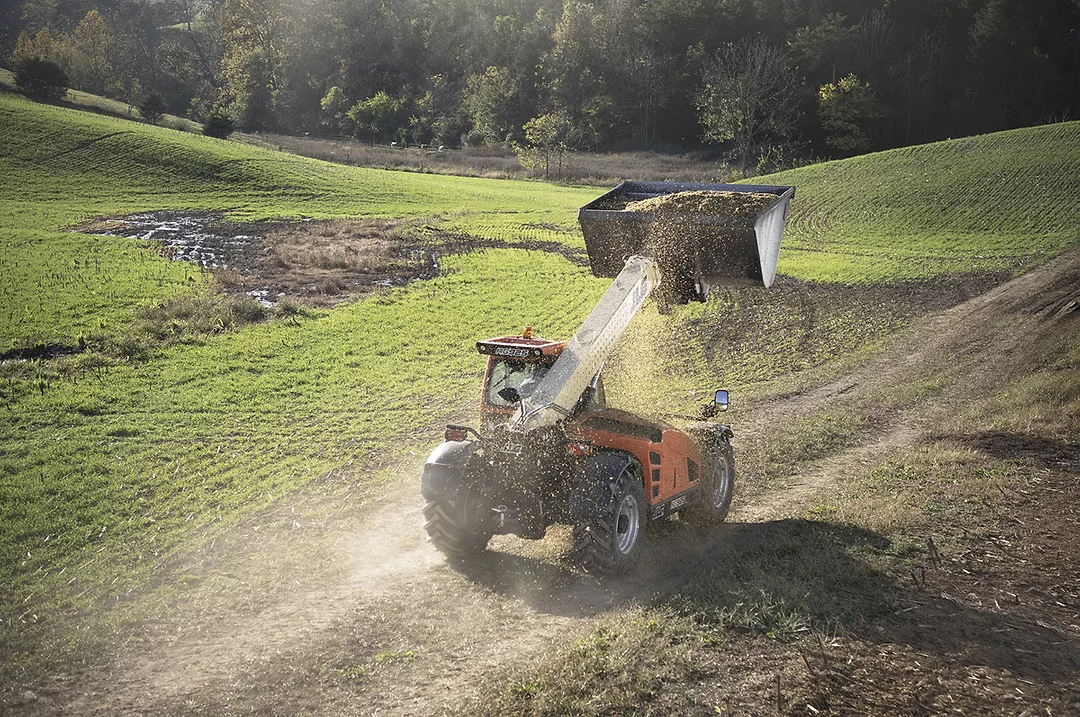
For years, telehandlers on U.S. farms have been “nice-to-have” rather than “need-to-have” machines. That’s because American farmers are price-conscious, and over generations of operating their farms, they’ve become skilled at maximizing the equipment they already own. Ingenuity and efficiency are part of the lifestyle.
As a result, they typically rely on tractors to handle most daily tasks – lifting, loading, repairing and construction included. When additional equipment is required, skid steer loaders or wheel loaders often step in as supporting machines.
While tractors and loaders are reliable pick-and-carry tools capable of transporting heavy materials around the farm, they can fall short when it comes to placing those loads precisely where needed.
That’s where telehandlers offer a distinct advantage. They can do nearly all of the pick-and-carry work of a front-end loader-equipped tractor, skid steer or wheel loader, but with added versatility. Thanks to their telescopic booms, they provide greater lift height, extended forward reach and even up-and-over access. This means farmers can pick, carry and place materials with greater flexibility.
In agricultural settings, JLG telehandlers demonstrate an impressive range of capabilities – many of which surprise those who use them for the first time.
Brad Palmer, Pigeon Cove Farm – 'It has its place'
Fifth-generation farmer Brad Palmer runs Pigeon Cove Farm outside of Warfordsburg, Pennsylvania. Raised on the family dairy, he has worked the land for as long as he can remember. “Farming is all I know,” he says. “I’ve been working here since I was able to. I love what I do.”
Today, he and his son Logan, along with several farmhands, milk 400 cows and farm 2,000 acres in the Pigeon Cove Valley. They also provide custom farming services for neighbors. Days begin at 3:30 a.m. and often stretch late into the night. “There’s always more to do, and less time to do it. It’s all about efficiency,” Palmer explains.
Despite technology’s evolution, Palmer still leans heavily on skid steers and tractors with loaders. “Thirty years ago, when we got our first skid steer, it took some getting used to. Now, we wouldn’t be without it.” The farm currently operates three skid steer loaders and two tractor loaders.
But even these machines have their limits. “With a skid steer loader, I have to build a ramp so the machine can dump into a dump truck,” Palmer says – time and effort he’d rather spend elsewhere.
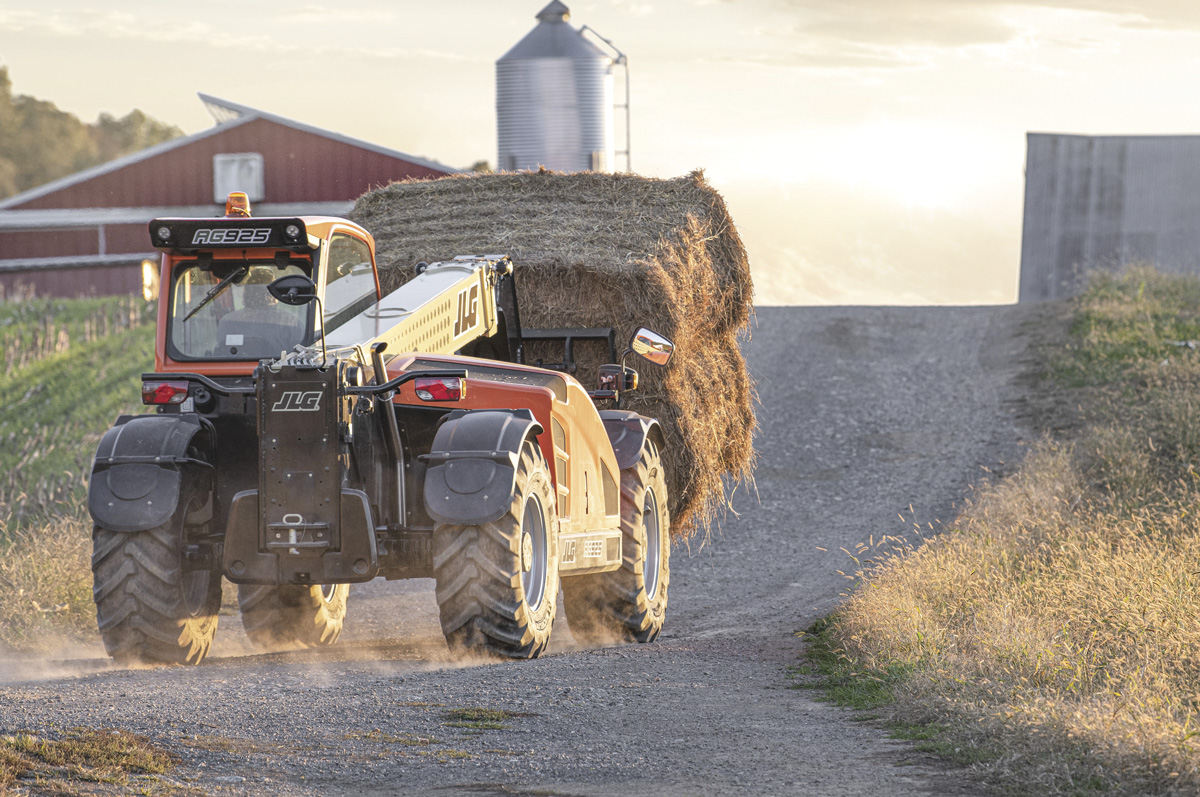
When farms are 2 to 3 miles apart, telehandlers offer a smooth ride at 25 mph to go between them as quickly as possible. Image courtesy of JLG.
After hearing about other farms using telehandlers, Palmer volunteered to test the new JLG telehandler when it launched. “All my guys were ecstatic,” he says. “We’d heard about what they could do – but we really didn’t know until we had one.”
That firsthand experience made a difference. “The biggest thing is its reach,” he notes. “It offers more than our tractors or loaders – and the lift power is incredible.” Now, his crew routinely asks where the machine is parked so they can use it.
They’ve used the telehandler for daily tasks like feeding cattle, defacing bunks and silage, loading mixers, bedding cows and moving large square hay bales. “It has a 3.9-yard bucket compared to our largest skid steer, which is only 1.5 yards,” Palmer notes. “That alone saves us 20 to 30 minutes every day.”
The telehandler has been paired with pallet forks, hay forks, defacers and other attachments. After about 400 hours of use over four months, Palmer says it handles 80% to 85% of what a skid steer does – plus a good deal more.
And now, they load dump trucks without ramps. “It can scoop the feed and reach over the side. A skid steer just doesn’t go that high,” he says.
They also use it for jobs that were once labor-intensive – hauling feed sacks, supplying the grain drill, moving tires and pushing brush. “We use it for everything,” Palmer says. “Its maneuverability is excellent, it makes tight turns and it’s great for towing.”
Comfort is another standout. The telehandler travels up to 25 mph with two-wheel drive and four-wheel drive options, independent suspension and an air ride seat. Compared to a 10-mph skid steer, it’s a smoother, faster ride – critical since their farms are 2 to 3 miles apart. His team also appreciates crab steering for maneuvering near walls and tight spaces.
“We’re pleased with it,” Palmer says. “It does everything we expected. There are still tasks for skid steers – but there’s definitely a place for telehandlers. I’d highly recommend it – it has its place.”
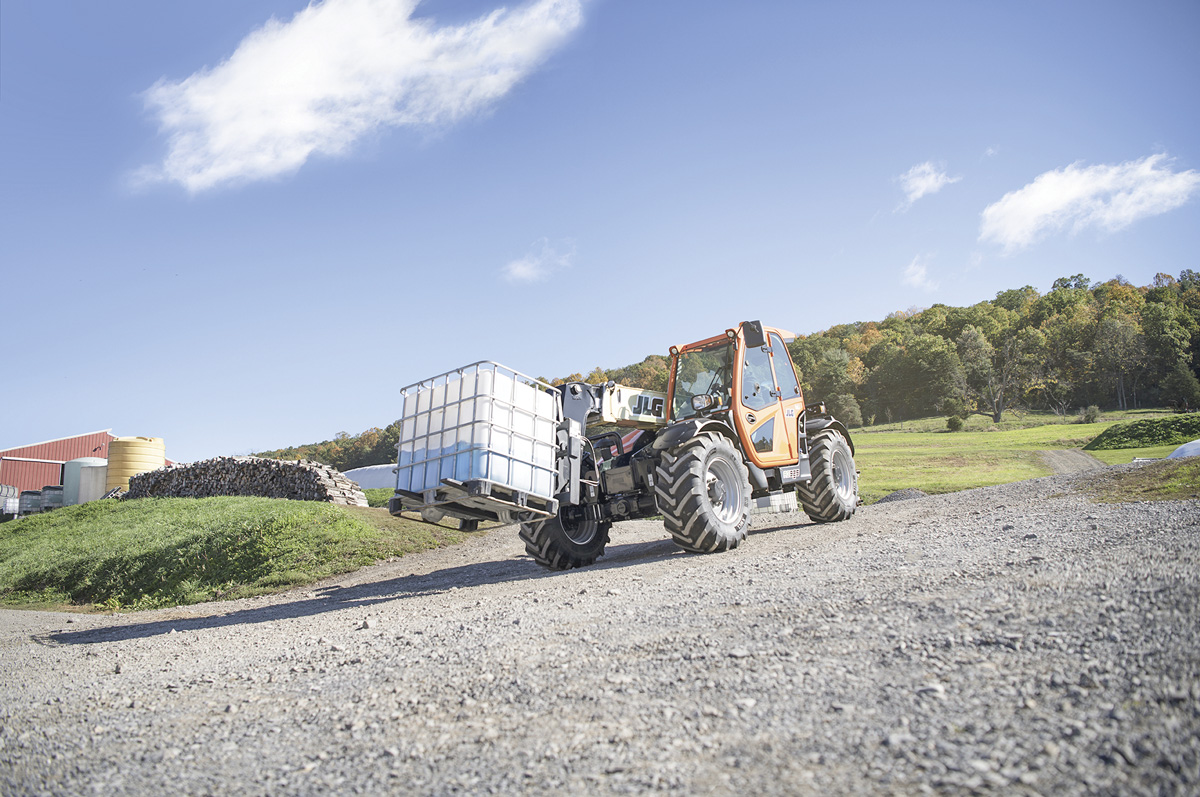
Telehandlers can do most of the same pick-and-carry tasks as traditional loaders but with the added capabilities. Image courtesy of JLG.
Logan Bower, Pleasant View Farms – 'It’s a winner'
Over at Pleasant View Farms in Blaine, Pennsylvania, third-generation farmer Logan Bower was excited to try a telehandler after seeing competitors’ machines in use nearby.
“We’re used to what we’re used to – tractors and skid steers,” he says. “This was our first telehandler, and we were surprised how competitive it is.”
He was particularly impressed with its low center of gravity and ability to navigate low-clearance spaces. The lift capacity and breakout force exceeded his expectations. “It’s a great substitute for our loaders,” he says. “It adds flexibility to our fleet.”
Pleasant View Farms has 15 to 16 full-time employees managing 1,500 cattle, with about 600 being milked. They farm 900 acres. Tasks for the telehandler included bedding, hauling, loading mixer wagons, moving tires and traveling between farms. The extendable boom made quick work of high-reach needs.
They also used it for building maintenance – roofs, fans, windows and more. “Being able to raise and extend the boom without relocating the machine makes it ideal around livestock and people,” Bower says.
A compact footprint paired with serious muscle makes the machine suitable for tight spaces and on-road use. “It carries about a ton more than our largest loader,” he says. “And it’s easier on the ground – it doesn’t tear up soil or driveways like a skid steer.”
Initially, his crew was hesitant. “They were worried they’d break it,” Bower laughs. But the steering wheel setup made it intuitive. “Now I can’t get them out of it.”
He adds, “The telehandler is so handy – we use it more than I ever imagined. I can’t believe we didn’t try it sooner. You really can teach an old farmer new tricks. It’s a winner!”
Do more with less
With extended reach, elevated lift heights and the ability to adapt to a wide range of jobs, telehandlers empower farmers such as Palmer and Bower to get more done in less time. On farms where a 12-hour day still feels short, that kind of efficiency is priceless.
For more information about ag telehandlers, visit the JLG website.