As dairy producers seek to maximize both genetic progress and economic return, the strategic use of beef semen has become a common herd management strategy across North America. Cows with higher genetic potential can be bred using sexed semen to produce high-quality replacement heifers, while cows with lower genetic merit can be bred with beef sires to produce crossbred calves that are more valuable in the beef market, compared to male dairy calves. Since 2015, the use of beef semen has more than tripled for the Holstein breed – growing from 8% to 28% on average.


This trend is largely driven by the current scenario of strong beef prices. Selling beef crosses offers immediate income, and buyers often seek healthy, uniform lots – making the management of beef-on-dairy crosses an increasingly important focus. However, it is important to remember that milk production remains the foundation of the operation. Therefore, the management of the dairy dam must remain a priority, especially considering that the use of beef semen can influence key factors like gestation length.
Considering gestation length: What the data shows
We receive roughly 150,000 insemination records each month from artificial insemination technicians and records collected through milk recording. We recently explored the average gestation length for Holstein dams bred with various beef breeds, considering those with at least 100 recorded births since 2021.
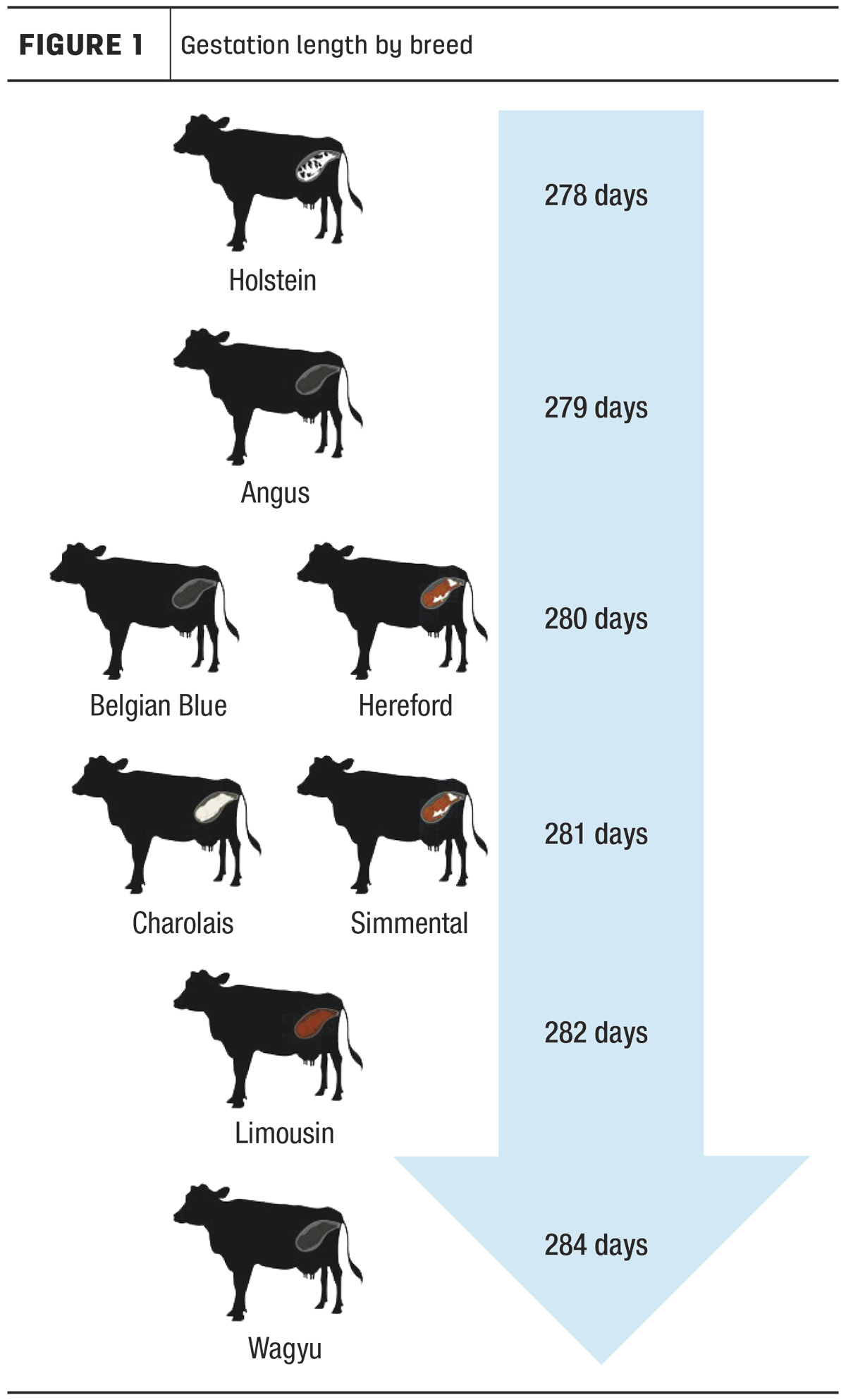
For comparison, a Holstein dam bred with a Holstein sire has an average gestation length of 278 days. However, when using beef sires, this average can increase by up to five days, depending on the breed. For example, Angus bulls are used for 80% of beef-on-dairy inseminations and are generally favoured due to their shorter gestation length compared to other beef breeds, averaging 279 days when crossed with a Holstein dam. In contrast, Limousin and Wagyu sires generally have longer gestation lengths when bred to Holsteins, averaging 282 days and 284 days, respectively (Figure 1).
Management implications: Rethinking targets
Farm management is typically guided by set targets, often based on herd averages. However, the choice of sire breed can shift these averages, and this must be taken into consideration. When dairy producers adopt beef-on-dairy breeding strategies, it becomes important to reassess associated management practices.
One key area is the dry period. Producers should clearly define their ideal total dry period duration and determine how many days cows should spend in the far-off and close-up groups, based on their nutrition program. While breed-related differences in gestation length may only span a few days, these small shifts can have an impact, especially on farms that move cows between pens only once a week. In such cases, cows may unintentionally spend too little or too much time in specific pens, affecting transition outcomes.
Getting the dry period right is crucial for a successful next lactation. Very short dry periods (less than 30 days) can reduce milk production in the next lactation, while excessively long dry periods may lead to overconditioned cows, increasing the risk of metabolic issues and impairing future production. Additionally, many farms follow specific feeding programs in the last three weeks before calving to prevent disorders like milk fever. The effectiveness of these programs depends on the duration of stay in the close-up pen – if cows are there for a short period, it may reduce their effectiveness; if the duration is too long, the risk of disease, lower milk yield and impaired fertility in the next lactation increases.
Calving difficulty in crossbreds: Should you be concerned?
In general, longer gestation lengths are associated with a greater risk of difficult calvings and stillbirth when using conventional semen. There are also concerns about calving ease using certain beef breeds in dairy herds.
Our database includes information on calving ease, though it’s important to interpret this data with caution, as there may be underreporting of crossbreed calvings. Our data suggests that beef-on-Holstein calves may present similar calving issues as conventional dairy calves. Among Holstein dams, 95.5% of calvings are recorded as unassisted or requiring an easy pull, compared to 96% when bred to beef sires.
However, the breed of the sire plays a role. For example, Belgian Blue crosses have the highest rate of calvings requiring hard pulls (4.7%), while Kobe Wagyu crosses are associated with the least problems (1.4%). Angus-Holstein crosses show favourable calving ease results as well, with 96% of calvings recorded as unassisted or easy pulls and just 2.6% requiring a hard pull.
Calving ease is influenced by many factors, including the age and size of the cow and the sex of the calf. Nevertheless, it remains important to consider calving ease when selecting both dairy and beef sires in your breeding program.
Making beef-on-dairy work for your herd
The use of beef semen in dairy herds is more than a trend – it is a strategic opportunity to enhance profitability. Successful implementation requires more than just selecting the right sires. The small shifts in gestation length can affect dry period targets, pen movements and transition cow management.
While we’ve provided population averages based on our recorded data, variation exists between farms. That’s why it’s essential to look at your own herd’s data and evaluate how your breeding strategy is influencing key management areas. A thoughtful approach helps you achieve your goals without compromising cow health, performance or long-term productivity.