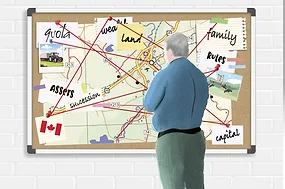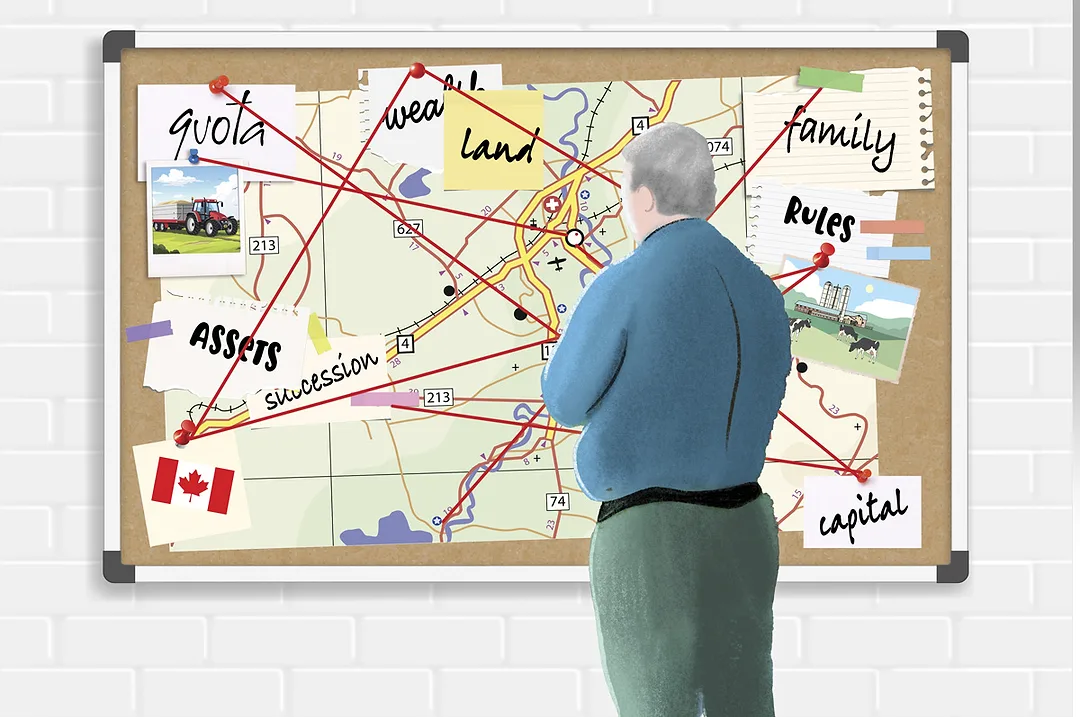
For more than a decade, I've helped Canadian farm families plan the handoff from one generation to the next. My clients live and work in all aspects of agriculture, but dairy makes up a large share of the work, and dairy is where the succession question has its sharpest edges. If you milk cows in this country, you already know why. The question that decides whether a farm stays in the family usually isn't whether the next generation wants it or not; it is whether they can possibly afford to take it on.

That, in a nutshell, is the state of dairy succession in 2026: A generation that built real wealth getting ready to hand it down, and a generation behind them staring at numbers that, on paper, shouldn't work.
A wave that’s already breaking
We talked about the aging-farmer problem for years as though it were still coming. It's here. A large share of the operators I sit with are within a decade of stepping back, and a striking number still have no plan past “the kids will figure it out.” What makes this moment different is the concentration – a whole generation that expanded and modernized through the same decades is reaching retirement all at once. The math of a dairy transition is unforgiving enough that figuring it out at the last minute usually means selling out. The farms moving through it well are, almost without exception, the ones that started the conversation years before anyone needed to.
The capital wall
You don't need me to explain quota or read you the exchange results. What's worth naming is what those numbers are doing to succession. When a recent Dairy Farmers of Ontario exchange draws roughly 1,900 bids to buy against only 18 offers to sell, the message is plain: Quota is effectively unavailable, and a young person without a family base is locked out before they begin. On a typical herd, quota alone is a multimillion-dollar asset before anyone counts land or cattle – and in the capped provinces, it's a firm value that doesn't appreciate, so a successor who finances it carries real debt against a value that simply sits. Higher interest rates have sharpened that edge, which is why more of the transfers I see now lean on the family to hold the paper rather than the bank. Bigger forces hover in the background, too – such as the investment needed to achieve the net-zero-by-2050 goal, the Canada-U.S.-Mexico Agreement (CUSMA) review and its question over supply management – but at my table, these reduce to one thing: Who will own the farm long enough to live with today's decisions?
But here's what I tell every dairy family: Of all the farming industries I work with, yours are among the best positioned to pull a succession off. The same system that makes quota expensive also delivers something that few other farming operations can count on – a stable, predictable milk cheque, largely insulated from the commodity swings that dictate outcomes for the rest of agriculture. That stability is gold in a transition, and that stability may be your farm's biggest asset when it comes to succession. It lets you more accurately quantify what the financial capacity of the farm truly is, gives a lender confidence to underwrite a multiyear buy-in and lets a family structure a gradual transfer knowing the cash flow will be there to service it. On a grain or beef operation, you plan a handoff around income that can halve in a bad year; on a dairy, you plan around a number you can trust. Quota is often viewed as a barrier because of its price and strict policies – but it's also the very thing that makes the puzzle solvable. The locked-up value is the parents' retirement and the farm's collateral; the milk cheque is what carries the transfer across the generation.
Land that has outrun the cows
Quota gets the headlines, but land has quietly done the same thing. Farm Credit Canada put the national rise at 9.3% in 2025, on top of decades of consistent gains – and most of you have watched your own acres do exactly that. For a retiring owner, it's a reward for a life of work; for the son or daughter trying to buy in, it's one more number even a steady milk cheque can't fully cover. Stack land on quota and the cost of entry climbs past what any lender will underwrite on cash flow alone, which is why nearly every transition I handle today stays – at least partially – inside a family.
The part the rules don't cover
Here's the most important thing I've learned in my 10-plus years working in dairy succession: The technical side can almost always be solved. The quota transfer, the farm rollover rules, the tax implications of succession – those are the parts families often lose sleep over, but they are also the parts good lawyers and accountants handle every day. Transitions rarely fall apart over structure. They fall apart at the kitchen table.
The hardest questions in a dairy succession aren't on the balance sheet. How do you fairly treat the child who stayed and milked for 15 years while also being fair to the child who built a life in the city, when the only real asset is the farm? Does the successor have real authority, or are they 45 years old and still asking permission to buy a tractor? These are the conversations I'm most often brought in for, and they decide whether a plan survives contact with the family. The structure is the easy part because math and logic give you the answers. The alignment underneath is where the real work is needed because math and logic are now competing with emotion and values.
Two patterns come up repeatedly. The first is the off-farm child: The instinct that feels fairest (include them in ownership or split the farming assets) is often the fastest route to a forced sale because the farming successor can't buy out siblings and keep the business whole. We can’t choose our siblings, but we should be able to choose our business partners. Forcing family members to work together just for the sake of fairness rarely results in a positive outcome. The families who solve it separate equal from fair, and this is where dairy's stable cash flow quietly becomes a tool rather than a barrier. An increasing number of the families I work with divert a slice of that predictable milk cheque, within their operating margins, to build wealth deliberately outside the farm – a modest, steady draw funding life insurance, savings, investments, a down payment for a home, an education for the children who won't farm, etc. It's real opportunity built over years instead of carved out of the business in one painful settlement. The same cash flow that makes the transfer bankable can also make it fair. The second pattern is the founding couple: Far more transitions stall on a husband and wife who have never said out loud when they intend to let go. Until that happens, nothing downstream can be planned with confidence.
What's working today
It would be easy to read all of this as gloom, but it isn't. Canadian dairy is productive, stable by any global measure and – for the families who plan – entirely transferable. The transitions that work share the same habits: They start a decade out, they bring the successor into genuine management long before ownership changes, they spread the financing and tax load across years rather than one crushing event, and they treat the family conversation as seriously as the financial one. The order matters: Families that settle the human questions first find that the legal and tax work fall into place around those answers far more smoothly than the other way around. Even outside the family path, the new-entrant programs have, since 2010, put new faces into barns that might otherwise have gone quiet.
So here is the honest snapshot. Dairy succession in Canada in 2026 is demanding, but it is not fragile, and dairy families are better equipped for it than most because the milk cheque gives them something solid to plan around. The wealth is there, the structures exist and in most cases, the next generation is willing. What the moment asks for isn't a bigger balance sheet – it is time and honest conversation started early enough to matter. The families who give it both are still handing down farms beautifully, one generation at a time. The ones who wait are the ones I worry about because succession is one of those problems that gets harder to solve the longer it sits. That, in the end, is the real state of dairy succession today: The assets have never been larger, the rules never more settled and the factor that decides how it all turns out has never been more human.