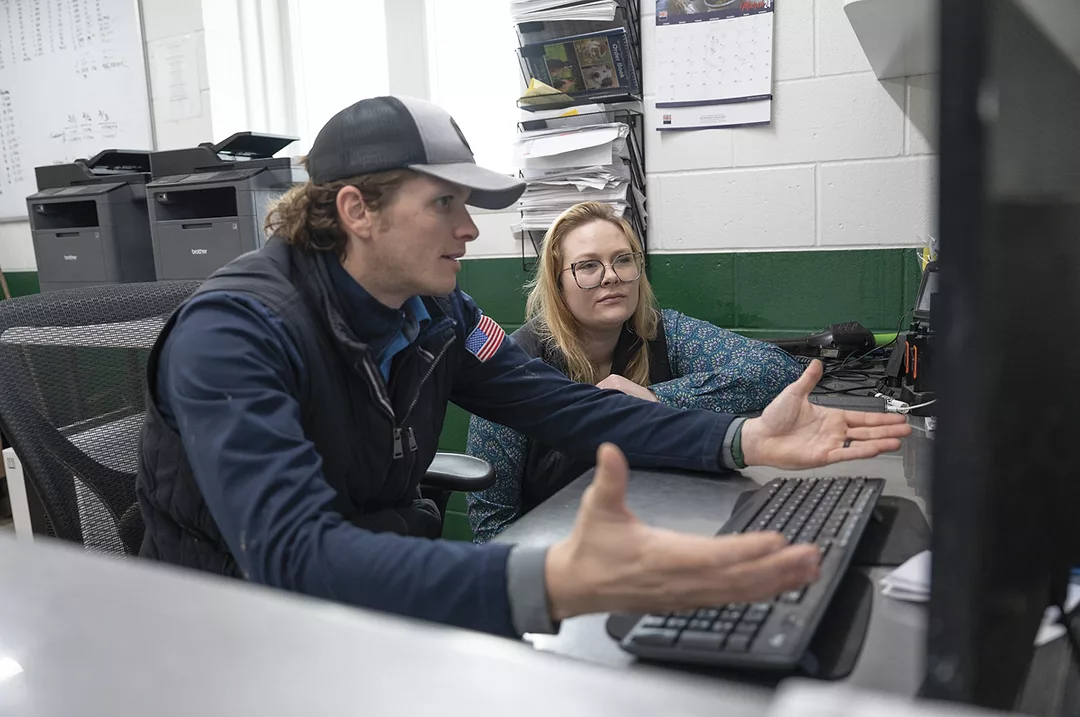
A new webinar series from Progressive Dairy debuted this summer, and the manager of a 3,000-cow dairy in Bailey, Michigan, was the featured guest for the first episode. Dairyman Clare Alderink talked about success with new technology as well as some technology challenges during his time on the Real Producer Exchange. Read more about his operation here and rewatch the full 60-minute show.

New feed efficiency monitoring technology
The dairy Alderink manages is one of the first in the world to try a new feed efficiency monitoring technology. For the last year and a half, the dairy’s activity monitoring (AfiCollar Feed Technology Service from Afimilk) has been contributing data on feed intakes to give the farm insight into which cows are converting feed more efficiently into milk. The sensors in the cows’ collar provide accurate feed consumption data, combining it with milk production data to calculate a feed efficiency score and income over feed cost for each cow.
"I’ve learned it's harder than you think to determine which cows are actually profitable," Alderink says. "I always thought that any cow making 80 or 90 pounds of milk was a profitable cow. That's not necessarily true."
So far he's been using the new feed efficiency data for cows in their first 60 days in milk to determine how a cow will be bred – with a potential dairy replacement animal or to beef. He's also using it to make culling decisions.
"I already have room in my program to make fewer replacements because I have a few more than I need," he says. "You can't just go cull all your inefficient cows, or you won't have enough cows. However, over time, I can see we'll be able to breed efficiency into our herd by using our most feed-efficient cattle to make more feed-efficient cattle."
Alderink admits he's probably quicker to try new technology than maybe others are, although he says he only likes to be testing one new thing at a time. He shared his experience using animal welfare monitoring technology during the webinar.
Feeding high-oleic soybeans
Last fall, Ryzebol Dairy started feeding high-oleic soybeans it contracted to have grown on nearby farmground. The dairy roasts and grinds the beans themselves. Alderink reports that adding them into the ration produced an immediate energy-correct milk increase.
"Compared to traditional soybean meal, it still costs more, but I'm not getting the same things from high-oleic soybeans that I'm getting from traditional soybean meal. It's not just a protein source. I'm getting energy and not having to supplement fat."
Alderink says he believes the supply of high-oleic soybeans will continue to increase and that processing them will become more cost-efficient.
"That was part of the idea of feeding [high-oleic] beans. Yes, I can buy soybeans from the guy across the road, but I have to buy palm fat from Malaysia. In terms of sustainability and long-term feed security, I think this is the better way to go."
What's not working?
Alderink explained the dairy's struggles with a recent solar power project. The farm wanted to be able to create their own power and installed solar panels on a less productive patch of ground near the dairy. It turns out the installed array produced more power than the dairy needed and that the power company was willing to take back onto the grid. So the end result was that 20% of the panels they paid for are basically unplugged and not doing anything. They may still be able to find a way to use the panels, but overall, the project has been more costly and time-consuming than they thought.
"The idea that we could make our own power from the sun sounded great," Alderink says. "But it's been almost two years now and we still haven't seen an electric bill where we say, 'Oh, there it is. That's half what we paid before.' It's been frustrating."
He also described a few areas of the dairy where he's learned that many technologies are not durable enough to survive.
"We put things on dairies in all sorts of different, harsh environments," Alderink says. "It's hard for some technology to operate on a dairy, and you just have to be ready to fix everything yourself. I don't like having too many things that could stop me from milking or feeding cows."
Alderink says over the past few years, the dairy has had a hard time keeping heifer inventory and heifer-raising costs down. He explained how he's been using weigh data throughout the raising process to dial things in and get a better handle on it.
"We can't get too caught up trying to sit here and run through all of our technology and all of our reports, and spend hours a day at our computer to know everything about our cows," Alderink says. "The most important thing is still to go look at cows and spend some time with them."
This episode was sponsored by Balchem and AfiMilk. The Real Producer Exchange webinar series celebrates what’s working for dairies but also the key learnings from unexpected outcomes. By sharing the good and the not-so-good, this series aims to uncover valuable lessons every dairy producer can apply.
See all episodes of the Real Producer Exchange and register to participate in the next one.