Many of us learned in high school how to balance a checkbook or budget, a skill that is used monthly or maybe even weekly if you’re a number cruncher like me. When budgeting, we determine what funds are entering or already in our accounts, and what is available for use or not already allocated toward other expenses. This same logic is used when building a dairy ration or assessing a feedstuff. We first gauge what is present in the feed via proximate analysis and then employ a host of analytical tools to appraise what is available for use – i.e., digestibility or disappearance, in this case.

For carbohydrates, we assess what is available in the rumen by estimating the disappearance of a specific component, such as starch or fiber, at certain time points. For proteins, similar methods can be employed with additional assays added to estimate intestinal disappearance. Apparent total tract digestibility is another tool that entails taking TMR and fecal samples from a pen of cows and comparing the nutrient density of each using a marker for indigestibility to estimate the portion of nutrients digested. One advantage of this method is the estimate of digestibility for organic matter, starch, fiber, protein and fat. Fat is highlighted, as measuring fat digestibility or disappearance is more nuanced due to processes such as biohydrogenation and endogenous fat loss.
While typically fat only makes up a small percentage of the total ration, cost per pound of fat added to the ration is expensive. So how do we maximize this small yet impactful portion of the ration? This is made more complex by the fact that different fat sources have various digestibilities and different impacts on the rumen. The Lucas Test is often used to evaluate fatty acid digestibility by assessing apparent digestible fatty acids against total fatty acid intake. More recently, researchers at Virginia Tech, in collaboration with others, have created models to estimate fatty acid digestibility based on the different types – using a meta-analysis approach employing the Lucas Test. This offered an improved way to account for the variation and impact of fat sources derived from different feedstuffs.
So why dig this far into analysis? This is for universities and labs to figure out, right? Just as when we are budgeting, we like to understand the cost associated with different parts of our budget – such as fixed cost versus variable cost. Or maybe understanding how much we spend monthly on groceries versus dining out. Understanding the digestibility of fatty acids can help fine-tune our ration costs and identify where we can find nutritional and economic opportunities.
It is well understood that while some sources of fat have proven benefits to dairy rations, certain fats can have detrimental impacts on the rumen. Thus, it is important to be able to quantify how much of what fat we are delivering to the cow. This would fall in the "what’s present" bucket of our bank account. This helps ensure we aren’t loading the rumen with too much available unsaturated fatty acid, which can impede biohydrogenation and cause milkfat depression. Protected fats work by bypassing the rumen and providing milkfat more directly to the mammary, while avoiding negative impacts on the rumen and creating net positive milk and milkfat production. This is another instance where knowing what nutrients are available and where they are available is so critical. Rumen bypass fat can be measured similarly to other nutrients – by measuring disappearance within in situ or in vitro systems. This can help ensure supplements fed don’t negatively impact the rumen unexpectedly.
The recent increase in the implementation of high-oleic soybeans has also given rise to more questions on the topic of fat in dairy rations. Oleic acid does not have the same impact on rumen biohydrogenation as other unsaturated fatty acids, rendering it safer to feed. We can easily get an estimate of total fatty acid content and individual fatty acid content via near infrared (NIR) analysis to help balance these individual fatty acids in the diet. This is valuable as there is a substantial range in both total fat content and fatty acid content of these products. However, measuring the digestibility of fat and fatty acids post-rumen fermentation remains a challenge.
Recently, colleagues of mine, in conjunction with efforts from the University of Wisconsin – Madison, worked to create a regression equation that would better help explain total fat digestion without the need for extensive wet chemistry testing – such as what is required for apparent nutrient digestion assays. From this, they then developed an NIR calibration to reach the answers faster. Similar to what was done with starch many years ago, which allowed the prediction of total tract starch digestion using only fecal NIR analysis, this breakthrough allows a rapid benchmarking tool to assess how much fat is available for animal use. Figure 1 shows the range in TMR fat, fecal fat and fat digestibility observed in commercial samples.
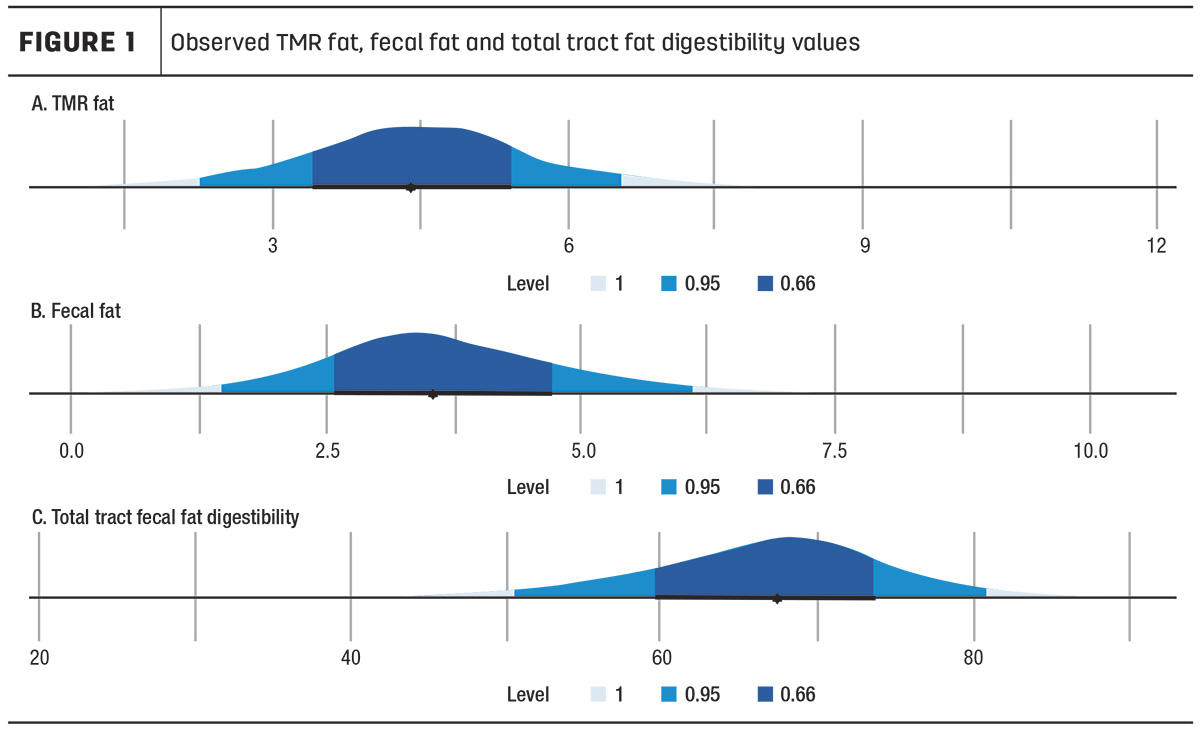
This metric does not allow differentiation between what was available ruminally or post-ruminally, but it still offers quick benchmarking within a group of cattle to see how feed changes may impact fecal fat output. For over a decade, we’ve been capturing value from minimizing starch in manure. This tool allows us to add back to our budget by doing the same with fat.
While there is still opportunity to further fine-tune the fat budget in our rations as research is devoted in this area, current tools give greater insight as to what strategies are working and which need further adjustments. Who knows, maybe someday balancing our rations with fat will be as easy as balancing that checkbook.