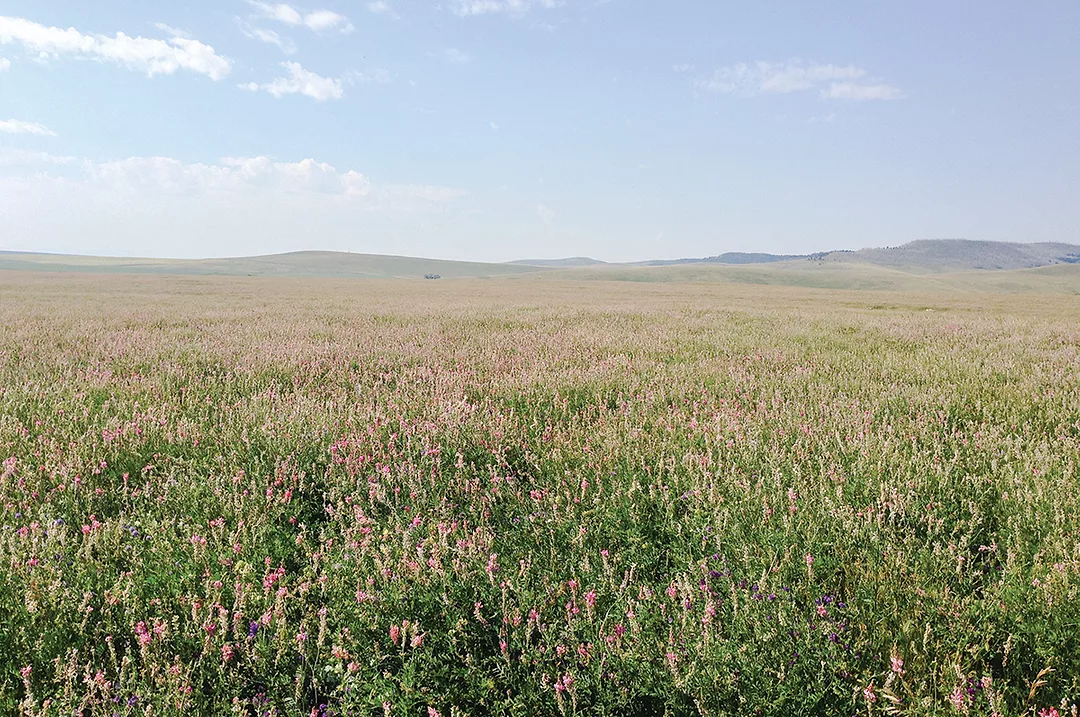
Legumes are always beneficial as livestock forage because they generally contain more protein and minerals than grasses and add nitrogen (N) to soil, but some legumes – especially alfalfa – carry risk for bloat. A legume that has renewed interest is sainfoin.

Surendra Bhattarai, assistant professor of forage agronomy in the department of plant sciences at the University of Wyoming, was doing research with sainfoin in Canada before taking his current position in January of 2025, and has started some new trials. One of his projects includes many kinds of forage legumes to compare their various benefits and drawbacks.
His research includes the production and adaptability of sainfoin, cicer milkvetch, birdsfoot trefoil and alfalfa in the environment, some of which have already been studied, but he wants to look at different varieties.
“I started with non-bloating legumes such as sainfoin, cicer milkvetch and birdsfoot trefoil and will be comparing their yield with traditional alfalfa," says Bhattarai. "Those non-bloating legumes have beneficial nutritive values, but their yield is not up to the mark that alfalfa growers are getting. We have the challenge of harnessing their nutritive values while improving their yield and competitiveness with traditional alfalfa.”
Alfalfa varieties have become very advanced, with many different high-yielding and high-quality varieties available, but there are very few forage scientists working on non-bloating legumes.
“With my experience on the non-bloating legumes, I want to take the sainfoin research forward," adds Bhattarai. "My project is in Wyoming, but my main objective is to provide a sustainable and alternative solution for producing legumes in all areas where alfalfa production is limited.”
Currently, alfalfa production is challenged by alfalfa weevil, a problematic pest for alfalfa growers.
“Some of the literature from earlier research suggests that sainfoin is resistant to the alfalfa weevil. I want to look into the different agronomic aspects of sainfoin, and the adaptability of this and other non-bloating legumes so we could provide substitutes in regions where alfalfa productivity has been challenged," he says.
He is not completely confident that sainfoin will be a solution in the future because alfalfa varieties have been so genetically advanced, unless there can be support from producers and government for more research in sainfoin breeding.
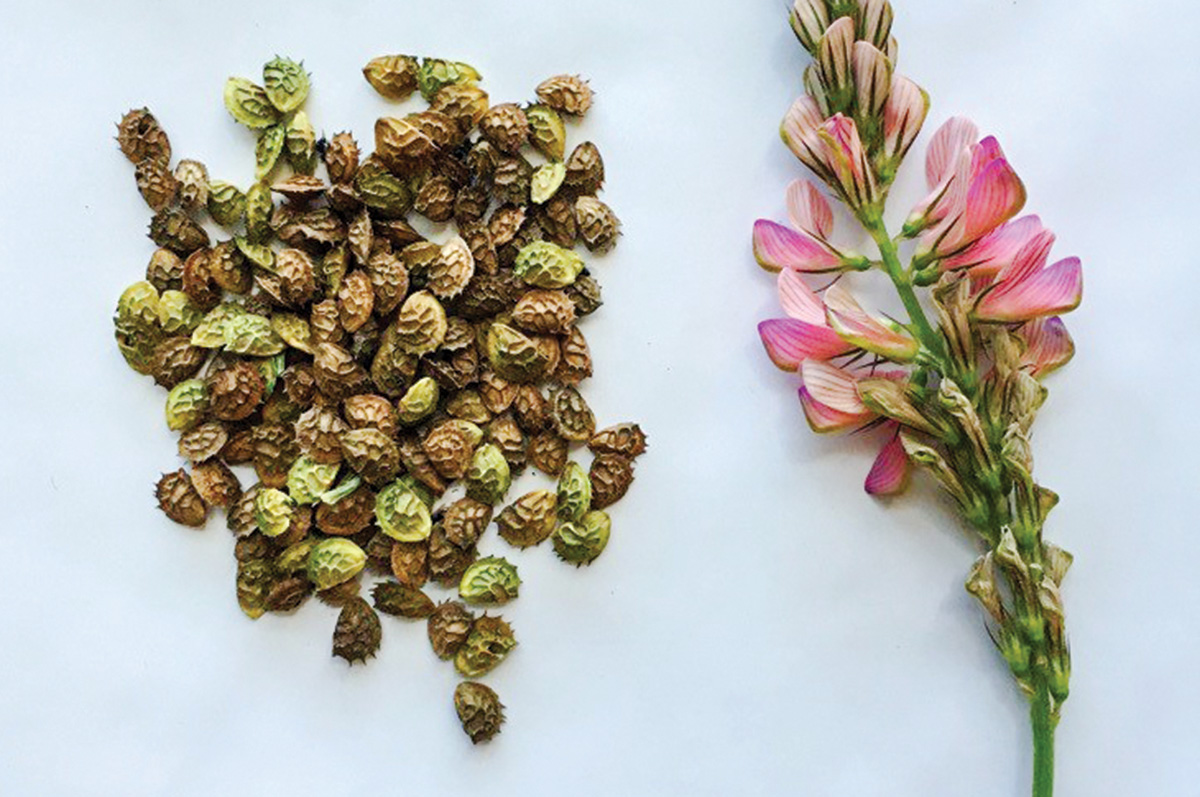
Sainfoin seed, which is significantly larger than alfalfa seed, and its pink bloom is pictured. Image by Surendra Bhattarai.
“If we can get enough support, there is a lot we can achieve. Sainfoin could be a very good alternative, and that’s why I am continuing sainfoin research here in Wyoming,” says Bhattarai.
In addition to the non-bloating benefits of sainfoin, it has high palatability, anthelmintic benefits and reduced methane emission, so there has been renewed interest in sainfoin cultivation. Traditionally, the main challenge is lower yield and lower stand persistence, compared to alfalfa; it doesn’t have the swift regrowth. Producers can’t get as many cuttings during a long growing season, compared to alfalfa.
“This is why sainfoin has not gotten a lot of attention in our region in Wyoming, but if you go farther north, such as Montana and the Dakotas, where you might only get two cuttings of alfalfa, this is a different situation," says Bhattarai. "I spent a lot of my time in Canada and we had a one- or two-cut system, even for alfalfa, and sainfoin is a good fit there. If forage scientists can improve the yield, regrowth and persistence of sainfoin, it would become highly valuable to more producers.”
He is excited about the use of sainfoin as an alternative forage legume in regions where alfalfa production has been challenged, because sainfoin is resistant to the alfalfa weevil. If the weevil is problematic, producers can use sainfoin and not compromise the quality of the forage.
“I'm working on several projects, including alfalfa research into winter survival and yield response of alfalfa varieties with different fall dormancy with different rates of phosphorus and potassium fertilizers," says Bhattarai. "Phosphorus and potassium nutrients are crucial for alfalfa. This experiment will look into alfalfa winter survival under different rates of phosphorus and potassium fertilizer.”
He adds that they are also trying to understand forage crop response to soil salinity, which is a major constraint on crop production in arid and semiarid regions worldwide. Salinity generally manifests in two forms: neutral salts and alkaline salts. Alkaline refers to carbonate and bicarbonate salts that increase soil pH, while neutral salts refer to chloride and sulfate salts that do not affect soil pH. Alkaline soil is very problematic in Wyoming, so they are looking at these forages’ response to neutral and alkaline salt in terms of germination and post-germination.
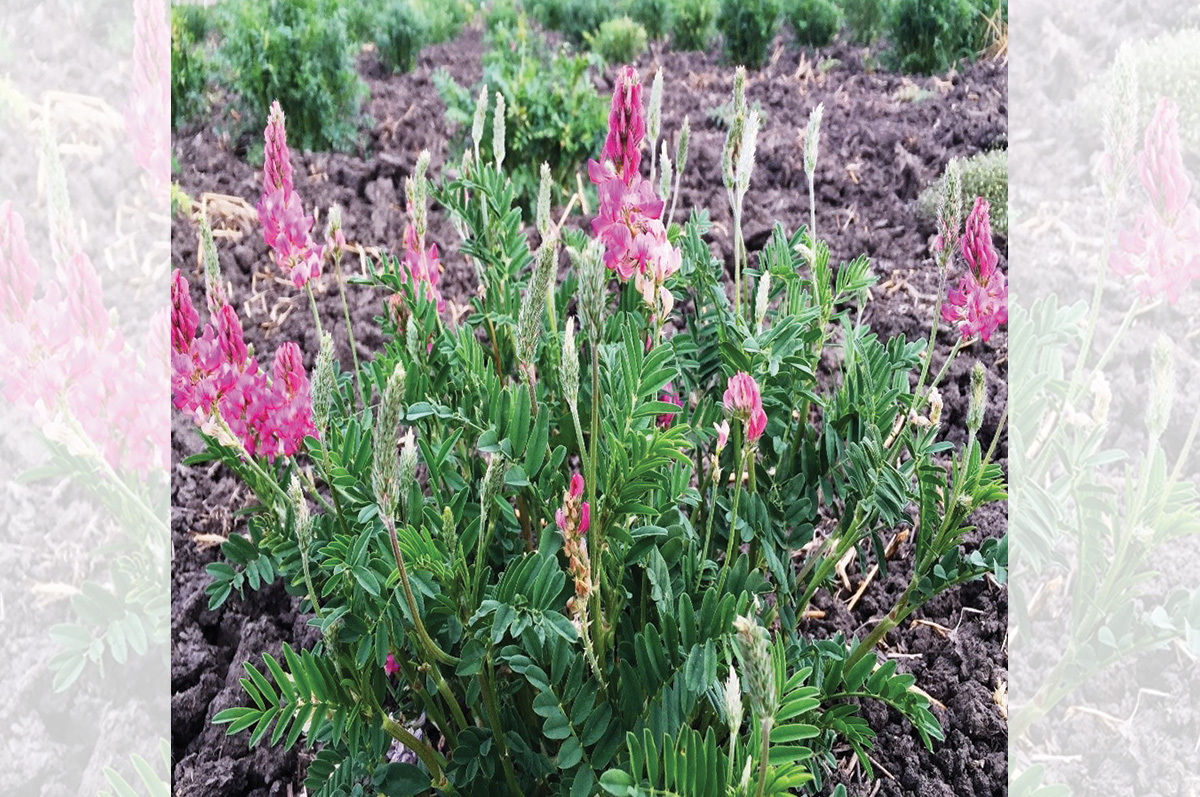
The reproductive stage of sainfoin marks the transition from vegetative growth to flowering and seed development. Image by Surendra Bhattarai.
They want to see if there are any management changes that they can make to address and achieve better establishment and higher yields in alkaline-stressed marginal land. Currently, forage research has funding challenges, but he is positive that he can continue to get good support for this research.
Bhattarai earned his master's and Ph.D. degrees at the University of Saskatchewan on sainfoin and alfalfa, where he learned a lot about forage breeding, and has been working with sainfoin for several years, focusing mainly on forage breeding.
One of his collaborative research projects with his mentor, Dr. Bill Biligetu at the University of Saskatchewan, Canada, focuses on reducing the cost of sainfoin cultivation. Sainfoin seed is very large compared to alfalfa seed. Forage seed producers are reluctant to use sainfoin because the seed size is so big; it costs more for seed than it does for alfalfa seed.
"One of my research projects in Canada was looking at ways we can reduce the seed size so it would be lower cost for seed producers, so they could incorporate sainfoin in their cultivation programs,” says Bhattarai. “In the future, I plan to continue work on forage agronomy and breeding for Wyoming and other semiarid regions in the western U.S. I hope to support the forage and livestock producers in Wyoming, focused on sustainable, profitable and resilient production of forage.”