Manure is the linchpin of biocircularity in dairy production systems, with the nutrients in cow manure recycled to the land to produce crops that are utilized as animal feed.

As herds grow and farms consolidate, this recycling can become challenging, both by the longer distances manure needs to be hauled or by the fact that there is more manure generated than acres to responsibly apply it to. These situations may necessitate advanced manure treatment systems that consolidate and partition manure nutrients to facilitate their transport or export from the farm. While still largely emerging practices, innovation and development over the last 10 years have started to make advanced manure treatments more feasible solutions for large, consolidated dairy farms.
Start with primary separation
Advanced manure treatments systems are typically implemented sequentially starting with solid-liquid separation. A screw press, the most common primary separation system used by dairy farmers for manure slurry (5% to 15% dry matter), can reduce manure slurry volume by 5% to 15% and capture around 45% of the total solids [15% to 20% of the total, organic and inorganic nitrogen (N), and 10% to 20% of the total phosphorus (P) and potassium]. This alone may be an adequate reduction in volume and nutrients for some farms and facilitate longer-distance pumping of separated liquids or hauling of separated solids. Separated solids can also be composted, which may facilitate their export to other farms or potential marketing to consumers. Sequential separation (e.g., belt press, centrifuge) can further improve removal efficiency, achieving closer to 60% solids capture and doubling the nutrient recovery.
Fine solids separation
If primary separation cannot adequately reduce manure volumes or partition nutrients to address the disconnect between herd size and land base, additional practices and technologies can be utilized to preferentially target P or N recovery. Phosphorus, which is typically found in dairy manure as insoluble calcium or magnesium salts, can be recovered using chemically enhanced fine solids separation, ultrafiltration, intentional struvite formation or biological removal. Intentional struvite formation and biological removal are not yet commercially feasible, due to dairy manure’s higher calcium than magnesium content, which limits struvite recovery, and the challenges of maintaining P-accumulating algal and bacterial cultures. However, chemically enhanced fine solids separation and ultrafiltration are increasingly feasible on large dairy farms.
Chemically enhanced fine solids separation uses a ferric coagulant and/or polymer to clump together and separate out P-rich fine suspended solids. While early systems using dissolved air flotation were large, energy-demanding and did not produce a reliably stackable nutrient-dense solid, newer and more efficient moving disk presses can generate stackable solids (25% dry matter) containing 85% to 95% of the influent P and organic N. Solids may be over 20 pounds per ton of organic N and 15 pounds per ton of phosphate equivalent, leaving a low-P “tea water” containing 10 to 15 pounds per 1,000 gallons of N and potash equivalents. The primary challenge to these systems remains the cost of the ferric coagulant and polymer, which for some farms may be as high as 25 cents per cow per day.
Ultrafiltration and phosphorus recovery
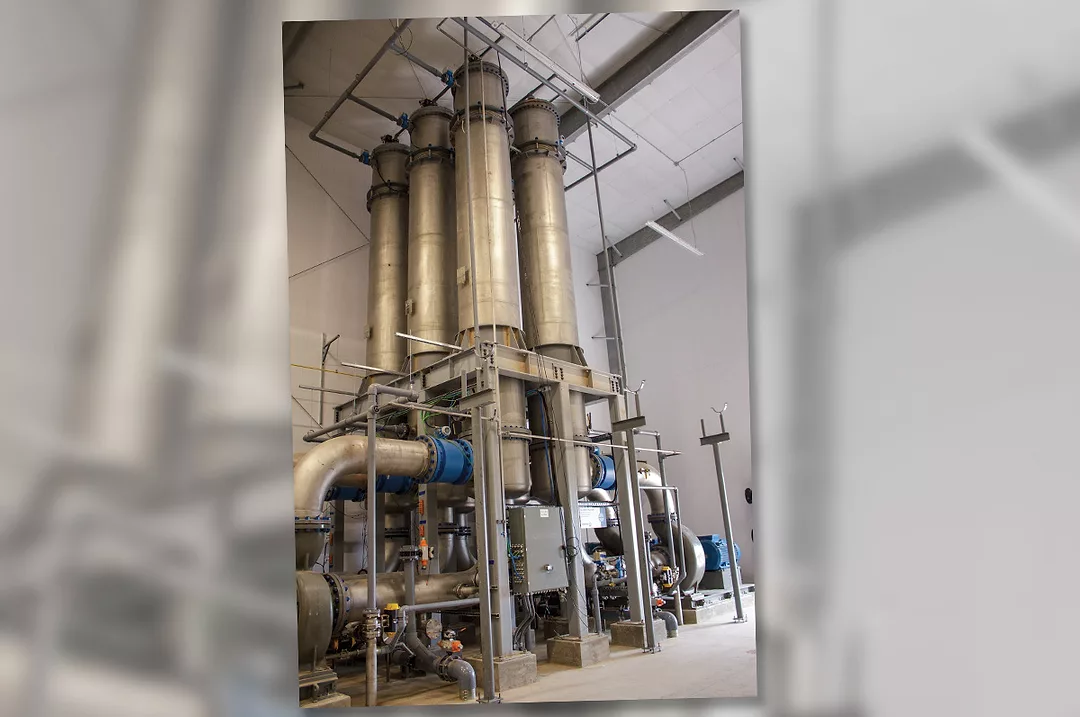
Ultrafiltration systems, where membranes are used to selectively remove P-rich fine solids, can reliably achieve 95% total P and 40% total N removal efficiencies. Select membranes can be used in-series to preferentially generate higher or lower P and N streams. The low solids and nutrient content of the final permeate also lend itself to treatment by reverse and forward osmosis, whereby clean water, approximately one-third of the original manure volume, can be generated for use on-farm or, in some cases, is permitted for discharge. Ultrafiltration is an energy-demanding treatment with substantial operating and maintenance costs currently feasible on dairy farms with herds in excess of 7,000 cows, though smaller herd installations are being explored.
Nitrogen recovery
Several approaches can also be used to target N recovery following P partitioning, though vermifiltration is the only current commercial, on-farm solution. In a vermifiltration system, low solids manure is trickled through a passive bed reactor with layers of wood shavings, composting worms, castings and other porous media. Nutrients are sequestered in worm castings as liquids are polished. Capable of capturing over 85% of N and P, vermifiltration has a large footprint, requires careful management and, due to its dependence on worms, may be best suited for dairy production regions of the country, like California’s Central Valley. Although, systems are being trialed as far north as Washington state. Other strategies like biological conversion of ammonium and nitrate to atmospheric nitrogen gas, or ammonia stripping where pH shifts are used on high-ammonium post-digested manure to volatilize and then capture ammonia in an aqueous stream, have not been deployed commercially, though pilot studies are promising.
The Varcor system, which heat treats and dries manure solids, volatilizes then separately concentrates ammonia and condenses clean water, is another technology to watch. While it has performed well in municipal wastewater applications, only a couple of our country’s largest herds are exploring the system and performances have so far been mixed.
Plan before you invest
Investment in advanced manure systems can be substantial, and careful assessment of your need and ability to purchase, maintain and manage these systems is essential. All advanced manure treatment systems require primary separation pretreatment and thoughtful integration with the current farm manure system. They have an energy demand and often require three-phase power. Consideration must also be given to the handling and storage of new manure streams, how these can be utilized on-farm or what their marketability is off-farm. Explore the vendors offering these technologies, visit farms using them and discuss with your advisers the fit of these technologies to your farm, and if they will in fact address your consolidation challenges and needs to transport and export manure nutrients. The Newtrient Solutions Catalog is a helpful resource to learn about the many options available today for manure treatment.