Advancements in technology are the fuel behind every leap in dairy efficiency. Bigger planters cover more acres in fewer passes, smarter harvesters bring in crops with less labor and less fuel, modern parlors milk more cows per hour with fewer steps. And just like the machines in the field and the barn, today’s cows carry more power under the hood than cows of a decade ago – more milk, better fertility and stronger resistance to disease.
But there is a catch:
“In the future, it’s not enough just to get more efficient. Dairies will win by speeding up how fast they gain efficiency. That’s where genomics changes the game,” says Kelsey Luebbe, technical services scientist with Neogen. “By identifying each calf’s true potential on day one, genomics helps dairies stack the deck with the right replacements and accelerate the rate of progress across the whole herd.”
The impact of genomics isn’t just theory; it shows up clearly in the numbers. A look at Figure 1 shows how Net Merit Dollars (NM$) has shifted in the Holstein bull population since genomic testing became mainstream.

“Before genomics, genetic progress in Holsteins advanced at a measured pace, with Net Merit gains creeping along at just 5 dollars to 38 dollars per year. After genomics entered the picture, those gains jumped to 66 dollars to 88 dollars per year – a two- to tenfold increase in the pace of improvement,” says Victor Pedrosa, technical director of genomics innovation with Neogen. “In practical terms, today’s replacement heifers are making in one generation the kind of progress that used to take two or three. Cumulatively, that acceleration has added more than 1,100 dollars in Net Merit since 2000 – value that translates directly into greater lifetime profitability for the nation’s dairy herds.”
Accelerating genetic progress through genomic testing of females
Sustaining faster genetic improvement of replacement animals depends not only on sire selection but also on fully leveraging the female side of the genetic equation.
“Genomic testing of heifers provides the opportunity to identify elite females early, long before they contribute to the next generation,” Luebbe explains. “This allows producers to make more strategic breeding and culling decisions, using the very best females as dams of future replacements, accelerating genetic advancement within the herd. By recognizing that half of the genetic progress comes from the cow side, dairy operations can capture additional gains in fertility, health and longevity traits, ensuring that rapid improvement in Net Merit translates into both profitability and sustainability for the herd.”
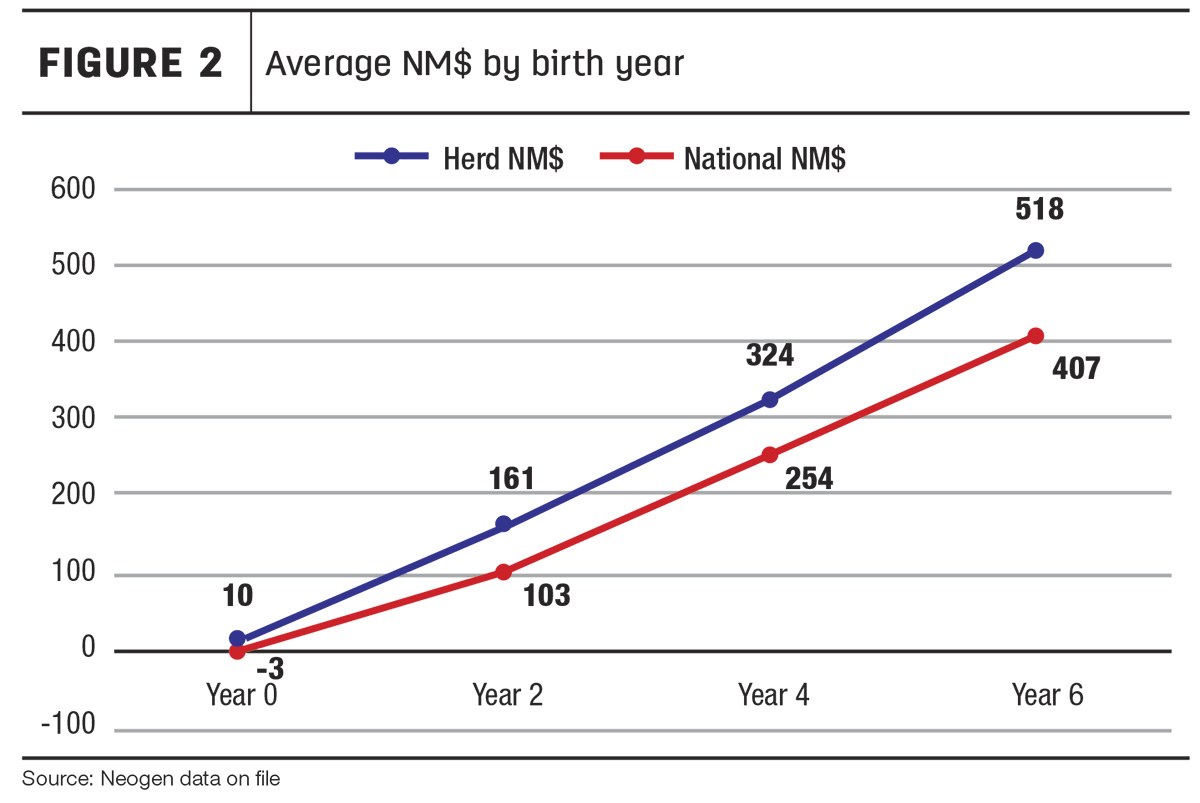
Figure 2 compares the average NM$ improvement of calves from a Midwest farm that implemented genomic testing against the U.S. national average for Holstein females across the same period. For the farm, the average NM$ gain improved from $75.50 per year (Year 0 to Year 2) to $97 per year (Year 4 to Year 6). Strategic breeding based on genomic results from the approximately 7,000 Holstein females born each year in this herd allowed them to not only improve their genetics but also increase the rate at which they are improving their genetics.
Improving breeding accuracy with genomic insight
The utility of genomic results on dairy females is found in the ability to increase the reliability of strategic breeding decisions. Decisions left to chance or based on inaccurate information can detract from a herd’s ability to make genetic improvement. Identification assignments at birth, artificial insemination and data entry into recordkeeping systems are all subject to human error. These errors can lead to certain dairy females being overvalued or undervalued as replacements if the parents on record are used to estimate their genetic potential. Through genomic testing, parentage errors can be discovered and corrected.
“Accurate pedigree information aids in the management of inbreeding, representing yet another sustainable advantage of genomics, which allows selection decisions to be made with greater precision and profitability,” Pedrosa adds.
Even in cases where correct parents are identified, using parent averages to assess genetic potential creates a low-resolution view. Figure 3 shows the genomic results for NM$ compared to parent average for NM$ for 14 half-siblings (sired by the same bull) born in 2024 on a Midwest dairy.
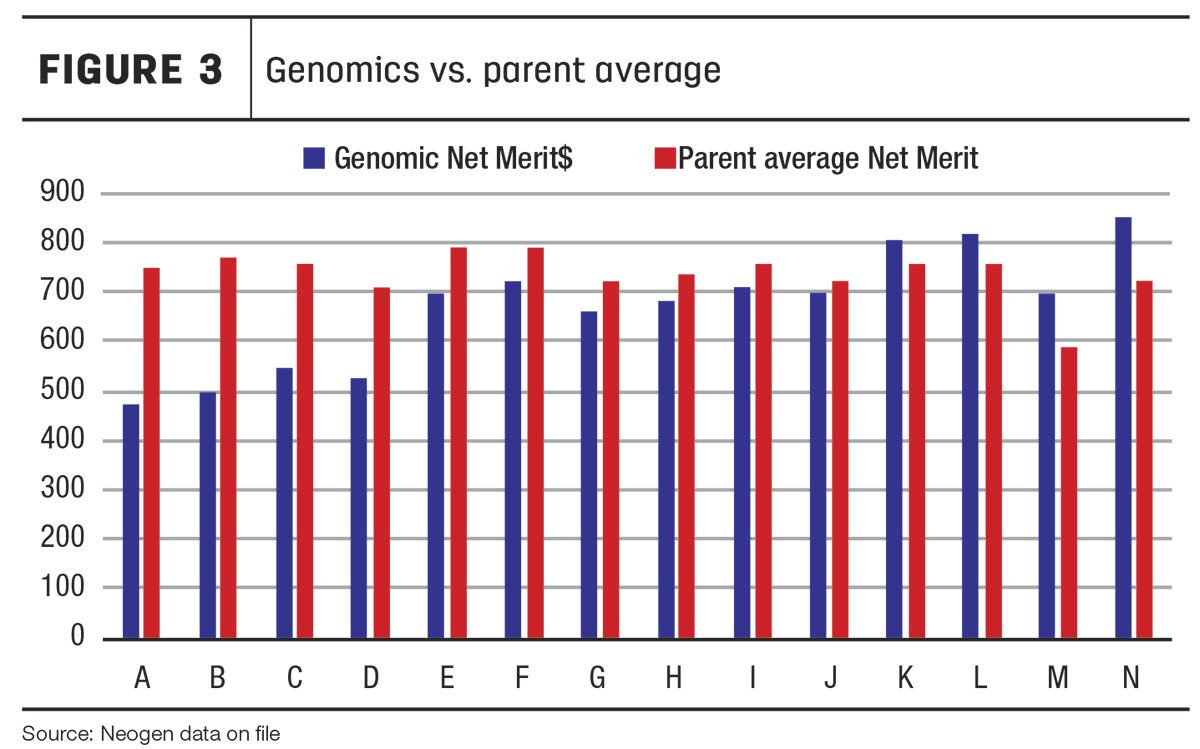
When looking at the parent averages for these 14 heifer calves, there is limited variation in the NM$ values. All but one are in the range of $700 to $800. If parent average were to be used in breeding and selection decisions, it would be likely that a similar strategy would be applied to most or all of them.
With the increased reliability of genomic results, more variation in the genetic potential for this group of animals is detected. The value of genomics is indicated by looking at Heifer A and Heifer N. The difference in parent average NM$ is modest at $23, but genomic results reveal a $380 difference. Even among half-siblings, the genetic value they bring to a dairy operation varies greatly. Genomic testing provides a high-definition view of the actual differences in genetic potential. These insights allow producers to confidently select and breed the next generation of dairy cattle that will perform at a higher level.
The use of technology to drive efficiency is the cornerstone of today’s dairy industry. Genomic technology improves the ability to enhance efficiency by accurately diagnosing differences in genetic potential. With this knowledge, dairy producers can maximize improvement from one generation to the next and secure a more successful future for their operations.