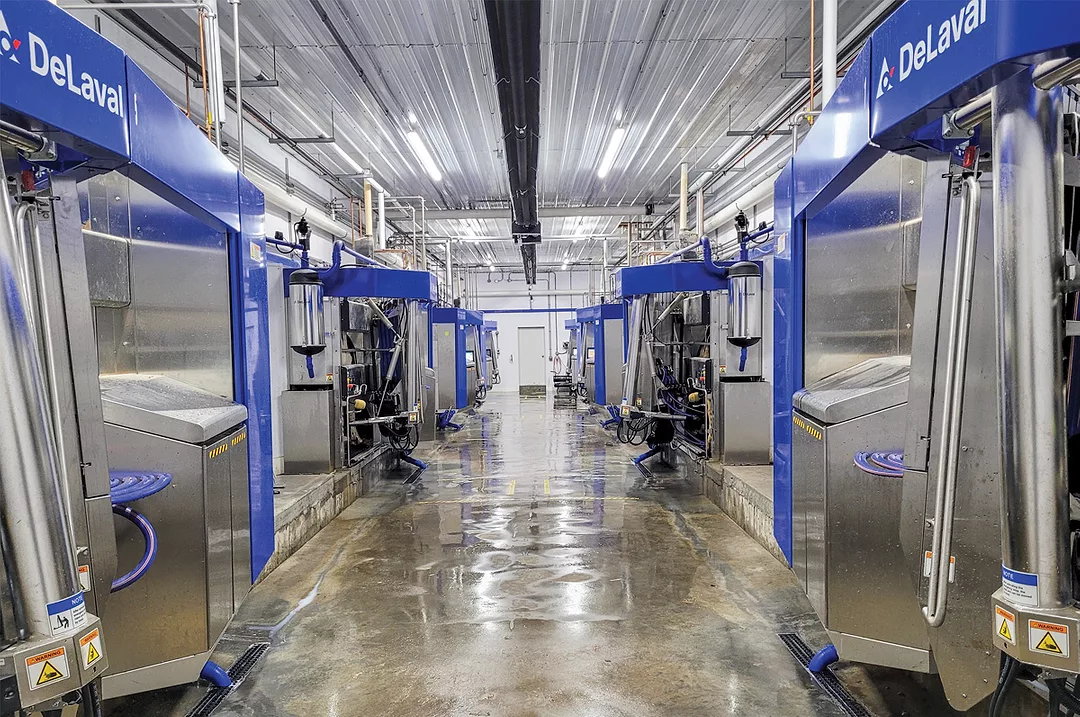
The first automated milking system in North America came online in Ontario, Canada, in March of 1999. The first system in the U.S. followed over a year later in Wisconsin in July of 2000. Those early adopters had a lot of things to figure out on their own. There was not a lot of experience to draw on. Success required an adaptation mindset – a mindset that was anxious to learn, questioned everything and always looked for a better way. Twenty-five years later, we are still learning new things and finding new ways to work with automated milking technology. An adaptation mindset is still the key to automated milking success.

Six automated milking dairies share their success stories here. Each of them have that adaptation mindset. All of them identify net profit as an important measure of success, and most of them consider total milk sold and milk per cow to be key drivers of net profit. They each credit many of the same things that helped them to achieve high milk per cow. Each of their stories highlights a specific strength that successful automated milking dairies have in common.
Feed management
Homestead Dairy is one of the largest automated milking dairies in the U.S. Brian Houin and his extended family own and operate this 36-unit barn near Plymouth, Indiana. The farm also milks in parlors with a total of about 4,800 head. Quality feed has always been important at Homestead. They recently raised the bar with a fully automated feed mixing system. Ingredients are automatically weighed into a stationary mixer and delivered to the pen with a truck. The system has improved mixing accuracy to the point that intake is so uniform that batches are adjusted weekly rather than daily. In another effort to constantly improve and try new things, Homestead Dairy switched to feeding high-oleic soybeans in the milking robots. Pellets worked well, but they made the switch to see if they can increase production and improve their return on investment. Accurate and consistent feed management is a key to success at Homestead Dairy.
The right cows
Kyle Zwieg and his wife, Rachel, own and operate Zwieg’s Maple Acres near Ixonia, Wisconsin. They have a one-unit barn and they raise about 2,000 acres of cash crops. The single robot is one of the highest-producing units in the world. Milking the right cows is an important part of high production per robot. Zwieg says you have to make the cows fit the system, not the system fit the cows. He has created a cow-friendly system focused on health, cow comfort and top-quality feed, but if a cow does not thrive in that system, she will be replaced. There are no favorites. Zwieg also stresses maintaining the equipment for top-notch performance. He says, “You can spend time before the problem, or deal with the problem, but you have to spend the time.” Automated milking cows and well-maintained equipment combine for a milking duration that averages well under six minutes at about 35 pounds per milking.
Effective labor management
JTP Farms is located near Dorchester, Wisconsin, and owned by Jake Peissig and his wife, Tolea. The dairy has nine milking robots. Peissig has been milking with robots for 15 years, and his barn was among the first guided-flow barns to use toll-booth configuration. When cows leave the robots, they are directed to the feedbunk. The original barn had one robot per pen, but Peissig was among the first to add another robot to each pen and increase stocking density. Automated milking allows Peissig to staff the barn with several part-time employees and give them a flexible work schedule. His automated TMR feeding system creates even more flexibility. One person can run the barn alone on the weekends. Peissig is maximizing the milk shipped and controlling cost while keeping the barn full and managing labor effectively.
Maximizing milk sold
Sam Schwartz manages Rolinda Dairy, together with co-owner Pat Reisinger. They focus on maximizing milk per cow and total milk sold. Located in Waterville, Iowa, the barn includes 15 milking robots. The barn was built in 2020 with eight robots in four pens. Three of the pens got an additional robot in 2022. Then Reisinger and Schwartz visited JTP Farms, and another robot was added to each pen in 2025. The extra milking robots allow the cows more opportunities to be milked. They also create flexibility to keep the barn moving during maintenance or downtime. Maintaining cow comfort is essential with higher stocking density per stall. Stalls are groomed three times per week, and bedding is added weekly. Extra robot capacity allows extra opportunities for every cow to be milked as needed and maximizes milk per cow and total milk sold.
Effective use of data
Everyone agrees that automated milking systems generate a lot of data. Four Cubs Dairy in Grantsburg, Wisconsin, is owned by Gary, Chris and Ben Petersen. Their dairy herd manager, Nathan Brandt, says the data should be used to “compare yourself to the best – don’t get comfortable.” They share benchmarks with a peer group, and their goal is to be in the top 1% for profit per cow. They subscribe to a software platform that summarizes data from the milking robots, herd management software, genomic testing, feeding system, milk plant and even the weather, for better decision-making. Those records allow them to account for every detail and project confidently so that they can position themselves to stay profitable.
Facility design
Heeg Brothers Dairy added an automated milking barn to their farm near Colby, Wisconsin, in 2023. The farm is operated by Jay, Mark, Gary, Nate and Corey. The eight-unit barn is designed to work efficiently for cows and people. Jay Heeg says the goal was to set cows up for success. The special-needs pens allow cows to flow through the system without interference. Cows are automatically sorted to the special-needs pen for most management activities. New heifers are trained in the special pen for the first five milkings. Heeg says he believes that the barn flows best when the people stay out of the way. The guided-flow traffic system allows the barn to operate without feed in the robots. Cows come to the sort gate to get to the feedbunk. If they need to be milked, the sort gate sends them to the robot before they go to the feedbunk. The facility is designed so efficiently that the herd and automated milking management tasks for 480 cows take an average of 12 hours of labor per day.
These dairies demonstrate how feed management, the right cows, labor management, maximizing milk sold, effective use of data and facility design contribute to successful automated milking. While some of the examples involve cutting-edge technology and specialized facilities, it is possible to improve in each of these areas without those investments. The real key is an adaptation mindset to find the opportunities, as demonstrated by the management teams on each of these dairies.