In 1939, a young graduate student arrived late for class in Berkeley, California. Scratched on the dusty, gray chalkboard was a jumbled amalgamation of cryptic letters and numbers representing two complex, incomplete statistical theorems. Assuming this to be his homework, he returned the completed problems to his professor a few days later. What he didn’t know at the time was that these were two of the most famous, perplexing and previously unsolved problems in all of statistics.

George Dantzig, today known as the “Father of Linear Programming,” took leave from the doctoral program at Berkeley to serve as a combat analyst for the Army Air Forces after the U.S. entered World War II in 1941. With his efforts for the Air Forces, Dantzig advanced the mathematical model known as linear programming (LP), which functions to maximize (or minimize) an outcome given finite resources and requirements.
In the case of combat analytics in WWII, Dantzig used linear programing to optimize spending and logistics with the goal of reducing costs to the army and increasing losses to the enemy. Eighty-four years later, Dantzig’s work continues to be applied in a variety of industries and functions, including ration balancing for dairy cattle.
Linear programming for dairy cattle
Rather than optimizing for .50 caliber munition distribution for P-47 Thunderbolts, dairy nutritionists utilize LP to minimize cost, while maximizing milk production potential, with the ideal combination of ingredients. The foundation of dairy cattle nutrition, and nutrition in general, is that nutrient requirements have been identified and are continually fine-tuned based on new research and discoveries. Given a set of nutrient requirements and a list of ingredients with known nutrient profiles and value, nutritionists may leverage LP to derive the most cost-effective combination of ingredients to supply these desired nutrients. This practice is often referred to as “least-cost formulation.”
Now, hang in with me here, as we are about to get a little math-y. Linear programming gets its name from the fact that a list of requirements are represented as linear relationships. For example, if a cow consumes a maximum of 55 pounds of dry matter, and I increase one ingredient in her ration, another must go down to keep the total pounds constant; this trade-off can be represented as a linear relationship. In dairy nutrition, pounds of various ingredients are used to meet nutrient requirements, such as protein and starch, through linear constraints like dry matter intake (DMI) in the example above. Constraints may also be added to specific ingredients and nutrients. Often, the more requirements we add to the model, the more constrained it becomes, reducing flexibility and increasing ration cost. It’s the job of the nutritionist to determine these constraints, given what he or she knows about an individual operation, such as breed, size and performance of the cattle, and availability and costs of forages, commodities, minerals, etc. With further qualitative observations gathered by the nutritionist, such as manure consistency, cud chewing and body condition, they fine-tune their requirements to further improve the effectiveness of the ration, derived at least cost via the linear program.
All of the major ration balancing software platforms available today, including NDS Professional, Agricultural Modeling and Training Systems (AMTS) and Ration Balancer (formerly Dalex), come equipped with a ration optimizer that uses LP algorithms. Using LP in ration-balancing software can be difficult and frustrating to learn, but it is a valuable tool in the proverbial “nutritionist toolbox.” Not all rations need to be balanced with LP, but its targeted application provides powerful insights for decision-making, such as with the use of “shadow pricing.”
Shadow pricing
When I first heard the term shadow pricing, I contextually intuited the definition by imagining the following scene: In the depths of a dingy back alley, a hooded stranger proffered his unholy wares – his face shaded from the oppressive orange glow of a polluted metropolis, the black market shadow prices were revealed upon his foul breath. Turns out I was wrong. What shadow pricing actually refers to is a potent metric that may be calculated as a component of LP; if an ingredient was not selected for use in the linear optimization, the lower price at which it would have been used is referred to as the shadow price. Accordingly, using shadow pricing can be very insightful when trying to make a value determination between certain ingredients. Better yet, shadow prices take into account the exact context in which an ingredient is being evaluated for, i.e., the constraints on the model and the value of the other available ingredients. Shadow pricing allows us to determine whether or not something is a good buy based on the specific criteria of the situation.
Least cost vs. best cost
When rations are optimized, nutritionists and dairy producers alike need to be careful not to fall into the trap of least cost over best cost. Let’s look at a simple example to illustrate my point.
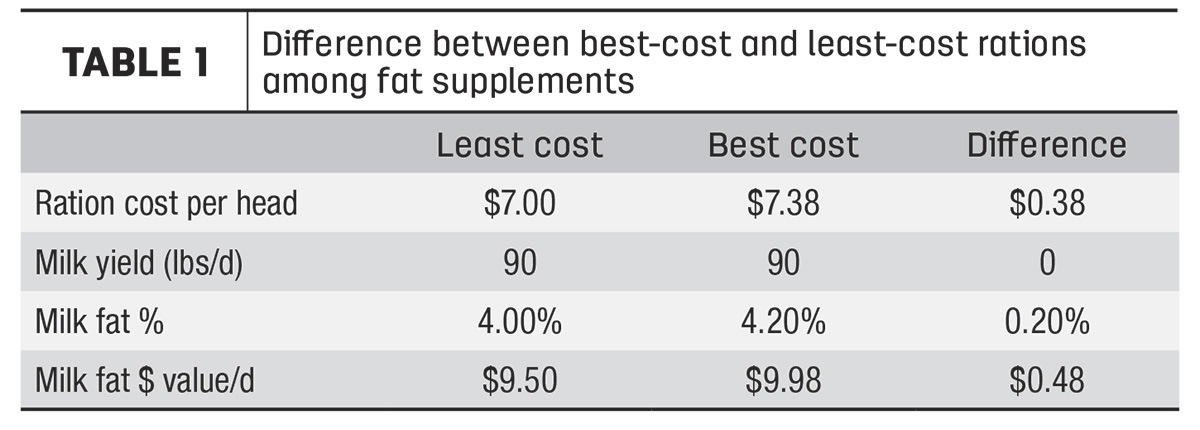
I stroll into your office and present you with a solid ration. I’ve taken the time to meet essential nutrient requirements and operated within the constraints of forage inventory – a perfect linear optimization of which George Dantzig would be proud. This ration costs $7 per head per day and will theoretically yield 90 pounds of milk. You interrupt my nutritive pontification, reminding me of a recent conference we attended where we learned about modern approaches to fat supplementation strategies. “Heavens to Betsy!” I exclaim, “that will add 38 cents per head per day to my least-cost ration!” However, we can anticipate a 0.2% unit increase in butterfat. Assuming a fat price of around $2.64 per pound, we gross an additional 48 cents per head on the milk, equating to a net improvement of 10 cents per head (despite the more expensive ration).
The moral of the story is that the cheapest ration is not always the most economically advantageous, and making strategic investments with probable and significant return on investment will increase profit. Further, as shown in Table 1, LP could help us determine the best cost among fat supplements, for example, to supply specific fatty acids to satisfy our supplementation strategy.
Why not LP?
If you’ve made it this far through the article, you’re an astute and ambitious reader of Progressive Dairy. Congratulations! LP may seem like nuanced, nebulous, technical jargon, and quite frankly, it is. Notwithstanding, LP is an incredible mathematical tool that should not be overlooked for use in nutrition balancing. I’d like to leave you with an example Dantzig himself laid out to explain the power of LP.
Imagine you were tasked with assigning 70 people to the best of 70 available jobs. If you were to look through all of the potential combinations of assignments, the total would exceed the estimated number of particles in the known universe, which would be computationally impossible for modern computers using a brute-force approach. However, if we apply LP, the best solution is solved in a matter of moments. Why not leverage LP for balancing dairy rations?
This article is dedicated to the memory of my great uncle, Col. Robert F. Hemphill, my middle namesake, who flew a P-47 fighter in the Pacific Theater, WWII.