It was a year of mixed dairy numbers in 2024. Milk prices and income margins improved from 2023, but total milk production and average cow numbers were down from a year earlier. With fewer dairy cows and heifers, prices for replacements set new record highs. Attrition and consolidation remained a long‑term trend among U.S. dairy farms licensed to sell milk.

U.S. milk production
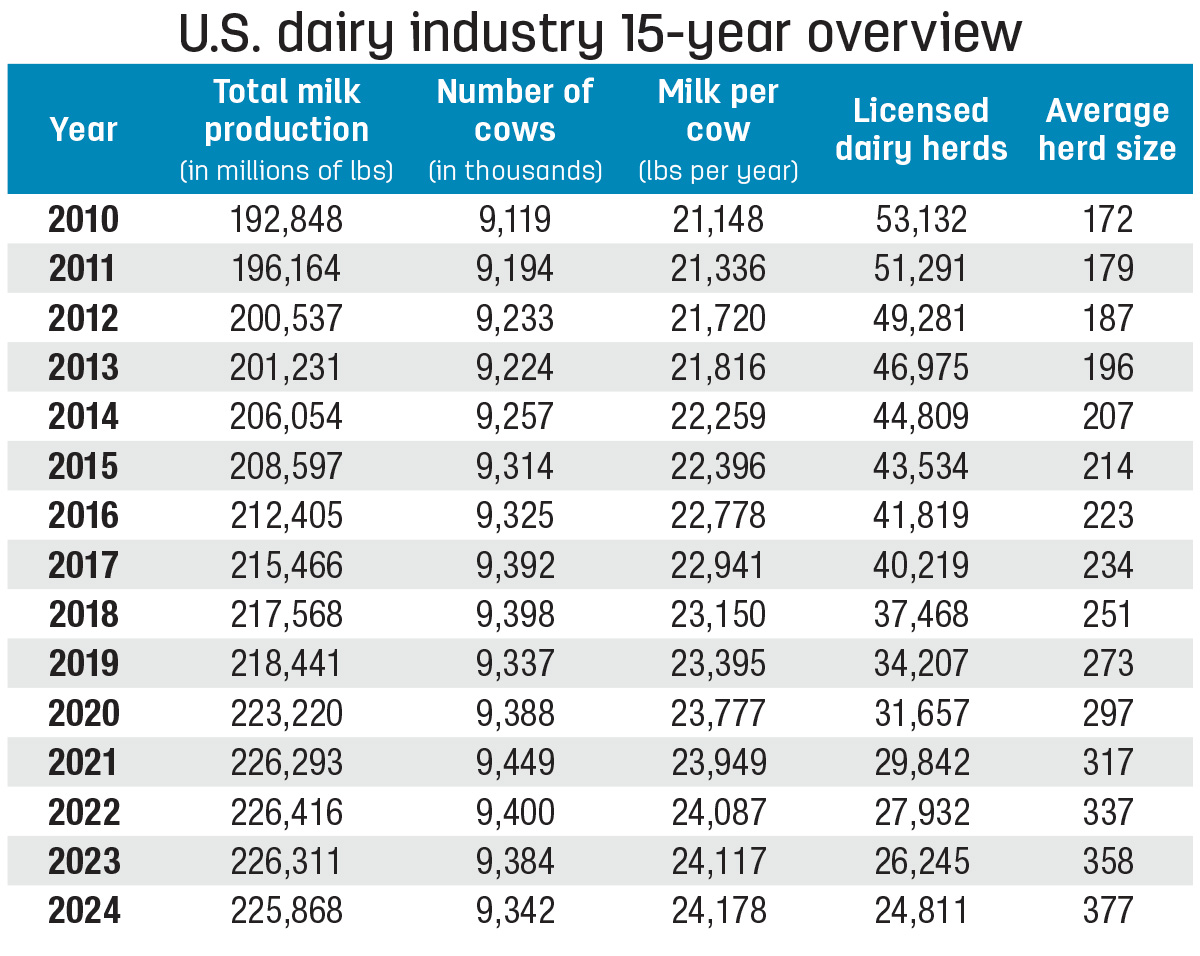
U.S. milk production fell to 225.868 billion pounds in 2024, down 443 million pounds from 2023. Annual milk production had exceeded year-earlier totals for most of the past quarter-century, down only in 2001, 2009 and 2023.
Seventeen states registered annual milk production increases during 2024, led by Texas and South Dakota. Offsetting those gains, 28 states yielded production declines compared with 2022, led by New Mexico and California.
State ranking
Based on annual milk production, there were several minor changes in major dairy state rankings compared to 2023. Texas moved ahead of Idaho at 3-4. Washington and Iowa moved ahead to 9 and 10, respectively, while New Mexico fell two positions to 11. South Dakota moved ahead to 14 while Arizona and Indiana fell to 15 and 16, respectively. Vermont moved ahead of Oregon at 18-19, and Florida moved ahead of Georgia at 21-22.
Licensed herds
In another year of attrition and consolidation, the annual average number of dairy farms commercially licensed to sell milk fell to 24,811, a decline of 1,434 (about 5%) from the year before and down about 20,533 (45%) since 2014.
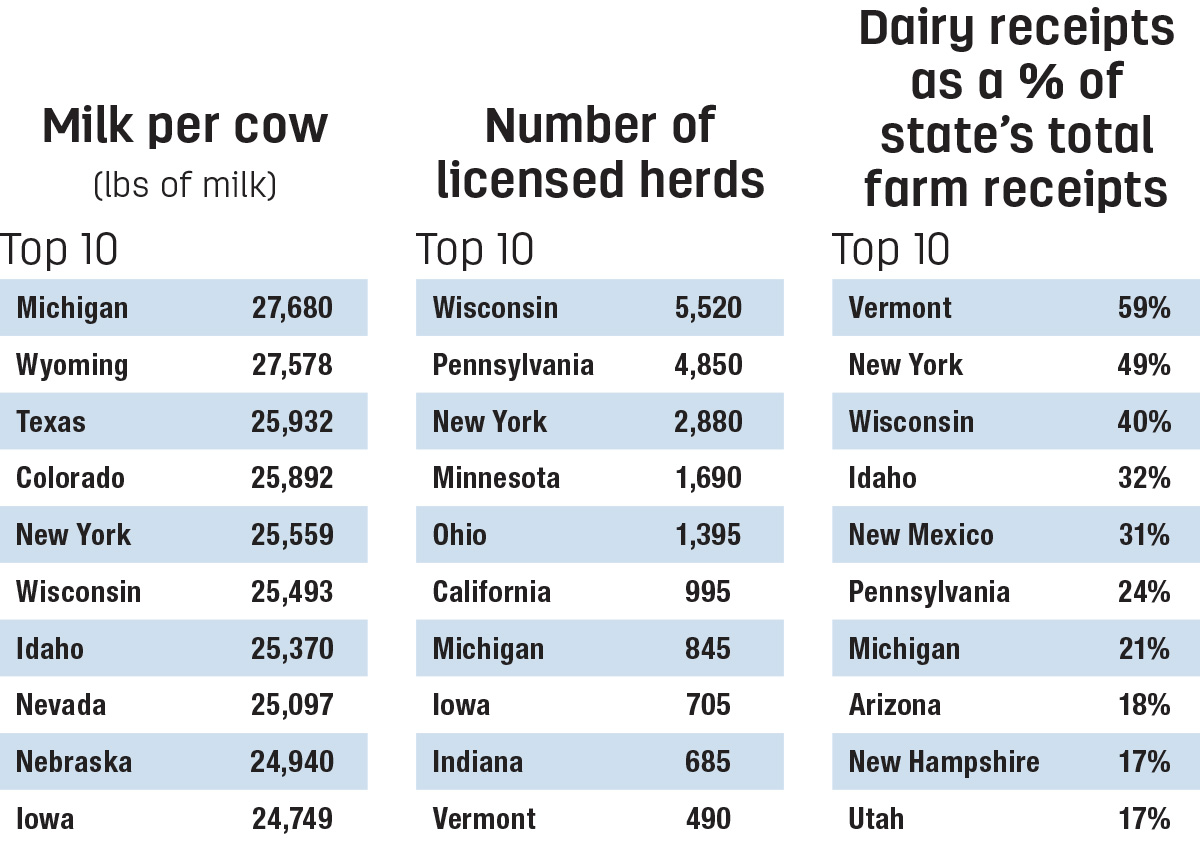
On a percentage basis, year-over-year declines were fairly steady across the U.S., but 86% of the decline in herd numbers occurred in the Midwest and East regions. Wisconsin remains the nation’s leader in the number of herds, at 5,520, but declined by 400 in 2024. Herd numbers were down a combined 315 in Minnesota and New York, and down 90 in Pennsylvania.
Cow numbers
The U.S. cow herd averaged 9.342 million cows in 2024, down 42,000 head from 2023’s average. Seemingly, it was a year of almost quarterly swings in cow numbers, with month-to-month growth in January-March and again in July-October, followed by declines in April-June and again in November-December.
Ten states increased cow numbers in 2024, but almost two-thirds of the total increase came in just two states, South Dakota and Texas.
Twenty-eight states had fewer cows than the year before, with 10 others unchanged. Largest declines were in New Mexico (-31,000), Minnesota (-8,000) and California (-6,000).
California remains the national leader in cow numbers, with 1.708 million head, followed by Wisconsin, with 1.269 million head.
Herd size
The national average dairy herd size grew to 377 cows in 2024, up 19 cows (5.3%) from 2023. The Northwest showed the largest increase, up 127 head, while the Southwest held claim to the largest average herd size, at 1,868 head.
The largest herds were in Arizona, which averaged 2,743 cows, a 103-cow increase from 2023. Florida recorded the largest increases from the year before, up 436.
Dairy herds averaged more than 2,000 head in five states (Arizona, New Mexico, Texas, Florida and Colorado) and more than 1,000 head in seven others. The size of Midwest herds grew by an average of 7.49%, reaching 298 cows per herd.
Milk per cow
The national average annual milk production per cow increased just 0.3%, up 61 pounds in 2024 to 24,178 pounds.
See the poster with the full year's stats here.