We often go to great extremes to do the best for our animals. We build enormous barns, we manage top-notch pastures, we feed tasty grain supplements, we give medicines and vaccines, and we provide minerals and vitamins. And sometimes our well‑meaning efforts get us into nutritional hot water, especially concerning minerals and vitamins. Actually, more often than you would imagine. Perhaps the most common problem is something that I call “double trouble.”

The basic principle of minerals and vitamins is quite simple: Livestock should get enough of them each day. Because only some minerals and vitamins are stored effectively in the body, our best strategy is to give them access to a mineral mixture daily – either free-choice or in prepackaged amounts – and assume that the mixture takes care of their needs. There is not enough room in this article to go into details about individual minerals, but there is a common belief among some folks that our livestock have some sort of internal “nutritional wisdom” about minerals and vitamins.
Let me say this unambiguously: With one important exception, livestock do not have nutritional wisdom to choose minerals and vitamins properly. If offered a selection of trays, cafeteria-style, each containing an individual mineral, our animals would not select what they need in the correct amounts. In fact, since many mineral compounds are quite unpalatable, animals will stubbornly avoid those trays, even when they are dying of those mineral deficiencies.
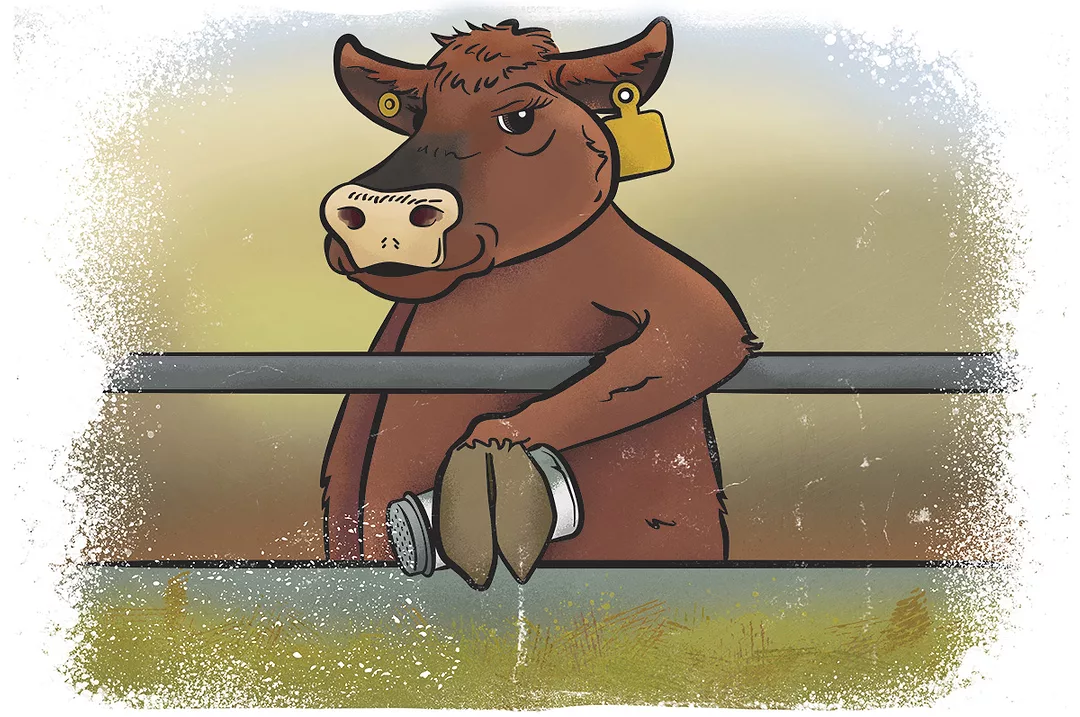
The one clear exception is white salt – which means old-fashioned sodium chloride. In fact, “salt” is the official and legal feed tag name for sodium chloride. Livestock obviously relish salt. They seek it out when they need it, and they won’t overconsume it to toxicity as long as they drink enough water to excrete the excess. The feed industry universally recognizes this feature, and companies mix salt with other less palatable minerals (and vitamins and drugs), selling the product as a trace mineral (TM) mixture. The percentage of salt in this mixture is not as critical as you might think. I’ve seen successful TM mixtures with salt levels ranging from 4% up to 96%. Each company formulates its own recipes, and each mineral recipe is carefully designed for a specific expected level of intake. In any case, the underlying concept for these TM mixtures is that salt is the driving force of the mineral intake.
And this creates the double trouble problem. If you offer animals two or more sources of salt (the “double” in “double trouble”), what will happen to the intake of your main TM mixture? Either a) mineral intake will go down, or b) mineral intake will become more variable – either over time (some days very little, some days very high) or within the herd or flock (individual animals responding differently to these choices). Or all of the above. You will have lost control of your mineral intake. And if you depend on that TM mixture to provide specific dosages of critical minerals like selenium or drugs or other antibiotics, what will happen to the dosages of those ingredients? The dosages will decrease or become more variable, which will increase the risks of mineral deficiencies, reduce drug effectiveness and increase microbial resistance to drugs.
Now, let’s talk about some double trouble scenarios that occur on farms and ranches in the real world.
The most obvious scenario is to feed extra white salt. Yes, some people do this because they think 1) their TM mixture doesn’t contain enough (or any) salt, 2) to save money (“Hey, my animals eat less of that expensive mineral when I offer white salt!”), or 3) they have simply heard that white salt is a good thing. A variation of this scenario is to offer three or four or even more mineral mixtures, “just to make sure.”
One quick cure for this problem is to read the feed tag of the original TM mixture. If the feed tag specifically gives directions to feed white salt, then of course follow the directions. But if there are no such directions, study the list of ingredients. If you see the term “salt,” then you know that the feed company has already included sodium chloride in its original mixture, and you don’t have to supply any additional salt. But if you feed extra white salt to reduce the intake of those minerals, you actually dilute the intake of the original mineral mixture, and you defeat the goals of the company nutritionists and expose your animals to all those health risks. And if you offer three or four different mineral mixtures at the same time, mineral nutrition really becomes a tangled mess.
Another double trouble scenario occurs when some folks routinely feed a grain or protein supplement. Sometimes this supplementation is necessary for production, sometimes not. But in either case, look at the feed tag of that supplement. Straight corn or oats or other grain don’t contain salt, but a commercially prepared grain mixture may. Grain mixtures are always very palatable. If animals eat 1 pound of a yummy supplement that contains salt, they’re also consuming that extra salt. Again, how will this affect the consumption of your free-choice TM mixture? Many times, I have visited a ranch where the owner proudly shows me how he feeds a little of this, a little of that, a scoop of this other stuff, and also a cupful of a special mix from that bag in the corner. Oh my.
Another variation: Do you use a lick tank to provide extra energy or protein? A lick tank usually contains molasses and urea and perhaps some other ingredients or drugs. But you should read the label; does it also contain salt?
Here’s something that may be a specialty of my native Pacific Northwest (although I suspect it is used elsewhere): salted hay. On the west side of the Cascade Mountains, we sometimes get a bit of rain during the hay-making season. (That’s a joke. We always get rain during the hay-making season.) Sometimes the square bales are too wet to stack safely in the barn, so we do this: After laying down a layer of damp hay bales in the barn, we generously sprinkle white salt on top of that layer. We do this for each layer of hay. Our hope, of course, is that the salt will draw enough moisture out of the bales to prevent the barn from exploding in flame. The existence of ancient barns in the Pacific Northwest is kind of a backhanded proof that this technique works. But a secondary result of this technique is that the hay contains salt. When that hay is fed months or years later, folks may have long forgotten about the salt, but soon the animals begin suffering from unexpected mineral deficiencies. Double trouble, again.
Here’s another interesting double trouble scenario: the ocean. It’s a big world out there, with more than 70% of it covered in water. Salt water. All along the coastlines of North America, fields are exposed to ocean fog, spray and wind. When I work near the ocean, I like to take a grab sample of the growing forage and analyze it for minerals, especially sodium. I generally expect to see background sodium levels lower than 0.2%, dry matter basis. A sodium level higher than 0.4% is a red flag. Salt in growing grass is still salt, and it’s something to watch.
This double trouble theme has nearly endless variations, such as salt licks, bloat blocks, high-salt streams, etc. But once we identify the problem, what can we do about it? Some scenarios are quite easy to fix. For example, it’s easy to stop feeding the extra bag of white salt. But what about those situations where we can’t easily eliminate the second source of salt?
Let’s return to the original concept of TM mixtures. If mineral intake is driven by salt, and something interferes with the effectiveness of salt as an intake stimulus, then we should try changing the driving force of intake. Find an alternative TM mixture that contains other tasty ingredients, like flavor additives or molasses. This new mixture will probably also include salt, but the salt is only along for the ride, just like any other required nutrient. The real intake stimulant is something else. Something that can get you out of double trouble.