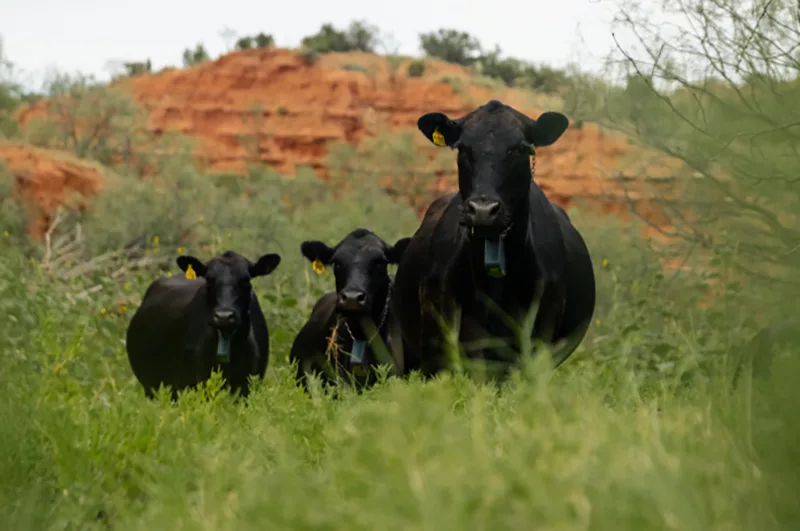
Most producers come to Nofence because they need a fence. They want to keep cattle where they belong without the cost and labor of running wire across every ridge and creek crossing. That's a good reason. It's also just the beginning.
The producers who've been using Nofence longest will tell you the same thing: containment is what got them started. Everything else is why they stayed.
Know where your cattle are
There's a particular kind of stress that comes with not knowing. A gate left open, a stretch of fence pushed down in the night, a neighbor pulling in the yard to tell you the herd isn’t where they should be. Livestock producers carry that uncertainty with them through every day of the season, and most have learned to live with it because there was no other option.
Nofence changes that in a way that's hard to fully appreciate until you've experienced it. When every animal in your herd is carrying a GPS collar, you always know where they are. Not roughly. Not after a drive out to check. Right now, from your phone, from wherever you are.
That knowledge does something to you. Producers talk about it in different ways, but it comes back to the same thing: peace of mind. You stop carrying that background worry. You check the app, you see the herd is where it should be, and you move on with your day. After years of not having that, it registers as something close to relief.
It isn't just a feeling, though. Knowing where your animals are at all times is the foundation everything else builds on.
Data that works for you
What the collars collect goes well beyond location. Every movement, every pattern, every time the herd shifts is logged. Over time, that adds up to a picture of your operation you've never had before.
You can see where animals are spending their time, which parts of a pasture they're using and which they're avoiding, and how the herd moves through the day. You can track grazing history across the season and compare it to previous years. Patterns that used to be invisible become readable.
This matters because ranching has always been about reading the land and the livestock. Experienced producers develop instincts over decades. The data from Nofence doesn't replace that instinct, it sharpens it. You're not guessing what happened overnight. You're not waiting to see damage that's already done. You can see what's developing and respond before it becomes a problem.
Reactive management is exhausting and expensive. When a fence goes down, you're already behind. When cattle drift somewhere they shouldn't, you're already chasing. Nofence shifts the balance. You're working from information, turning data into insights.
Land and grazing, on your terms
Physical fencing defines the limits of what's possible. A stretch of rugged terrain that would cost more to fence than it would ever return stays ungrazed. A hillside that's too steep or too broken up to run wire across doesn't get used. Remote sections of a lease get written off.
Virtual fencing doesn't care about terrain. You draw a boundary on your phone, the collars learn it, and the herd stays within it. That opens up land that was functionally off the table. Rugged creek country, steep marginal hillsides, remote corners of a large operation. Places where the economics of physical fencing never made sense suddenly become workable.
And because moving a virtual boundary takes seconds instead of hours or days, you can manage grazing in ways that physical infrastructure simply doesn't allow. Rotate more frequently. Move animals to fresh grass when it makes sense, not just when you have a crew available to help. Rest sections of pasture long enough for them to actually recover. Respond to what the land is telling you rather than working around the fence posts that already exist.
The cattle do better on fresh, well-managed pasture. The land builds over time rather than getting overgrazed. And the producer is in control of grazing in a way that used to require significantly more infrastructure and labor.
Time for what actually matters
Ask a rancher what they'd do with an extra hour a day and most of them won't have to think long. There's always something that needs attention that isn't chasing strays or replacing wire.
Chasing cattle is one of those tasks that doesn't show up on any plan but consumes whole days when it happens. One animal pushes through a weak section of fence, others follow, and suddenly the afternoon is gone. Multiply that across a season, across years, and it adds up to a significant portion of a producer's time spent on problems that can be proactively managed.
The same goes for fence maintenance. Running wire is expensive and slow. Keeping it up is a constant, unglamorous job that expands to fill whatever time is available. A stretch of fence that's taken down by a fallen tree or pushed through by a bull or wildlife doesn't wait for a convenient moment.
Nofence doesn't eliminate all of that. Physical infrastructure still plays a role for most operations. But it reduces the reactive burden substantially, and that time doesn't disappear. It goes somewhere.
It goes toward things producers actually want to be doing: spending more time observing the herd, improving the land, planning ahead, being present for the parts of raising livestock that drew them to it in the first place. And it goes beyond the operation. A Saturday that doesn't start with a fence problem is a Saturday you can spend with your kids. An evening where you know the herd is settled is an evening you're actually home.
For operations where labor is stretched thin, it can mean the difference between managing an expansion and having to hold back. For producers running large acreages, it can mean doing more with the same crew.
The value isn't just efficiency in the abstract. It's the actual texture of a working day, and what it feels like to run an operation when you're not behind.
A different kind of operation
Virtual fencing is the technology. What it produces is something harder to put a number on: an operation that runs on better information, uses land more fully, manages grazing more actively, and gives the producer back time and attention they can direct where it matters most.
The fence was always just a tool. What producers are really after is control, confidence and the ability to do this work well for a long time – and into the next generation. That's what Nofence is built for.