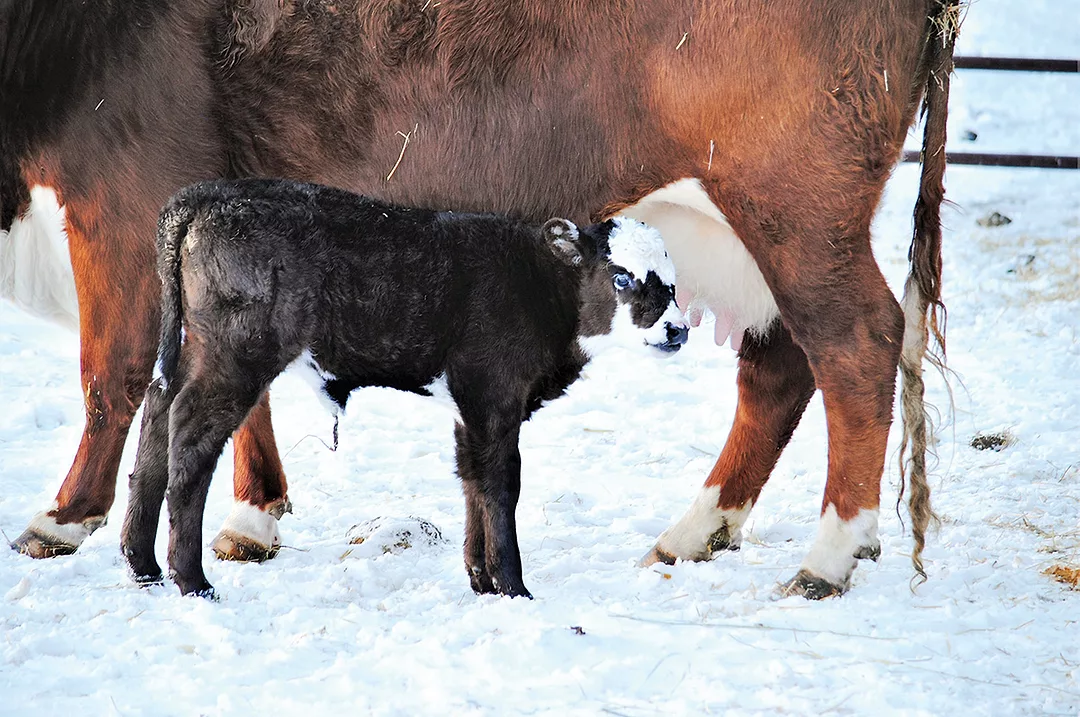
During calving season, your herd transitions through parturition to become a lactating herd. Late-gestation nutrition challenges such as decreased rumen capacity are replaced with the energy demand of milk production. The physiological changes during calving, not to mention the strain of parturition, require energy and, simply put, are pretty remarkable.

The cow’s metabolism and physiology change quickly during and after parturition. After giving birth, the gravid uterus naturally goes through involution as secretion of the hormone progesterone is decreased and energy is directed to the mammary gland to support milk production. Although the birth of a calf and the reduction in uterus size may result in a reduction of about 200 pounds, the total energy demand of the cow remains high during lactation. During late gestation, the main energy substrates for the growing fetus were glucose, which must be synthesized by the cow, and amino acids. Now during lactation, fats may be incorporated as a major energy source in the milk.
An area of nutrition management to keep in mind during lactation is how much energy the cow spent pre-calving by mobilizing body tissue to feed the growing fetus. Avoiding major loss of body fat reserves is critical to not only support lactation, but also to maintain reproductive fitness for the upcoming breeding season. Body fat and muscle degradation during late gestation occur as the uterus has such a high demand for glucose and amino acids. Body fat is broken down to long-chain fatty acids such as non-esterified fatty acids (NEFA) in an attempt for the cow to maintain normal levels of blood glucose for herself. Typical scenarios resulting in increased NEFA include fasting, metabolic stress and late gestation. Although elevated NEFA levels in a state of undernutrition during pregnancy are processed in the liver and can cause a negative metabolic state called “fatty liver syndrome,” during lactation, the uptake of NEFA into the mammary gland appears to have no upper limit as a source of long-chain fatty acids contributing to milkfat.
A ration providing adequate energy to fuel milk production without large body fat reserve losses still requires adequate protein for milk production to occur. Processes such as the formation of lactose in the udder require adequate amino acids, along with glucose and galactose. Lactose is a sugar that is made in abundance within the udder and is present at about 5% of milk weight in dairy cattle. The total amount of lactose correlates with milk production because lactose is what draws nutrients, including water, from the blood supply into the udder to create milk.
With this information, a loose analogy can be formed by comparing the anatomies and functions of lungs and mammary glands. Anatomically, lungs and mammary glands are very similar. Both organs have large surface area provided by the presence of alveoli. In the same way that individual fibres create a rug, these individual alveoli maximize surface area so that blood passing through the lung has a large area to grab oxygen from the new air and get rid of carbon dioxide. In the udder, the epithelial layer of these alveoli makes the lactose, which then pulls water, protein and fat out from the blood passing by. The more lactose there is, the more water can be pulled out from the blood supply.
As mentioned, cows will mobilize body reserves to provide nutrients to the fetus during pregnancy and to the mammary gland during lactation. To put these concepts together, recent research showed if you restrict beef heifers to 70% necessary energy and protein from day 160 of gestation to calving, it results in a 40% decrease in colostrum volume due to decreased lactose production, and increased NEFA by 78% at day 265 of gestation, showing increase in body tissue mobilization. Additionally, restricting energy in the last 100 days of gestation can decrease calf weaning weights by more than 10 kilograms. Given the current price of weaned calves, a decrease in 10 kilograms represents a significant impact when selling 100 calves or more.
Estimating requirements for lactating beef cattle is difficult given they can produce anywhere from 5 to 13 kilograms of milk. For a mature cow weighing about 600 kilograms, current requirements outlined in the Nutrient Requirements of Beef Cattle suggest that an extra 5.7 megacalories of energy (equivalent to 2.5 kilograms of barley) and 400 grams of metabolizable protein (equivalent to roughly 2 kilograms of dried corn distillers grains) are required to produce 8 kilograms of milk. To encourage steady production of milk, it is also important to provide free access to water.
Cattle operations that calve earlier may provide access to waterers in pens, whereas later spring calving out on the range may have larger waterers or rely on groundwater. No matter how your operation is set up, free access to fresh water and avoiding reliance on snow or low-level sloughy areas is advised. Cattle weights can vary day to day upward of 40 kilograms based on their level of water intake, but current NRC recommendations are that water intake rises nearly 60% for a lactating cow versus a wintering pregnant cow. However, this total amount can be influenced by ration and rumen capacity, with drier rations causing higher water intake.
By providing access to fresh water, and ensuring adequate waterer space, you can minimize variance of water intake from day to day and encourage steady milk production. Removing or restricting access to water can not only reduce milk production but can also reduce dry matter intake, which affects the cow’s energy balance and milking.
Another effect of free access to water, particularly in the winter, is the reduction of consuming dirty water laying on the ground or eating snow. Hopefully in turn, that reduces the occurrence of calves drinking that dirty water as well. If the little monkey doesn’t see Mommy drinking the dirty water, hopefully the monkey won’t drink it either. The post-calving pen does not need to be completely sanitary, but little things to keep both cow and calf a little cleaner will hopefully lead to avoidance of mastitis or subclinical events that lead to increased somatic cell counts in the milk, since mastitis causes significant reductions in lactose content and milk yield.
References omitted but are available upon request by sending an email to the editor.