When breedback rates drop and herd health becomes a concern, have you thought to check your water sources?

In a webinar hosted by the Beef Cattle Research Council (BCRC), Dr. Cheryl Waldner, beef cattle research chair at the Western College of Veterinary Medicine, spoke to attendees about the impact of water quality on reproduction, health and growth in beef cattle.
“Water quality is important,” she said. “Poor water quality can lead to reduced number of calves on the ground, reduced weight gains in the calves that we do have and an increased risk of disease – and occasionally and unfortunately, poor water quality can also result in sudden animal deaths on pasture.”
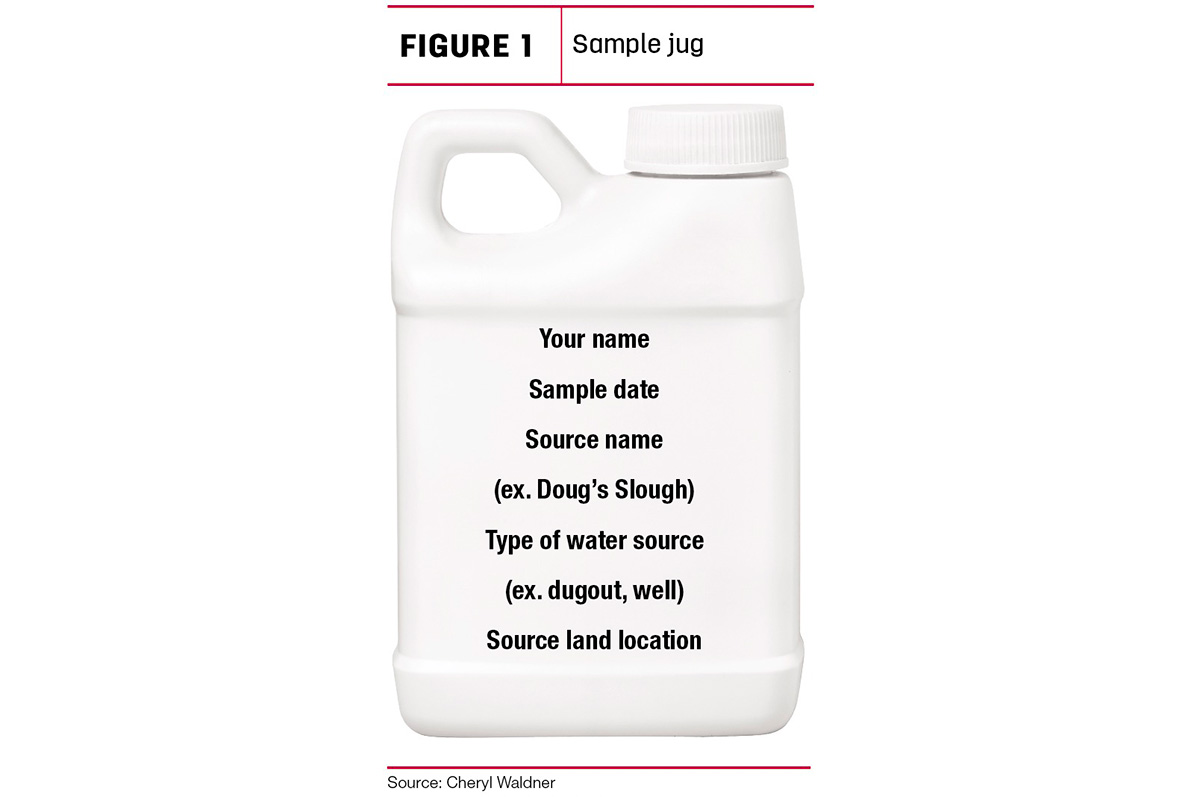
Waldner said lab testing is critical to assessing water quality issues; however, according to the recent Canadian Cow-Calf Survey, only about 38% of Canadian producers tested their water within the last three years, and 62% have never tested their water at all. Water sample collection isn’t complicated (Figure 1). Waldner recommended following these guidelines to collect a proper water sample:
- Clean 1 litre jug per sample site
- Avoid debris
- Flush lines/rinse container
- Keep sample cool
- Confirm any special instructions with your lab if testing for something specific like blue-green algae to ensure you collect a usable sample.
Canadian producers face no shortage of challenges when it comes to water quality and water accessibility. The repeated cycles of drought and evaporation that have plagued water sources in western Canada pose a risk when it comes to water quality, especially when compounded with the ever-present risk from manure contamination or runoff from manure or fertilizer, especially in dugouts. Additionally, water sourced from wells may be pulling from aquifers that contain a high concentration of salts and minerals.
Testing for toxins
So why test? An easy justification for not testing water is the added time, labour and expense incurred on an already busy ranch schedule. Another prevalent attitude is “Water is water – it’s the only source available, so we’ll have to make do.” However, this is one of those situations where ignorance is not bliss.
The risks to cattle health that stem through water quality are many and varied. The most dramatic risk is blue-green algae, which is actually a bacteria called cyanobacteria. It is highly toxic to livestock and typically affects the liver and nervous system. Death is the typical outcome from this issue, though if caught in time, some animals can recover.
Ruminants in particular are also susceptible to nitrate and nitrite toxicity because they convert nitrates to nitrites in the rumen. A common symptom is respiratory distress, and the effects can include death or abortion. This typically occurs where there is fertilizer runoff into surface water. Waldner noted that assessing nitrate toxicity risk also needs to include the nitrates found in harvested forages. Plants that naturally accumulate nitrates, like kochia, or forages that have undergone or been harvested in extreme conditions like frost, drought or even hail, can be high in nitrates. Combining that with water that is already high in nitrates could bring them to dangerous levels for an animal. “When you're thinking about toxicities, it's the total amount of toxin that the animal is taking into its system, and it might be getting some from the water, but it might also be getting some from the feed,” she said.
Timing your tests
According to Waldner, the biggest challenge to water quality has been the cycles of drought and evaporation that have been plaguing ranchers for the past several years. She said the elevated levels of evaporation have increased the concentration of total digestible solids (TDS) in surface water supplies. TDS measures the levels of calcium, magnesium, potassium, sodium, bicarbonate, chloride and sulphates in the water, with sulphates posing the biggest threat to cattle health. High levels of TDS results in lower intake of salt and trace minerals, which are necessary for health and successful reproduction in cattle.
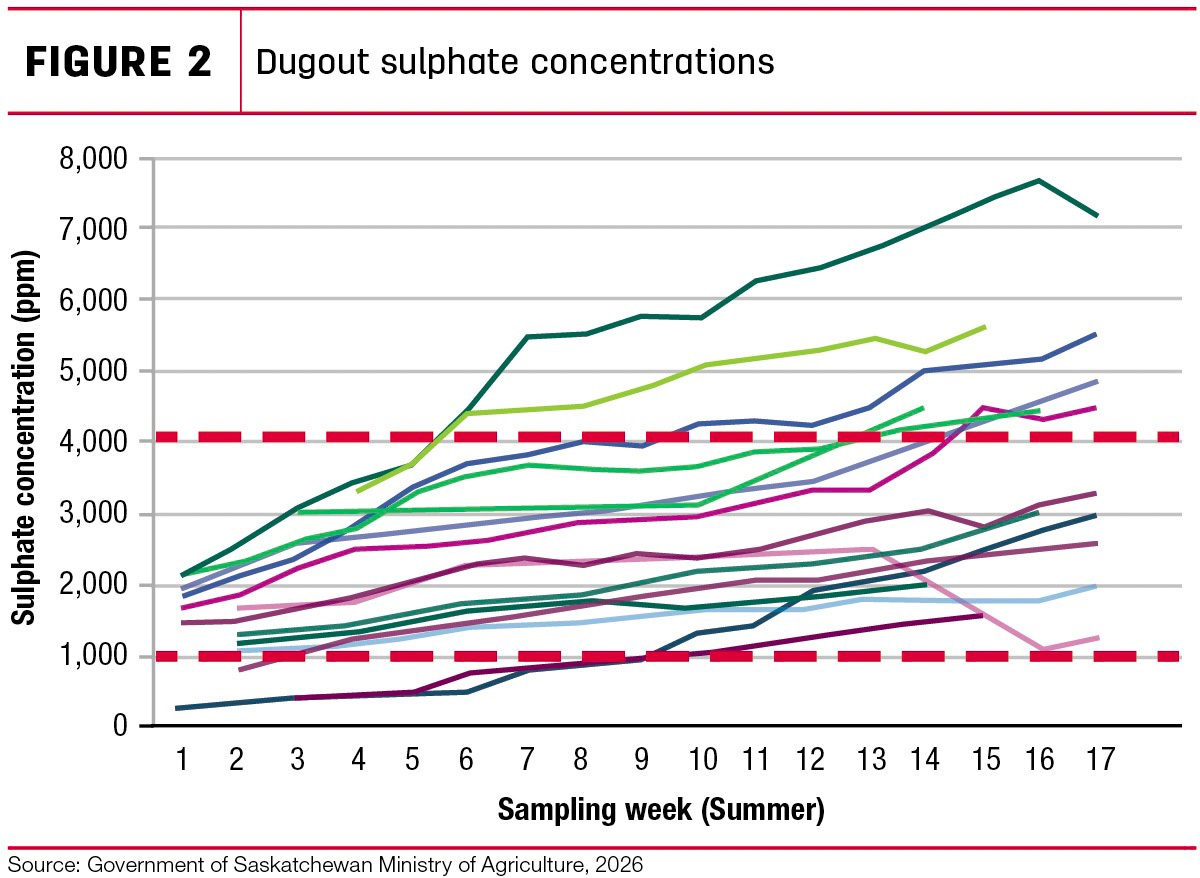
Waldner said testing water supplies once at the beginning of the grazing season is not enough to make an informed decision about season-long water quality. Figure 2 shows the sulphate concentration of several water samples taken from dugouts in southern Saskatchewan and tested weekly over the summer months to capture the true impact of evaporation on water quality.
“If you look at the early part of the growing season, when they start sampling every year … we have some sulphate levels that are perfectly OK from the same dugouts. Another year, we have dugout sulphate levels that are high but potentially not at a panic point yet, but over the course of the summer, we see all of these lines are trending up, and some of them go over the second red dotted line into a very, very dangerous level,” said Waldner. “The take-home message here is, if we were just to have sampled these dugouts at the beginning of the grazing season, we would have potentially been misled into thinking we had perfectly safe water for the entire grazing season, when in these cases, we clearly didn't.”
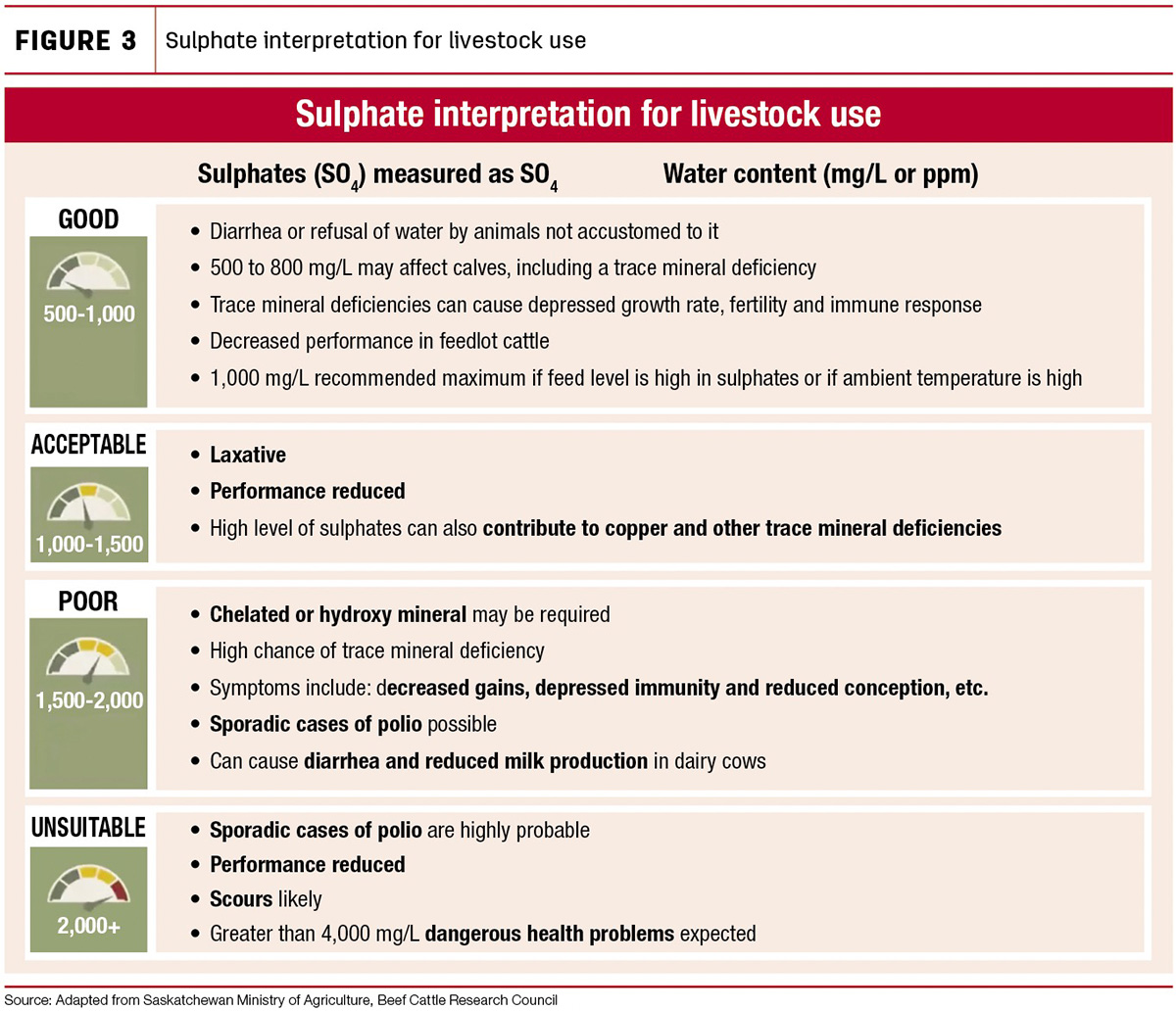
Prolonged exposure to elevated sulphate levels can also cause polio syndrome in ruminants. Polio syndrome, not to be confused with the human virus, affects the central nervous system, is noninfectious and can be treated if detected early enough. Cattle are more at risk for this condition during warmer temperatures while nursing calves, since water intake is higher during this period (Figure 3).
For more information, visit the government of Saskatchewan website.
Additionally, even lower concentrations of TDS can also tie up copper in cattle, which is essential for reproduction, immunity and growth. Waldner says copper deficiency is one of the most common trace mineral deficiencies in Canada, especially in the Western region. Most feed and forage sources are already low in copper, but when the copper is bound by other minerals and compounds like molybdenum, sulphur or iron in the feed, and sulphates in the water, the scale tips toward deficiency, and supplementation is both critical and a bit complicated.
At-home solutions
Sending weekly water samples to a lab would be a costly, labour- and time-intensive practice for producers. So where’s the solution? Thanks to some work done by the government of Saskatchewan and Ministry of Agriculture, there has been some success with using electrical conductivity (EC) meters to screen test water sources to see if they even need to be lab tested. These meters, relatively inexpensive and available via Amazon and other retailers, can give a reading that will indicate whether or not a sample needs to be sent into the lab. For these readings, the higher the EC level is, the higher the TDS concentration. Waldner recommended that water samples with an EC reading of 2,000 microSiemens per centimetre or higher should be sent to a lab for testing. “The bottom line is, there's a lot of us that have water with sulphate levels that are in the trouble zone,” said Waldner. “And getting a better understanding of exactly what this means is important.”
Additional water management resources can be found on the BCRC website.