As Americans celebrated the nation’s independence on Friday, July 4, President Donald Trump signed into law a budget reconciliation bill, known as the One Big Beautiful Bill Act. In addition to changes to tax policy, border security, immigration, defense, energy production, the debt limit, and adjustments to the Supplemental Nutrition Assistance Program (SNAP) and Medicaid, the bill includes key agricultural provisions typically included in the farm bill. It also increases the estate tax exemption and makes those changes permanent.

Dairy-related provisions in the bill include the following:
- Renews the Dairy Margin Coverage (DMC) program through 2031
- Updates DMC’s production history calculation based on the highest production year of 2021, 2022 or 2023 and extends producers’ eligibility to receive a 25% premium discount for locking in their coverage for the duration of the bill
- Provides mandatory funding for the USDA to conduct mandatory dairy processing cost surveys every two years to provide better data for future make-allowance decisions
- Incorporates any remaining Inflation Reduction Act conservation funds into the farm bill baseline to increase long-term funding for conservation programs like the Environmental Quality Incentives Program (EQIP)
- Increases funding for animal health programs that help to prevent, control and eradicate animal diseases, such as the H5N1 outbreak in dairy cattle
- Provides new trade promotion funding based on current programs that return well over $20 in export revenue for every dollar invested in the programs
- Makes the Section 199A tax deduction permanent, which allows dairy farmer-owned cooperatives to reinvest the funds in their cooperatives or pass the deduction along to their farmer owners
This is welcome news for dairy producers who have been awaiting a new farm bill. However, it may not be the last of the farm bill updates in 2025, according to the National Milk Producers Federation (NMPF).
"The House and Senate Agriculture Committees have indicated plans to work on a slimmed-down bill this fall that includes policy items that were not able to be included in the budget reconciliation package,” says Paul Bleiberg, executive vice president of government relations at NMPF.
Another win for agriculture is an increased estate tax exemption that is now permanent and raises the exemption to $15 million per individual and $30 million per couple beginning in 2026. Indexed for inflation, the augmented exemption helps protect family farms from the death tax and assists them in passing the farm down to the next generation. Previously, the Tax Cuts and Jobs Act of 2017 doubled the estate tax exemption from $5.5 million per individual to $11 million, also indexed for inflation. This increase was set to expire at the end of 2025 and revert to previous levels if not renewed. However, the One Big Beautiful Bill Act prevents this reversion.
In a statement, Secretary of Agriculture Brooke Rollins called this bill a win for farmers, ranchers, rural communities and American taxpayers.
“The One Big Beautiful Bill marks the start of a new golden age for America and American agriculture,” Rollins said. “This historic piece of legislation makes permanent the largest tax cuts in history. It provides immediate tax relief to farmers, ranchers and rural Americans by increasing the small-business expensing threshold and permanently extending the Small Business Deduction. Through the president’s leadership, the bill makes agriculture great again, bolsters the farm safety net, makes crop insurance more affordable and protects 2 million family farms from the death tax.”
American Farm Bureau Federation Economist Danny Munch says that the economic impact is both immediate and long term.
“In the near term, enhanced DMC features mean more dairy farms (especially small and midsized operations) may see higher indemnity payments during periods of tight margins, with lower premiums due to the discount incentive,” Munch says. “The increase in the Tier I cap to 6 million pounds allows more milk to be covered at favorable rates, while updated production baselines let farmers use more recent, and often higher, output levels – both of which boost potential payouts. Over the long term, the bill's requirement for regular cost-of-processing surveys could lead to Federal Milk Marketing Order (FMMO) make allowance adjustments that better reflect actual plant costs, ultimately improving how milk prices are set and ensuring fairer compensation to producers. Tax-related provisions in the bill, including the permanent extension of the Section 199A deduction and higher estate tax exemptions, further reduce financial pressure and provide greater flexibility in farm investment and succession planning. Many dairy farmers also grow feed crops and benefit from commodity programs like ARC and PLC, conservation incentives, ag research funding and investments in export market development – all of which are strengthened in this legislation.”
Munch adds that the bill provides much-needed stability in federal milk pricing policy, even if the next five-year farm bill is delayed, though it stops short of removing the threat of the “dairy cliff.”
“While the bill locks in critical dairy programs through 2031, it does not extend the suspension of permanent law that could trigger outdated parity pricing mandates from the 1940s. That issue will still need to be addressed by the end of this year to prevent a reversion to outdated parity pricing rules starting in 2026. In the meantime, dairy farmers must remain engaged, as the implementation of key provisions – particularly the new mandatory cost-of-processing survey – will influence the trajectory of future reforms,” Munch says.
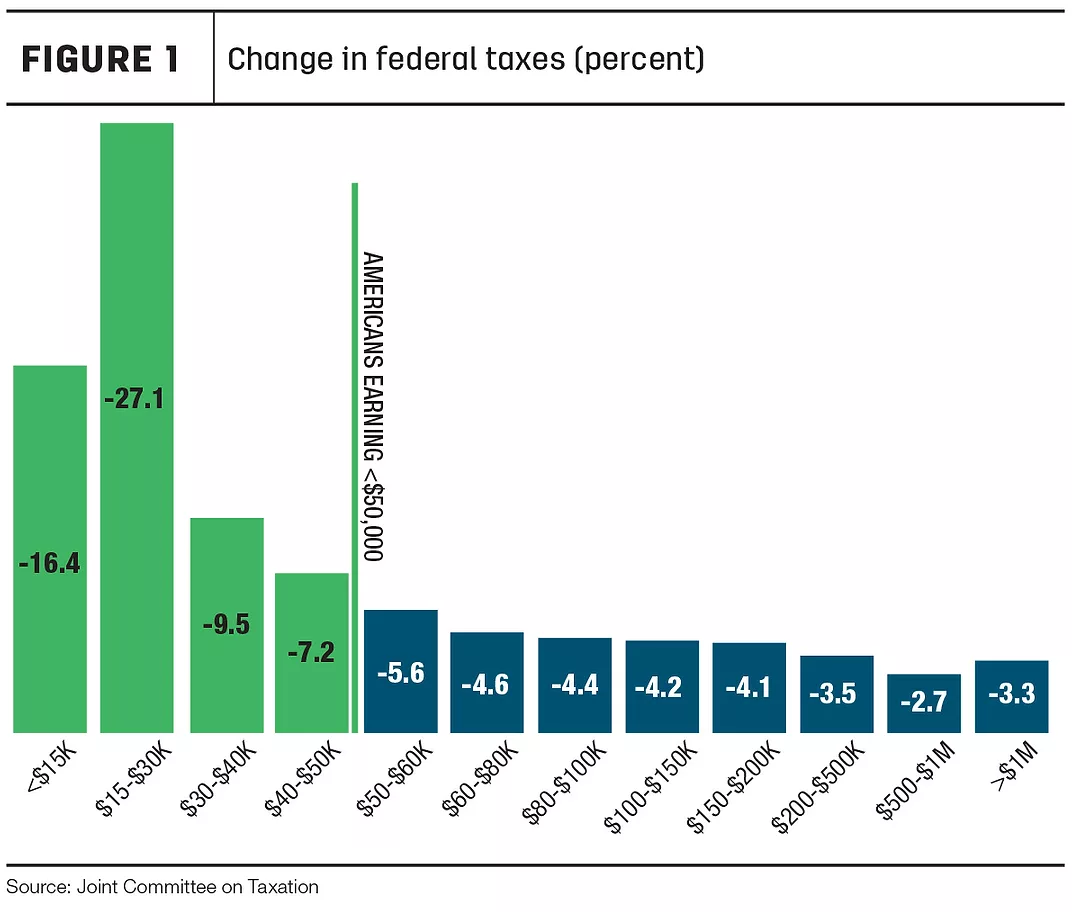
The Joint Committee on Taxation (JCT) says the tax bill will benefit workers and families making less than $50,000 per year the most. Figure 1 illustrates the tax cuts for various income levels.
The U.S. Senate passed the bill on July 1 with a 51-50 vote before it moved to the House of Representatives for consideration. The tie-breaking vote was cast by Vice President JD Vance. The House of Representatives then passed the bill 218-214 on July 3. It advanced to Trump’s desk and was signed into law on Independence Day.
Additional provisions in the bill include:
- Raises reference prices under the Price Loss Coverage program (PLC) and the Agricultural Risk Coverage (ARC) program
- Makes the 2017 Trump tax cuts permanent, delivering the largest tax cut for middle- and working-class Americans in history
- Doubles and makes permanent the Child Tax Credit
- Implements no tax on tips, no tax on overtime and cuts taxes for Social Security recipients
- Doubles small-business expensing, helping local businesses hire more workers and expand their operations
- Incentivizes made in America manufacturing by rewarding companies that build new factories in the U.S. and lowering taxes for businesses producing domestically
- Improves national security by delivering funding to complete the border wall, hire new frontline personnel (10,000 new U.S. Immigration and Customs Enforcement (ICE) personnel, 5,000 new customs officers and 3,000 new Border Patrol agents) and carry out at least 1 million annual removals
- Unleashes American energy, driving down the cost of living and restoring energy independence
- Provides $12.5 billion to overhaul air traffic control
- Funds the Golden Dome missile defense system to protect the homeland and modernizes our military
- Protects taxpayer dollars by removing waste, fraud and abuse from federal programs, so they can better serve the American people – specifically, it will remove 1.4 million illegal aliens from Medicaid and SNAP benefits and establish work requirements for Medicaid and SNAP.