When you’re shopping for hay, whether it’s for dairy cows, beef cattle, horses, goats or anything in between, hay test results are very useful. Asking for test results will help you make the best buying decision. Hay test results will tell you: crude protein levels, fiber content, mineral balance, digestibility and sugar content. But the truth is that the hay test results don’t tell you the full story. Just like reading the nutrition facts on the back of a candy bar, there is more to the package (and candy bar) than just what’s written in black and white.

That is why, especially when purchasing hay, it is important to also do a sensory evaluation of the forage prior to purchase. Sensory evaluation will help you judge the things that a chemical analysis just can’t give you. By conducting your own physical evaluation, you can find things like how the hay smells, feels, flakes apart, whether it has mold, rocks or is extremely dusty.
These things are all vitally important to consider, especially feeding this hay to more sensitive or high-value animals. In recent years as hay markets have become increasingly competitive, the combination of lab results and sensory evaluation has become the gold standard. Buyers want hay that tests good and hay that looks, feels and smells good as well.
That’s why many forage programs now offer sensory evaluation sheets you can take right to the haystack itself. These forms help you score hay on package quality, odor, maturity, cleanliness, texture, color and overall appearance. They also include places to note serious issues like mold, weeds or dirt clumps.
When you first approach a stack of hay, the first thing you probably notice is how it is stacked and wrapped. Hay bales should be stacked in a tight and uniform pattern; hopefully, they are covered either by a tarp or a hay shed to prevent deterioration from the rain and weather. When looking more closely at the bales, you should be able to see that the strings or wrapping of the bale are tight and evenly spaced.
Bales that are not bound tight are harder to transport and move and allow more moisture to enter the bale, leading to risk for molding. If bales are loose and falling apart, it will be very hard to not only transport these bales but also to feed them. Bales that are baled properly should be tightly bound so that when strings are removed, they “flake” off in an easier pattern for feeding. If you have ever had to feed bales that do not flake well, you understand this struggle and the importance of tightly bound bales.
The next step in evaluation is typically using your sense of smell. The scent of a bale can tell you a lot about how it was cut, dried and baled. Hay that was baled too wet tends to develop a sour or musty smell. Sometimes even after baling, if it was baled too wet it can start to heat up, causing it to have a caramelized or tobacco-like odor to it. While certain classes of livestock like beef cows, and some goats and sheep won’t mind this, other more sensitive classes of livestock like horses and milking cows can be sensitive to this. Moisture- and heat-damaged hay can also contain mold and should be fed with precautions.
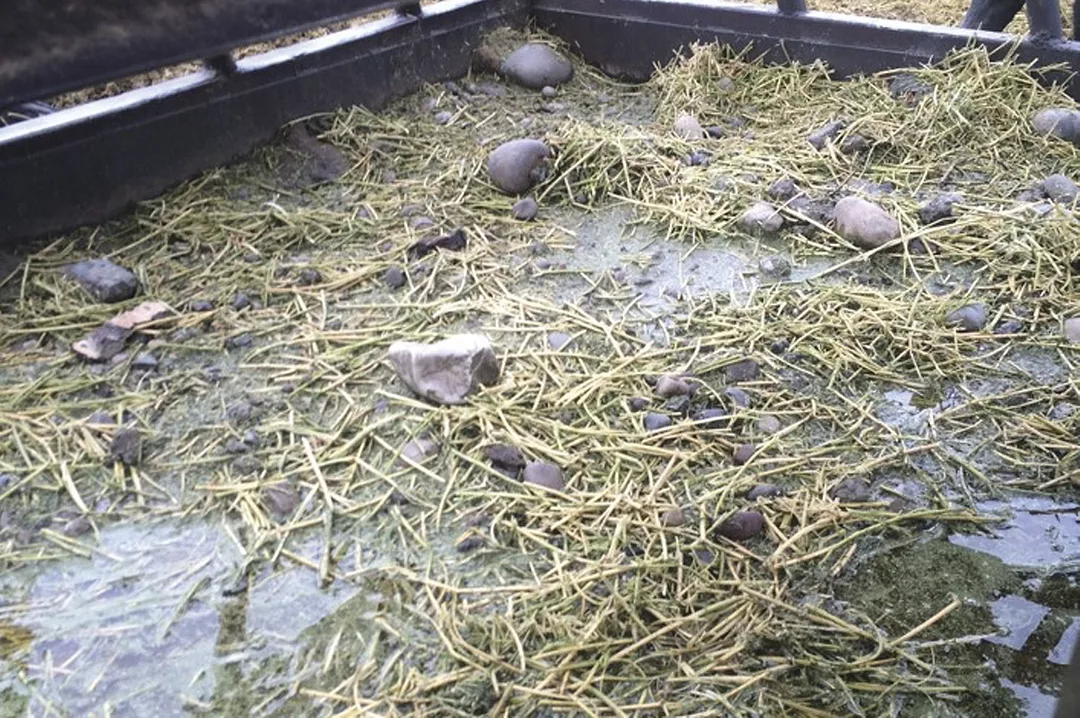
On the contrary, a fresh, slightly sweet-smelling stack of hay is a good sign. When opening a hay bale, it is easy to tell if it smells good or bad. Hay that was been well cured and baled will still smell like it is fresh from the field if preserved appropriately. You may also pick up a slight soil or dirt smell to some hay; this usually indicated that it was raked too aggressively, which deposited soil and rocks into the windrow prior to baling. In some cases, you can even see the rocks and dirt clods in the bales. If you come into this situation, this hay should be fed to less sensitive animals where the presence of these things won’t deter them from consuming the hay.
The next sensory test that you can use is a visual exam of the inside of the bales and flakes. This will help you judge the maturity of the hay when it was harvested. When opening a flake of hay, you will look for the leafiness of the forage, thickness of the stem and the bud stage or the formation of seedheads. All these things will tell you at what stage of maturity the forage was harvested. This should match common standards and your forage analysis. If you are examining a stack of hay and notice the maturity of the stems looks to be much higher than what was reported on the hay test results, you can always check back to ensure the results you were given match the haystack you plan on purchasing.
A good rule of thumb is that as plants get more mature, fiber levels go up and protein and energy levels go down. Examples of this are timothy for horses and alfalfa for dairy cattle. Timothy hay is usually harvested later in maturity after it has a well-formed seedhead to bring top dollar, whereas alfalfa hay is harvested at an earlier maturity with more leaf and less stem. The key here is to match the forage with the animal you are feeding it to.
Along with maturity, you can also use your visual evaluation to look for any unwanted debris in the hay. Unfortunately, foreign materials show up in hay more often than we would like. Things like soil, sticks, rocks, wire, weeds and plastic can all find their way into hay bales. High amounts of soil, rocks and sticks can make hay less palatable and at times dangerous for livestock to consume. If large rocks or metal make their way into a grinder or mixer, that can also cause damage to equipment and a headache to fix.
Hay should also be examined for noxious weeds, as these can cause health problems in livestock, some even leading to death as well as the risk of spreading these weeds onto your operation. Knowing what to look for and using sensory evaluation prior to purchase can help spot these problems before you bring them home.
Using both laboratory analysis and sensory evaluation gives you the best picture of the forage you hope to buy. Just like a candy bar, you can only get so much information by reading the label; usually you must peel the wrapper back to know what you are really getting.