For many years, the USDA has reported that average alfalfa yields have been flat since the 1980s. Over this period, we have seen fewer alfalfa acres being planted, alfalfa being planted in more marginal and less productive soils, and not being fertilized to maximize yield. In addition, the demand for better forage quality has intensified how the crop is managed, which also impacts forage yield.
As a perennial crop, it takes a longer period of time to bring a new alfalfa product to market as compared to corn and soybeans. Most people don’t realize that it can take 10 to 14 years to bring a new variety to market. This doesn’t mean there is no genetic yield gain. In early November, Steve Wagner, one of the DLF alfalfa breeders, presented a white paper at the World Alfalfa Conference in France called “Alfalfa Genetic Gain for Forage Yield Using Single-Cross Hybrid Progeny Testing.”
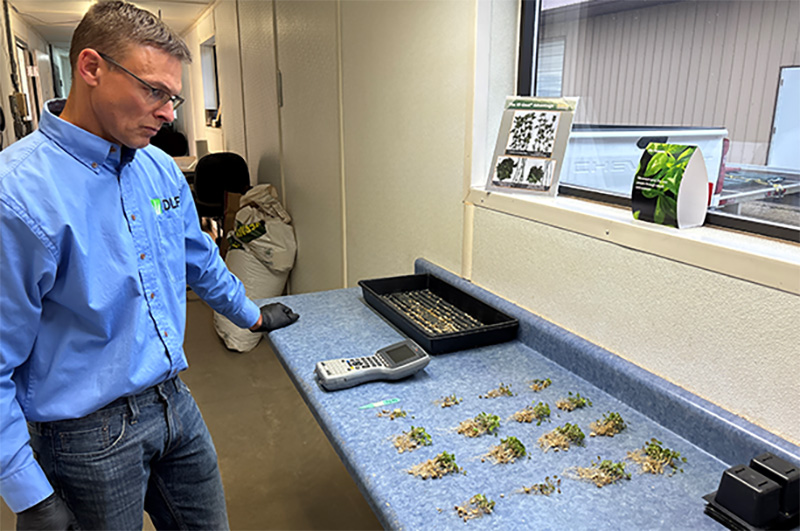 Steve Wagner, DLF
In his presentation, he shared some of the reasons why alfalfa lags behind other crops in yield advancements including:
- The challenge of improving the entire biomass of alfalfa versus allocation of assimilates to the grain of other crops
- The perennial nature of alfalfa requires breeding for more traits and significantly increases the testing resources required for breeding
- The industry has focused more on defensive traits like disease and pest resistance distracting from forage yield
- The autotetraploidy of alfalfa makes it more difficult to capitalize on heterosis (hybrid vigor) in alfalfa
- There are fewer companies and research programs with significant investment in alfalfa genetic improvement relative to other crops
In Steve’s presentation, he shared that over the past 13 years, the DLF alfalfa breeding team has been doing progeny testing to find and select the best parent plants to cross in order to have the greatest genetic gains that can be utilized to create new commercial varieties that are sold to farmers.
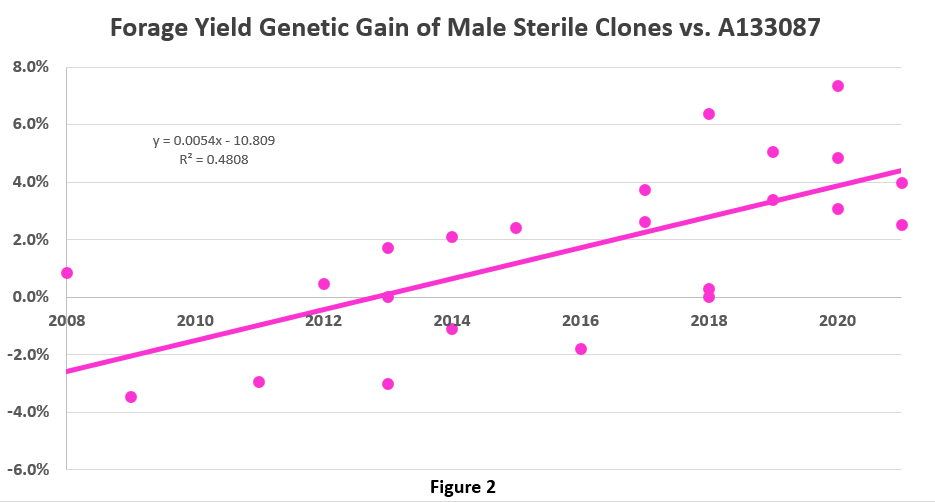
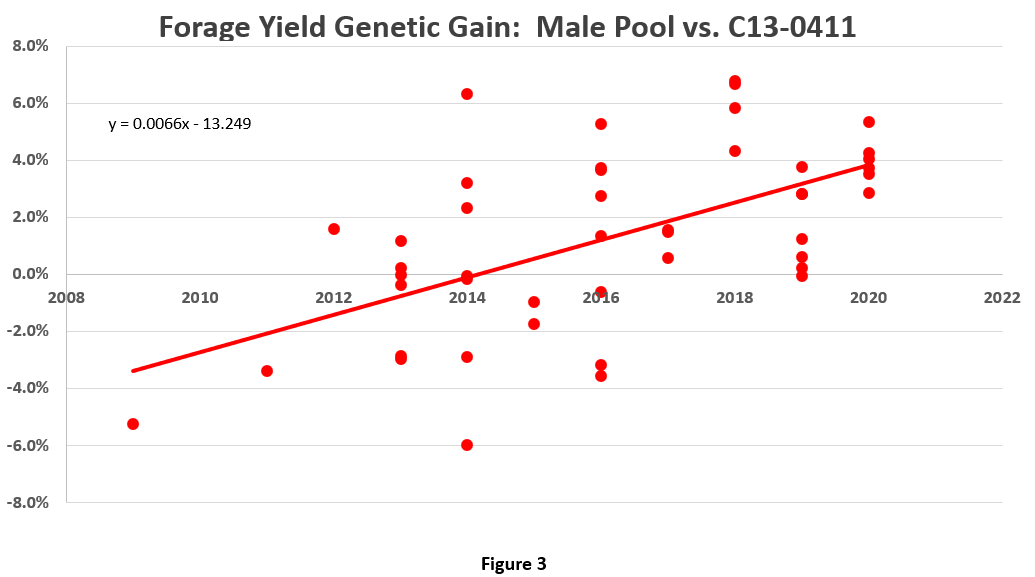
Each year, the DLF alfalfa research team identifies hundreds of new male sterile female clones and new fertile male clones to make crosses to create hybrid progeny families. These hybrid families were then tested at three locations for three to four years. The forage yield of each family was compared against common check clones. The best yielding hybrid progeny families from each year were placed on a regression line to indicate genetic gain (Figures 2 and 3).
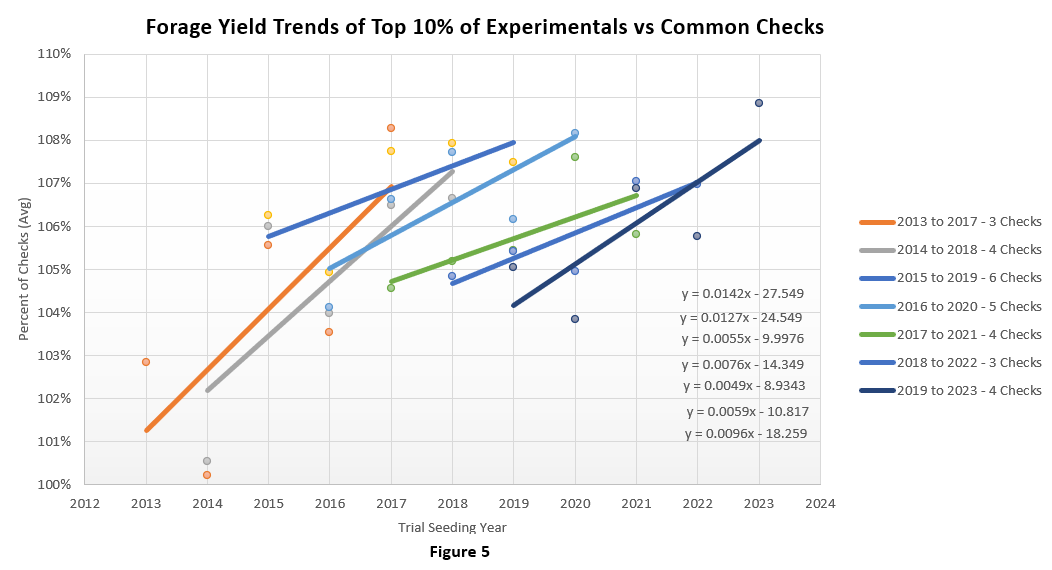
Once these top male sterile female and male fertile clones were identified based on progeny testing, they were crossed to make new synthetic varieties as potential commercial products and tested at four locations for three to four years. The top 10% of these new varieties each year were compared against common sets of commercial alfalfa checks and regressed across those respective years. As you can see in Figure 5, over a period of 11 years and over 100,000 data points, there was an average of 0.86% per-year yield gain compared to the common check varieties. Knowing that a variety can stay commercially available for seven to 10 years before being replaced by a new product, it is obvious why DLF is excited about the work the alfalfa breeders are doing.
In order to make this all happen, DLF over the years has acquired the most diversified alfalfa germplasm in the industry, incorporating the strengths from Cal/west, Pioneer and Dairyland, all of whom have a rich heritage in alfalfa breeding. This enables the alfalfa plant breeders to find and select the best parent plants to capture heterosis along with the yield, quality, disease and pest resistance, salt and drought tolerance that today’s farmers demand.
In summary, genetic gain is happening in alfalfa through this progeny testing program, capturing heterosis among the diverse DLF germplasm pools that the DLF alfalfa breeding team is then utilizing to bring the best alfalfa varieties to market through the brands they support in Alforex Seeds, Forage First and Forage First 5 Series. Knowing this, farmers who purchase any of these products can expect best-in-class yields with each new generation of products that are released in the future.
Written by Doug Bastian, DLF alfalfa business manager.