With some federal reporting still delayed, this report draws on state extension services, private market analysts and industry observations to provide current forage market insights.

As winter feeding demand builds, hay markets are expected to remain moderate, with exports limited and prices uneven by grade and region. Grass hay continues to show wide variation in quality, while moisture recovery in some areas contrasts with lingering drought elsewhere. Producers are managing inventories and input costs carefully, watching trade signals and weather conditions for clearer direction as 2026 gets underway.
Here’s a review of what we do know about hay and forage markets as you continue to look for answers.
The Midwest continues to wrestle with short‑term drought, as Missouri, Illinois, Indiana and Ohio see little soil moisture recovery despite scattered snowfall. In the Northeast, expanding dryness across New England persists, with precipitation deficits carrying into the new year. The Southeast shows further deterioration in Alabama and Georgia, while Louisiana’s earlier relief has faded, leaving forage conditions uneven.
Across the West, autumn rainfall gains in Nevada, Utah and Oregon have steadied supplies, though variability remains high. Snowpack development is now the critical factor, with below‑normal levels in the Pacific Northwest and Great Basin contrasting with stronger accumulations in the Southwest and southern Rockies. Roughly one‑third of hay acreage remains drought‑affected, keeping inventories tight and winter feed planning urgent.
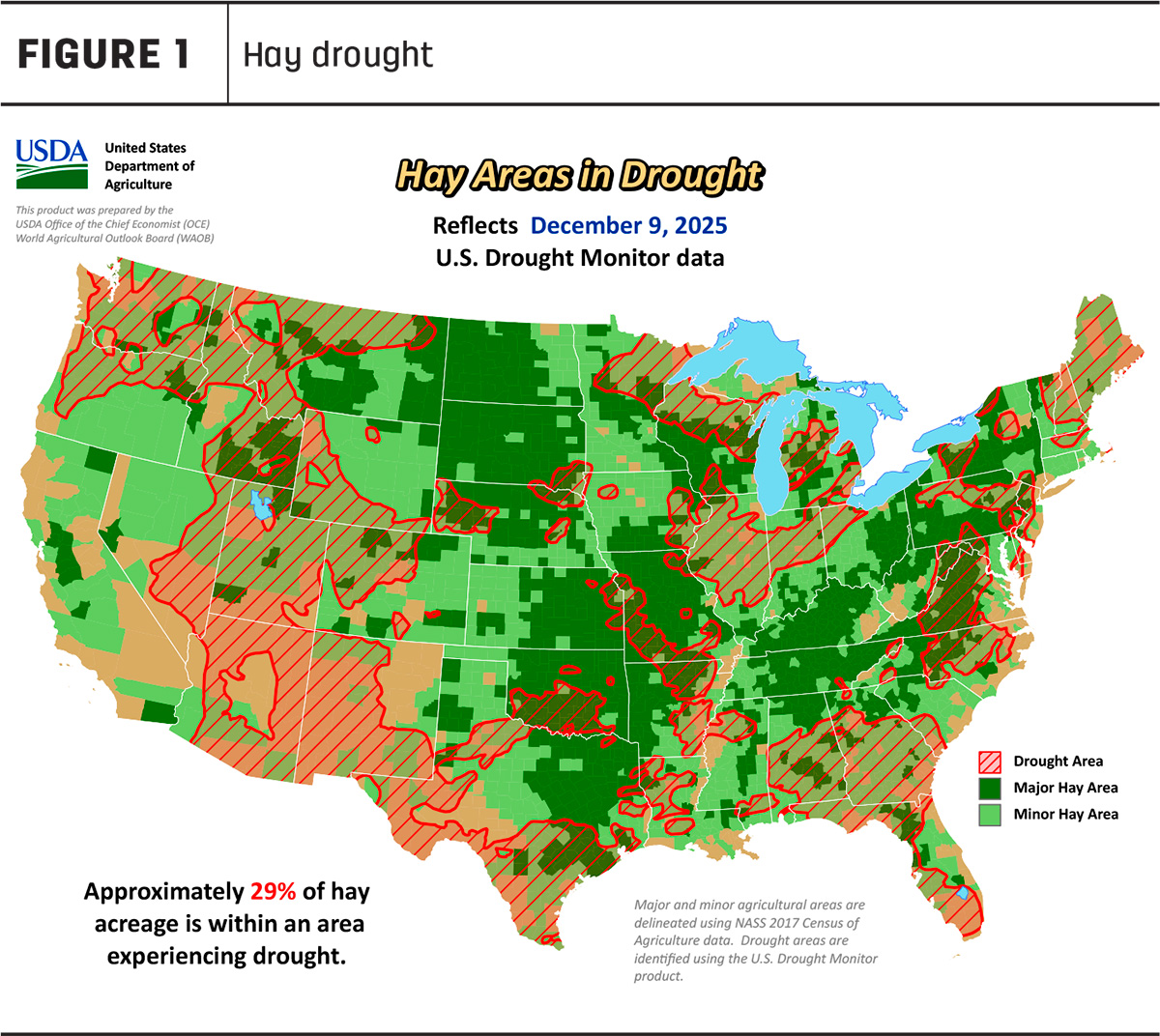
As of Dec. 9, approximately 29% of U.S. hay-producing acreage (Figure 1) was considered under drought conditions, a decrease of 5% from a month earlier. The estimate of alfalfa hay-producing acreage (Figure 2) under drought conditions, a decrease to 31%, 2% less than a month earlier.

A snapshot of hay prices
Dairy hay
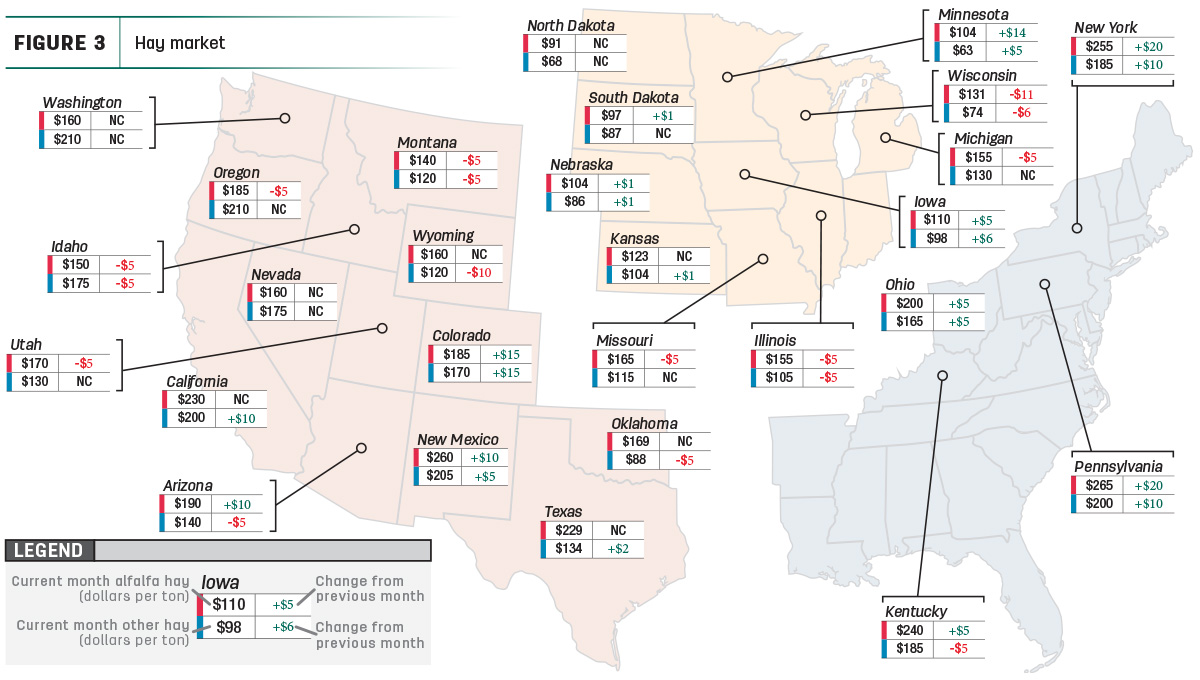
USDA price data for 27 major hay-producing states is mapped in Figure 3, illustrating the most recent monthly average price and one-month change. The lag in USDA price reports and price averaging across several quality grades of hay may not always capture current markets, so check individual market reports elsewhere in Progressive Forage.
The top milk-producing states reported an average price of $223 per ton for Premium and Supreme alfalfa hay in October 2025, a $2 increase from September 2025 (Table 1). The average price was $13 lower than October 2024.

Alfalfa
The U.S. average price for all alfalfa hay decreased $3 in October to $168 per ton. Compared to a month earlier, prices were lower in eight of 27 major forage states, with the largest declines in Idaho, Illinois, Michigan, Minnesota, Missouri, Montana, Oregon and Utah. Prices were up in 11 states including Arizona, Colorado, Iowa, Kentucky, Nebraska, New Mexico, New York, Ohio, Pennsylvania, South Dakota and Wisconsin.
With few exceptions, year-over-year alfalfa hay prices were down substantially, with the U.S. average down $9 compared to October 2024.
Other hay
At $140 per ton, the October 2025 U.S. average price for other hay was up $2 from September. Prices decreased in eight of 27 major hay-producing states, with the largest month-to-month decrease in Arizona, Idaho, Illinois, Kentucky, Minnesota, Montana, Oklahoma and Wyoming. Increases were recorded in 11 states including California, Colorado, Iowa, Kansas, Nebraska, New Mexico, New York, Ohio, Pennsylvania, Texas and Wisconsin.
Expanding the timeline, the October 2025 U.S. average price for other hay was $10 less than a year earlier.
The gap between average U.S. alfalfa and other hay prices was about $28 per ton in October.
Exports
As of December 2025, some federal hay export reporting remains paused, so exporters are still relying on September 2025 shipment data as the last confirmed benchmark.
Regional markets
Trade opens the year on a steady but subdued note, with demand moderate and exports still limited. Winter weather has tightened logistics, while lingering quality concerns from fall conditions continue to shape regional supplies. Prices remain uneven by grade and location, with biweekly reporting now the norm across many states. Producers are cautious yet prepared, watching for stronger movement as winter feeding intensifies and export clarity improves.
- Midwest: In Nebraska, compared to last report, hay sales sold mostly steady. Demand remains mostly light with some buyer inquiry picking up in the east after the snow.
In Kansas, hay movement was mostly steady. Increased moisture across the state limited some producers' abilities to move hay. There is still an abundance of grinder-quality hay, putting slight pressure on prices. High-quality alfalfa remains in high demand and is moving quickly.
In Illinois, comparable hays in small squares sold $2 to as much $5 per bale higher. Hays in large packages sold from $2 lower to $5 higher. Trade was active with very good demand.
In Missouri, the first snow provided a slight boost to hay movement and demand. The supply of hay is moderate to heavy, and at this time, there aren't any concerns with feed availability.
In Nebraska, hay sold firmer on few comparable sales. Demand continues to be on the softer side.
In South Dakota, there was light-to-moderate demand for all types of hay.
- East: Hay prices are fully steady. Trade is moderate with moderate supply, and with cooler temperatures, there is an increase in demand.
In Pennsylvania, it continues to show strong demand for Premium grades, with prices remaining firm despite seasonal harvest slowdowns.
- Southwest: In California, trade activity is moderate with steady demand. Retail hay is $20 to $25 higher per ton with good demand. There is steady demand on dairy hay.
In Oklahoma there is some movement but not enough to call it steady.
In Texas, hay prices were steady to higher with good demand.
- Northwest: In Montana, hay sold steady to $10 higher. A two-tier market continues to be seen as hay in the northern and western portions of the state is the highest priced. Hay in the southern portions of the state are starting to see some price increases but remains below hay in northern and far western Montana. Demand for round bales is very good as many ranchers report that they are hard to find. Hay in rounds outsold the same hay off the same farms in squares. Sales were more active as winter weather helped spur some buying. Several producers report that ranchers are buying hay for tax purposes. This has also helped spur some demand for hay.
In Utah, demand has improved; in northern Utah there is feeder hay being bought with the valley getting snow. In southern Utah, a lot of hay was bought and contracted to go to California, either to dairies or presses for export. Central and southern Utah would like to see more feeder hay move, but the weather isn't cooperating. There is hope demand will pick up when some winter weather sets in.
In Idaho, movement has increased since the last report, but demand for hay is still slow. Some are saying everyone has already bought their hay for the winter, and others say some ranchers haven't bought hay yet because their cows are still grazing green grass with the unseasonably high temperatures. There are a few offers being thrown around for feeder hay, but some are holding out for better prices.
In the Washington-Oregon Columbia Basin, all grades of hay are steady in a light test. Trade is slow with light demand.
In Wyoming, all reported hay sales sold fully steady. Demand was moderate with instances being good on large squares and round bales, along with very good demand for small square bales. Many loads of small squares are getting shipped to the eastern side of the U.S. and to the local markets. Good or better hay has been sold with several tons of the lower-quality hay sitting around waiting for a grinder or even a rancher to purchase the hay.
In Colorado, trade activity was light on moderate demand. Small squares and medium square 3X3s of horse hay sold unevenly steady.
Other things we’re seeing
- Dairy: Milk production is projected to remain steady, with herd sizes near historic highs but efficiency gains per cow modest. Class III prices face continued pressure, while Class IV shows firmer support thanks to butter and powder demand. Export strength is providing a price floor, but margin pressure persists as producers weigh cattle values against milk checks.
- Cattle: Cattle supplies remain historically tight, with prices still elevated though showing signs of plateauing. Feedlot placements continue below year-ago levels, reflecting limited feeder availability and cautious market sentiment. Herd rebuilding is gradual, as drought recovery and input costs constrain expansion. Cow retention persists, offering a foundation for long-term recovery, but meaningful herd growth is unlikely until feed and weather conditions improve. Producers enter the new year balancing strong cattle values against persistent structural challenges.
- Fuel: National average fuel prices were slightly lower to start December, according to the U.S. Energy Information Administration (EIA). The U.S. retail price for regular-grade gasoline averaged $2.94 per gallon on Dec. 8, down 4.5 cents from the previous week and 6.8 cents less than the same week a year earlier. The average U.S. on-highway price of diesel was $3.66 per gallon, down 9.3 cents from the prior week and 20.7 cents more than early December 2024.
- Trucking: Spot flatbed prices were mostly higher to start October, down in the South, higher in the Southeast, Midwest, South, Northeast and West, averaging $2.45 per mile nationally, according to DAT Trendlines. Regionally, average spot prices per mile were: Southeast – $2.62, Midwest – $2.61, South – $2.49, Northeast – $2.32 and West – $2.22.
- Other costs: The USDA’s December 2025 prices paid index increased 0.7% from November to 141.1, an increase of 1.5% from December 2024. Higher costs for feeder cattle, feeder pigs, complete feeds and feed grains outweighed declines in diesel, gasoline, hay/forages and concentrates.
- Total feed prices: Feed costs closed out 2025 with a modest rise, as firmer feed grain and complete feed prices outweighed softer hay and supplement markets. For producers, energy relief offers some balance, but ration management and livestock input strategies remain critical.
- Interest rates: USDA Farm Service Agency (FSA) interest rates for farm operating loans (4.625%) decreased, and direct ownership loans (5.75%) were lower for December.