Last year, the Midwest had its sixth-warmest fall on record and much of the Upper Midwest had below-normal precipitation, according to the National Oceanic and Atmospheric Administration. So it was a bit of a shock when much of the Midwest received near-record snowfall in late November. The ground wasn’t even frozen.
Ideally, graziers want to see ground frozen from November to March rather than a lot of freezing and thawing, says Jason Cavadini, grazing outreach specialist for the University of Wisconsin Extension. Melting followed by cold weather sets up plants, especially legumes, for winterkill. Since some grasses also are vulnerable to winterkill, it’s best to keep a close eye on pastures as soon as snow begins melting.
Monitoring for winterkill is one aspect of a successful pasture care program. Cavadini and Adam Abel, state grazing specialist in Wisconsin for the U.S. Department of Agriculture’s Natural Resources Conservation Service, recently discussed some additional recommendations for giving pastures some tender loving care.
One of those recommendations is frost seeding. Both Cavadini and Abel suggest that graziers interseed legumes on one-third of their pasture acres every year.
“Frost seeding doesn’t require expensive equipment, and you can seed while snow is still there,” Cavadini says. “A prime time for frost seeding is when you see patches of snow here and there.”
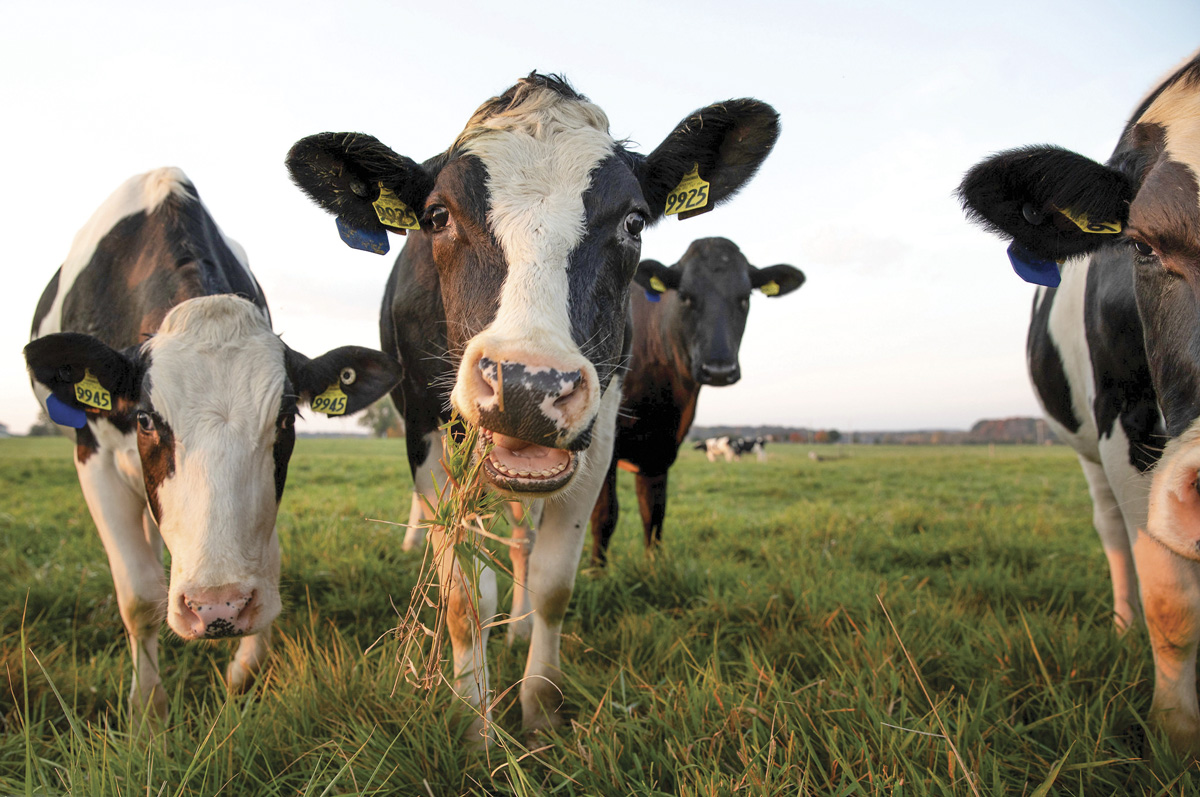
Dairy cattle graze at the Marshfield Agricultural Research Station’s north campus near Stratford, Wisconsin. Image courtesy of University of Wisconsin – Madison College of Agricultural and Life Sciences.
In a publication titled “Frost Seeding of Forages,” Dan Undersander, University of Wisconsin forage professor emeritus, wrote that seed can be distributed by broadcast seeders that are either tractor- or all-terrain vehicle-mounted or handheld or mixed with fertilizer and applied. Frost seeding works best if pasture residue has been removed prior to broadcast to allow seed to reach the soil surface. Residue removal is best done by grazing late the previous fall, he noted.
Frost seeding can be done with snow cover. But if the weather turns warm within a 12-hour period, one can lose seed to runoff.
Cavadini recommends frost seeding red clover because of its affordability and general success rate.
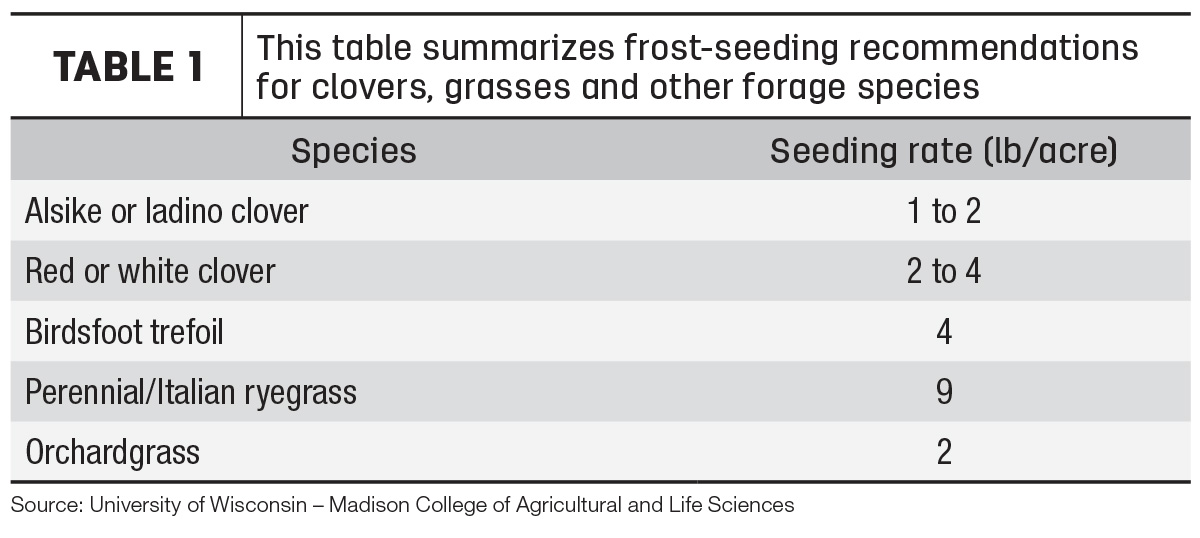
“Seed red clover at 5 pounds per acre,” he says. “It provides good forage quality and is a good source of protein.”
Red clover stands last about three years. But large amounts of red clover seed can include hard seed, which can sit in the soil ungerminated for one to two years. Graziers may need to adjust for that by planting at a rate of 7 pounds per acre and then wait to assess red clover performance until the following spring. If the seed is coated to protect against rot, for example, one may also need to increase the seeding rate, says Cavadini.
Abel adds that red clover contains phytoestrogens that may have an adverse reproduction effect in sheep and horses. In this case, white and Ladino clovers may be preferable options. Alsike clover also is an option for wetter soils.
Recommended seed rates for these and other forages are provided in “Frost Seeding of Forages.” A link is provided at the end of this article.
Weed forecasting
Weed forecasting for pastures is a difficult job because every year is different. The best way to manage weeds is good grazing management. Cavadini recommends planting pastures to at least two to three grass species and two to three legume species. Thick forage helps prevent weeds from gaining a competitive edge.
He also recommends timely clipping to manage weed seedheads.
“You want to clip plants back to the vegetative stage,” he says. “Clipping is the main way to returning to good pasture.”
He recommends clipping pasture plants to a 6-inch height after the first or second grazing to give forages a competitive edge over weeds.
“Keep alert to situations where weeds are bad,” he says. “If you have no desirable species, you’ll have to reseed the pasture.”
Chemicals can be used in alfalfa stands, but they’re not as effective as clipping, says Cavadini.
In “Weed Management in Pastures,” Pennsylvania State University’s John Comerford, professor emeritus of animal science; and Nancy Glazier, small farms specialist at the Cornell Cooperative Extension, write that herbicides should be used wisely. They suggest spot-treating small weed patches before weeds become widespread.
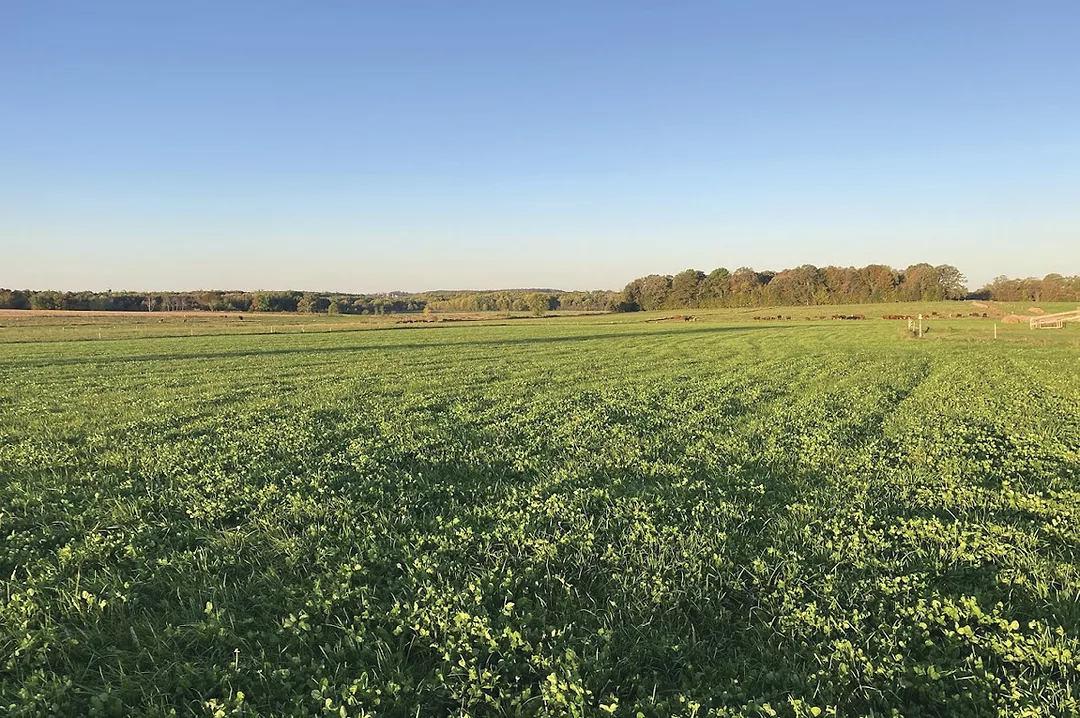
This fall pasture shows nitrogen‑deficient grasses where thinning legumes have reduced natural nitrogen contribution. Image courtesy of University of Wisconsin – Madison College of Agricultural and Life Sciences.
Weed control options are limited because one must choose whether to eliminate broadleaf or grass weeds. Most pastures are predominantly grasses, so broadleaf control is the choice, but herbicides will also eliminate legumes.
“If this is the option, overseeding or frost seeding may be done afterward,” wrote Comerford and Glazier.
They added that 2,4-D products work well since they are applied, absorbed by the leaves and translocated in the plants. They said to follow label instructions and check for grazing restrictions. For specific recommendations, graziers are advised to contact their local extension office.
Timing is critical for weed control. Annuals are most easily controlled in the seedling stage, biennials prior to flowering and perennials in the bud or early flowering stage. Growing conditions impact the effectiveness of herbicides. Drought conditions toughen the cuticles on weeds, making absorption more difficult.
Considering renovation
Again, the best way to manage weeds is good grazing management, but as Cavadini says, there are times when renovation is the best option for improving productivity or fixing problems. In “Renovating Cool-Season Pastures for Improved Grazing,” the University of Wisconsin Extension staff point out that renovation can play a significant role for every grazing operation, but the specific method may vary from farm to farm. For more information, please see the links at the end of the article.
The extension publication notes that graziers need to answer some key questions before deciding to renovate: What management practices contributed to the need for renovation? What are the goals for the renovation? And what approach should be used to achieve your goals?
When thinking about pasture renovation, one needs to understand one’s goals. Abel recommends considering the type of livestock that will be grazed as well as one’s soil types and composition. The Natural Resources Conservation Service has published a web soil survey that may be used as a resource.
Abel stresses working with someone who understands grazing, such as an experienced grazier, a technical service specialist at the Natural Resources Conservation Service, a Land and Water Department specialist, an extension specialist or an agronomist.
“Good planning will have a significant impact on the success of your operation,” he says. “You get what you plan for.”
Additional resources
For more information, visit:
- https://forages.org/Resources/Frost-Seeding-of-Forages-UW.pdf
- https://extension.psu.edu/weed-management-in-pastures
- https://cropsandsoils.extension.wisc.edu/articles/renovating-cool-season-pastures-for-improved-grazing
- https://cropsandsoils.extension.wisc.edu/articles/what-should-i-plant-in-my-pasture
- https://cropsandsoils.extension.wisc.edu/articles/calculating-carrying-capacity
- https://websoilsurvey.nrcs.usda.gov/app