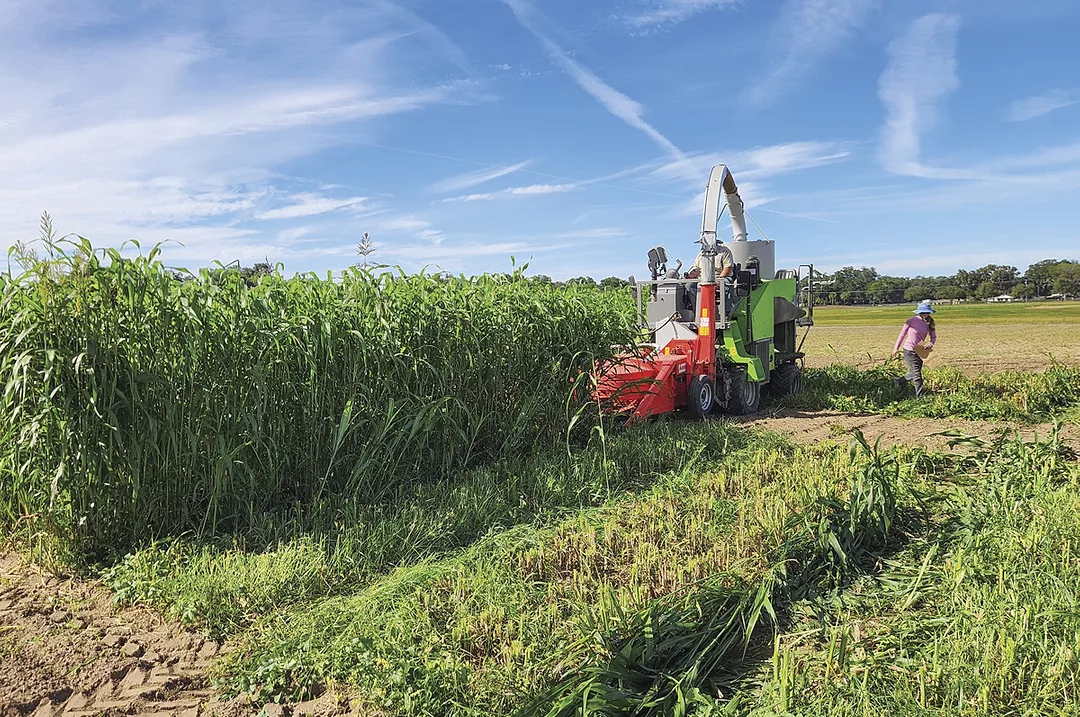
As cattle prices increased over the past years, there seems to be a renewed interest in better-quality forages that can put weight beyond what our traditional bahiagrass and bermudagrasses in the southeastern U.S. can do. This comes as investment capacity increases and producers are looking for alternatives to improve their operations.


Traditionally, annual forages for our livestock producers in the region equal cool-season annuals, such as the small grains (rye, oat, triticale) and, more commonly, ryegrass. But there is also an opportunity for warm-season annuals. Despite matching the peak of production of bahiagrass and bermudagrass, they offer unparalleled quality, capable of putting greater gains in livestock.
Forages such as sorghum, sorghum-sudan, pearl millet, sunn hemp and cow pea are some examples of summer annual grasses and legumes that can increase forage production and quality. With those, it is possible to obtain gains between 2 and 3 pounds per day in cattle, with stocking rates from 1,200 to 1,500 pounds of live weight per acre (2 to 2.5 stockers), with an 80- to 100-day grazing period if well managed, or even more.
Those forages, however, often require more intensive management compared to our warm-season perennials. First, because they are annual, they need to be planted every year. They have greater nutrient demand, especially for nitrogen (N), and often will need more careful weed and pest management. They also need to be monitored closely for grazing or cutting.
For sorghums, because of the risk of prussic acid during seedling stage, it is recommended to graze only after 18 inches. Ideally, grazing can occur once sorghums reach about 40 inches in height, and return grazing in 21- to 40-day intervals, depending on grazing intensity (i.e., more intensive grazing will require longer regrowth intervals). On the other hand, if we delay utilization too much, they enter the reproductive stage, which limits regrowth and reduces nutritive value for grazing.
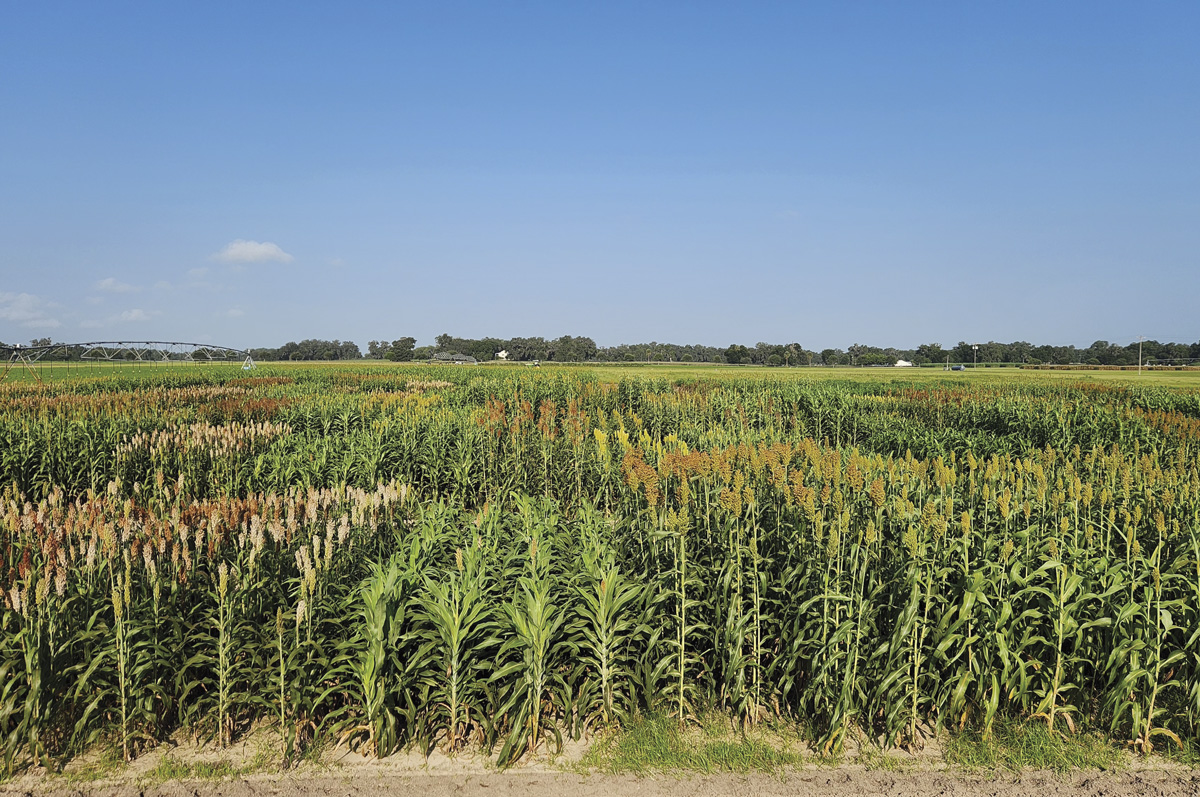
Forage sorghum variety testing displays a wide range of plant stature and maturity. This trial is targeted at silage production, with target harvesting at the soft-dough stage. Image by Marcelo Wallau.
Warm-season annual forages can be planted throughout most of the spring and summer and provide supplemental forage through the fall. Depending on the planting date and management, it is possible to obtain four to six grazing events in a season. The flexibility in planting date is a strategy to target peak of production with demand. Late plantings, for example, will have less total productivity but could increase forage availability in the fall, when our warm-season perennials have reduced growth potential.
One caveat about late use of sorghums is the potential for prussic acid production after a frost. For more on this topic, check out Shelby Gruss’ article on how to manage prussic acid in sorghums from the July edition of Progressive Forage or listen to our interview on the Cow Talks podcast.
Late plantings also require hybrids that are not photoperiod sensitive (PPS). PPS hybrids will switch to reproductive growth when daylength reaches around 12 hours 20 minutes, which is mid-September for us in Florida. Hybrids that are not PPS will continue growing through the fall until they reach a set amount of degree days, or until it gets too cold for growth.
The choice of varieties
Does the hybrid you are planting really matter? Well, yes! Big time! That’s why we have breeding and variety-testing programs at universities. Varieties or hybrids differ in many characteristics, including morphology, productivity, seasonality, quality and, especially, disease and insect resistance. In an environment like the Southeast, with hot, humid summers, disease resistance is an important factor in variety selection. This is the first integrated pest management (IPM) decision a producer can take. Selecting varieties that are more resistant to pests and diseases and better adapted to the growing environment will likely result in higher productivity and lower production costs.
Every year, our team partners with multiple seed companies and breeders to evaluate several forage varieties available in the market and provide producers with unbiased performance data on multiple forage species. We test corn, sorghum, millets, forage mixes, small grains (oat, rye, triticale, wheat) and ryegrass, among other species, some for silage (single-cut trials) or grazing (multicut trials).
Parameters evaluated are biomass production, nutritive value (quality) and disease incidence. Over the past years, we have been increasing the range of forage varieties and mixtures tested, including some novel species of interest in the region. The results from our trials are available on our website and the trials are showcased in our extension events.
Coming up on Feb. 26, we are hosting the “Cool-season forage tour” in north Florida, where we visit a local dairy to see cool-season forages performing under a high fertility environment and a beef cattle operation where those same materials are being used for grazing. On May 28, our team hosts the Corn Silage and Forage Field Day in Citra, Florida, a traditional event co-hosted with the University of Georgia forage and livestock group from Tifton. For those interested in our events, visit online, and find more announcements on our social media channels.
Results from the variety trials
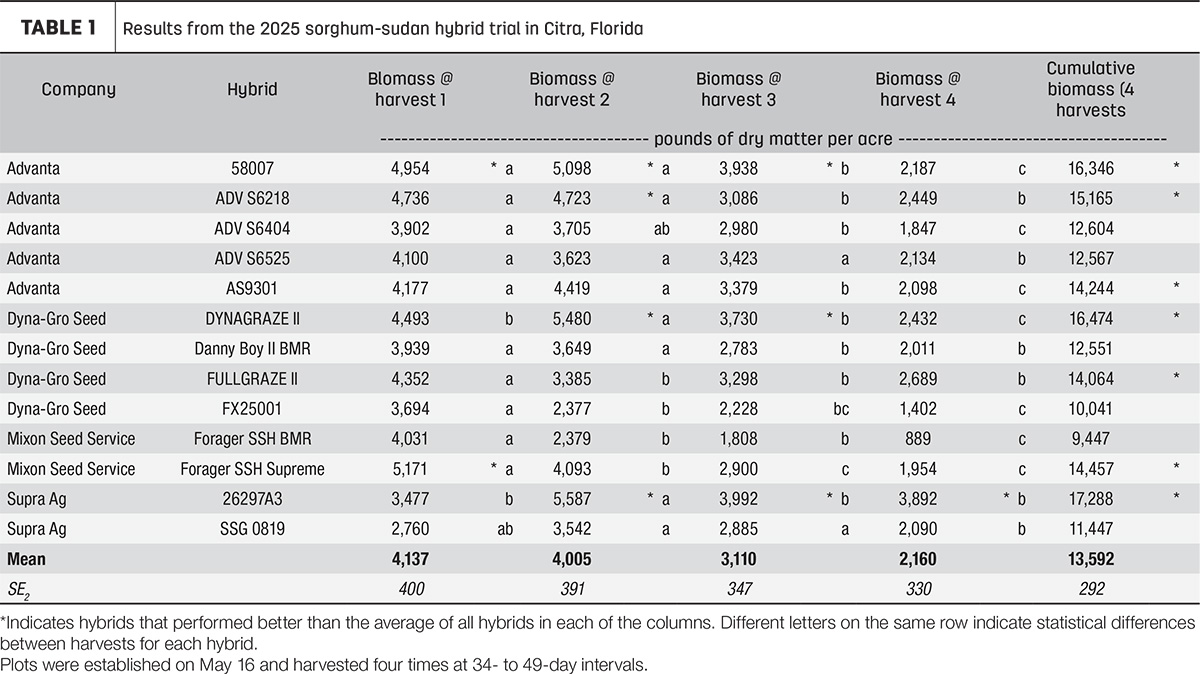
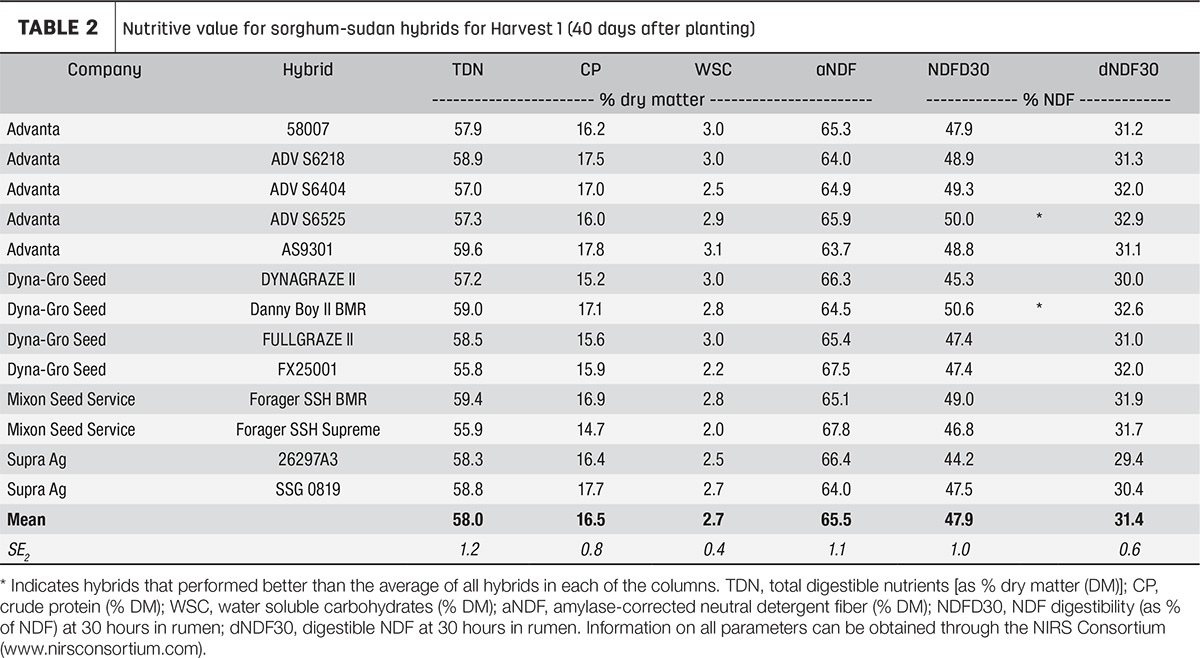
Results from the 2025 spring sorghum-sudan variety trial are displayed in Table 1 (biomass) and Table 2 (nutritive value). The trial was planted on May 16, 2025, at 300,000 seeds per acre on 7.5-inch rows, under irrigation. A total season fertilization was 200-56-80 pounds per acre of N-P-K, divided into pre-incorporated, starter and four other applications.
After each harvest, we applied 50 pounds per acre of N. Harvest dates were June 25, 2025 (40 days) for Harvest 1, July 31, 2025 (36 days) for Harvest 2, Sept. 3, 2025 (34 days) for Harvest 3 and Oct. 22, 2025 (49 days) for Harvest 4. It is unusual for us to have four cuttings for a spring planting, but we decided to push, and we got good results.
Some varieties dropped productivity significantly later in the season (Harvest 4), as shown by the mean separation letters (compare across columns). Two hybrids stand out for early (Harvest 1) and total (cumulative) production, Advanta 5807 and Mixon Forager SSH Supreme. Dyn-Gro Dynagraze II is a consistent material that has shown good performance across dates and years. Supra Ag 26297 A3 was a good option for total and late productivity, being the only one to be significantly above average in Harvest 4.
There was not that much difference in nutritive value parameters, since all entries were harvested before maturity (we often see more differences at later maturities, when seedheads are present). Two of the brown midrib (BMR) materials had, as expected, greater neutral detergent fiber digestibility (NDFd30).
More data is available for forage sorghum and sorghum-sudan, corn and millets, both for spring (March/April) and summer (July) planting dates, along with data from the cool-season annual forage trials. Those trials are partially supported by the sorghum checkoff program, the Florida Cattle Enhancement Board and the milk checkoff program, in partnership with the industry.
If you are interested in more information about our trials or have any questions about the data, contact us and follow us on social media: YouTube (UF IFAS Forages), Facebook (UFForageTeam) and Instagram (uf.forages).