Beef exports for September took another downturn in September 2025, according to data released by the USDA, with total beef exports dropping to the lowest level in five years.

Our Asian markets, a focal point for U.S. beef exports, trended lower in the month of September, according to export reports released by the U.S. Meat Export Federation (USMEF). Beef shipments to China are a casualty of the ongoing trade issues between the U.S. and China. Tariff rates, which reached 147% at their peak, have now dropped back down to 22% as of November 2025, as part of ongoing U.S.-China trade negotiations. September exports to China were down 96% in volume – 556 metric tons (MT) – and 98% in value ($2.5 million). As part of the Office of the U.S. Trade Representative’s (USTR) Section 301 investigation into China’s failure to follow through with the Phase I agreement, USMEF submitted comments to a public hearing on the issue, held in December 2025. They outlined the impact of the lost Chinese market share on U.S. red meat exports, estimating the lost value per head of fed cattle produced in the U.S. at $150 to $165 per head. Additionally, China has been filling the gap with Australian beef. Aussie beef exports to China have increased 55% (132,000 MT) from January-November 2025.
U.S. exports to South Korea decreased in both volume and value – down 18% (14,810 MT) and 20% ($139.3 million), respectively, compared to the previous year. However, the total January-September 2025 exports were 5% higher than 2024 numbers.
September shipments to Japan, the leading market by volume in 2025, decreased in both volume and value – down 12% (17,018 MT) and 16% ($121.8 million), respectively. Total exports January-September 2025 were 4% lower than the previous year.
Closer to home, September beef exports to Canada increased in volume – 2% (7,661 MT) and value – 13% ($73.7 million) compared to a year ago. Total January-September exports to Canada were 7% below last year in volume (71,858 MT) and 6% lower in value ($659.8 million).
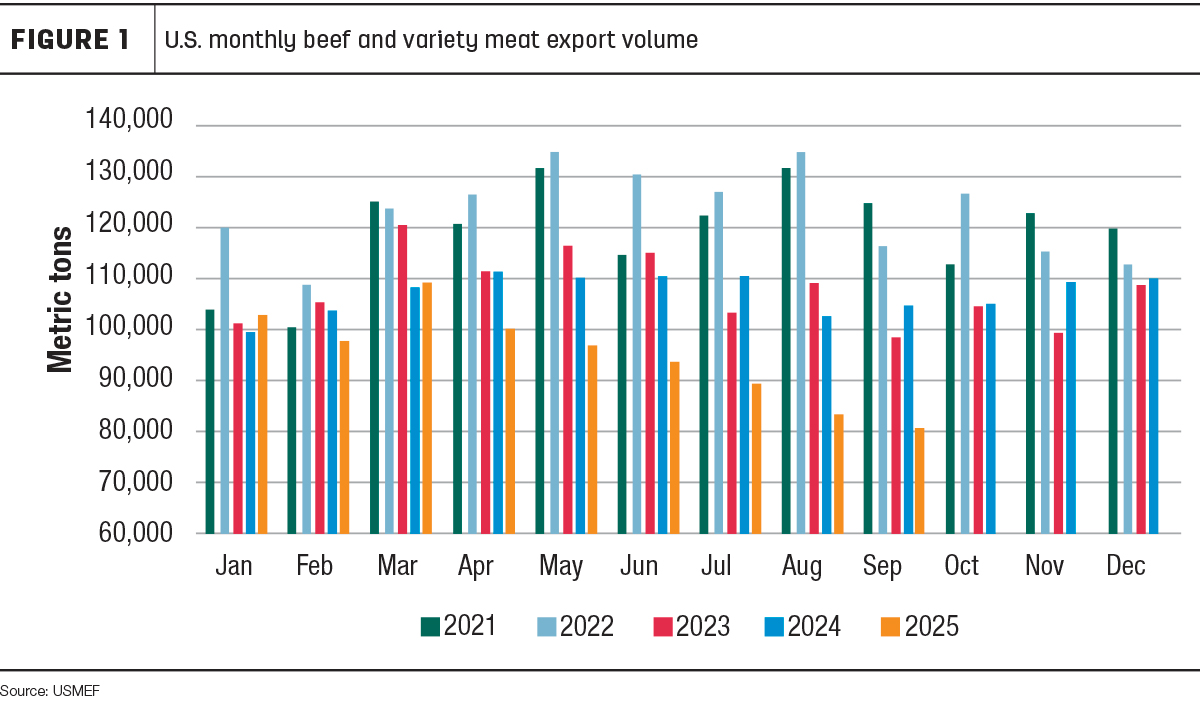
September exports to Mexico increased 5% ($117.3 million) in value and decreased 14% in volume (16,862 MT) compared to a year ago. Exports to Mexico were down 11% (154,694 MT) in volume and 4% ($974 million) in value, through the first three quarters of 2025. The USMEF report also takes note of Brazil’s increasing exports to Mexico. As of the most recent data available, Brazilian beef exports make up a significant part of Mexico’s beef supply, and they are the largest supplier of beef muscle cuts to Mexico.
USMEF calculates that the September beef export value equated to $337.21 per head of fed slaughter, down 18% from a year ago, while the January-September average was down 5% to $393.25. Exports accounted for 10.9% of total September beef production and 8.8% of muscle cuts, down significantly from the respective September 2024 ratios of 13.8% and 11.3%. For January through September, exports accounted for 12.9% of total beef production and 10.7% for muscle cuts, each down about one percentage point from a year ago.
With a tightening domestic supply and high beef prices at home as well as volatile exchange rates abroad, 2025 was an interesting year for beef exports, and as of the publication date for this article, we haven’t seen the full year’s data yet. Several awaiting developments will shape how the 2026 year will go: Trade negotiations with China, including actual enforcement of their end of the bargain and a relaxation of tariffs on a global scale; cattle prices which, while high, don’t seem to indicate a push for heifer retention and rebuilding the U.S. herd just yet; and the looming threat of New World screwworm, which continues to disrupt live cattle supplies from Mexico. Another big question for 2026 is how big of a role will Brazil and other South American exports play in the U.S. and global demand for beef? We shall have to see.