For the past 14 years, I’ve had the responsibility – and privilege – of serving as the independent economist evaluating the national dairy checkoff. My team at Texas A&M has looked at mountains of data, ran every model imaginable and has done what economists do: remove the noise to find the signal.
After all that analysis, here’s the signal I want dairy farmers and importers to know: Your checkoff investment is paying off in significant, measurable ways.
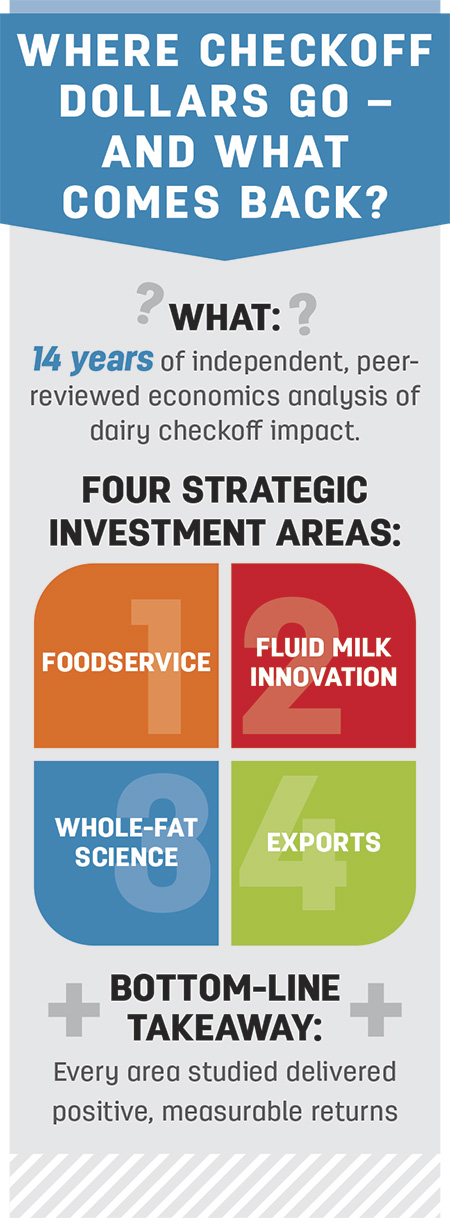
Our latest Dairy Checkoff Economic Impact Report examined four major areas of the Dairy Management Inc. (DMI) business strategy: food service partnerships, fluid milk innovation, whole-fat science and exports.
Each program exists because farmers set a strategy years ago to move beyond only advertising and build sales with and through partners who could bring real scale to dairy. My job was to examine the various years of investment and to determine whether those decisions made a difference.
They did. And the numbers speak for themselves.
Food service partnerships: Real menu impact
When you walk into Domino’s, Taco Bell or McDonald’s, you can see what checkoff leadership helped create: more cheese, more dairy ingredients, more innovation that keeps dairy front and center for millions of consumers.
When we modeled DMI’s investment alongside the pounds of milkfat equivalent used by these partners from 2009 to 2024, the net return was about 3.5 to 1 on average, so for every dollar invested, $3.50 in dairy sales were generated.
And that may underestimate the true effect. When major brands innovate with dairy, others follow in what economists call “spillover effects.” These gains aren’t included in the analysis, so the actual benefit may be larger.
Fluid milk innovation: Driving turnaround
For decades, per capita fluid milk consumption moved downward, but innovation has changed that trajectory.
Lactose-free and ultra-filtered milk and gut-health-focused products are bringing consumers back to dairy. DMI began investing in this area around 2015, and although our ability to measure starts in 2018 (due to data availability), the results are positive. From 2018 to 2024, fluid milk innovation delivered a net return of 1.7 to 1 on average, so for every dollar invested, $1.70 in dairy sales were generated.
And the most recent years show something more promising: net returns of 6.4 to 1. The early work primed the pump for today’s momentum. Without this innovation, the fluid milk decline likely would have continued and potentially accelerated.
Whole-fat science: Significant return
One of the most remarkable findings came from the checkoff’s work in whole-fat dairy science. National Dairy Council-led research has helped shift perceptions and better reflect what modern science shows about whole milk and butter.
You’ve seen butter consumption climbing and whole milk stabilizing fluid sales. Our job was to determine whether DMI’s investment helped fuel that shift.
The answer is yes. The net impact in whole-fat dairy science came in at 35 to 1 on average across the period 2012 to 2024. This finding reflects what happens when credible research and consistent investment shift consumer perceptions.
Exports: Vision that changed industry
Farmers had the foresight in 1995 to create the U.S. Dairy Export Council through their checkoff, and that decision continues to pay off.
Exports today account for roughly one out of every six tankers of milk produced. When we analyzed checkoff investments in exports from 2013 to 2024, focusing on skim-solids products where most investment occurs, the net return was roughly 12 to 1 on average.
That’s an extraordinary success story. Exports help balance domestic markets, add value to milk and support price stability, which are benefits felt across the industry.
Third-party, peer-reviewed analysis
I know farmers value straight talk. So here’s mine.
I’m not paid to produce good news. My role is to conduct replicable, peer-reviewed analysis. If the data showed poor returns, that’s what I would report. But that’s not what we found.
Across every area we studied, the checkoff delivered positive, meaningful returns that would hold up to any economist’s scrutiny.
Yet a common question I hear is, “What does this mean for my farm?” Every farm is different, and the analysis measures industry-wide impact, not individual outcomes. But we’ve run simulations to estimate what the all-milk price would look like without the checkoff.
The result: about $1 per hundredweight lower.
When I boil it down, here’s what I say to farmers: You may not see the checkoff’s hand every day, but you would certainly feel its absence.
No single program drives change overnight. But over many years, consistent farmer leadership and strategic direction have built programs that grow sales and strengthen trust in ways no farm or group of farms could accomplish alone.
As someone raised far from farm country who discovered a deep respect for the people who produce our nation’s milk, I can say this with confidence: Your work matters, and these results show the checkoff is helping you continue doing what you do best – helping to feed the world.
This column was written by Dr. Oral “Jug” Capps, executive professor and regents professor, director in the department of agricultural economics at Texas A&M University. To learn more about Capps’ research, check out the Your Dairy Checkoff Podcast. For more information on your national dairy checkoff, visit online or to reach us directly, send an email.