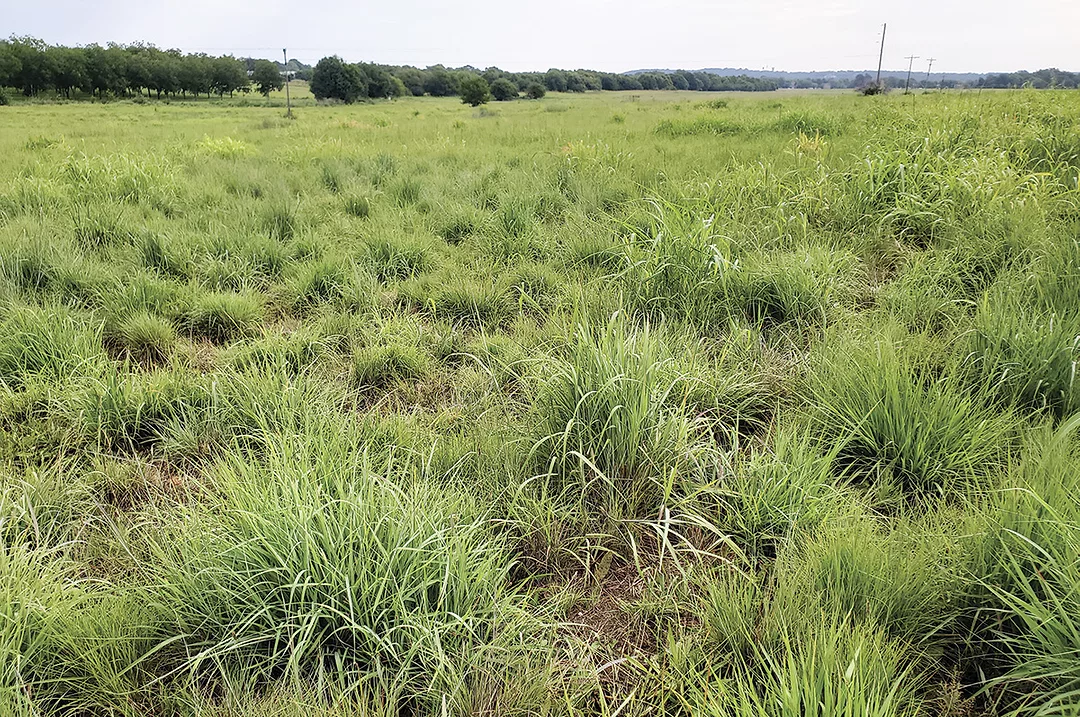
Native perennial warm‑season grasses once blanketed much of the continental U.S. – from the Gulf Coast to the Upper Midwest and from the Great Plains to New England. Shaped by millennia of heat, drought, storms and temperature extremes, these grasses formed the backbone of prairie ecosystems capable of sustaining ruminant herds at scales unmatched anywhere else in the world.

Their resilience stems from several biological advantages: highly efficient carbon dioxide (CO2) capture and energy conversion, superior water use efficiency and lower nutrient requirements than introduced cool‑season perennials, such as tall fescue. This blend of input frugality and reliable forage quality is what makes native grasses increasingly attractive to cattle producers across diverse climates and production models.
Native perennial warm-season species such as big bluestem, indiangrass, little bluestem, switchgrass and eastern gamagrass have been widely used on rangelands and in restoration projects, but their benefits are less known among cattlemen in the eastern U.S. The grasses mentioned are considered the “big” prairie grasses, making up 60% to 80% of dry matter (DM) accumulation in prairies. Because of their perennial nature, the establishment and management of these grasses requires a perennial commitment as well, but it is one that will pay off in terms of stand persistence, drought and heat resiliency, weed suppression capabilities and wildlife habitat value.
How would native grasses help improve your operation, you ask? Let’s look at a few points to consider.
Resilient, grazable summer forage
For grazing purposes, we recommend a three-way mix of big bluestem, indiangrass and little bluestem at a ratio of about 7-to-2-to-1. This mimics naturally occurring biomass proportions, canopy stratification, peak DM production and maturity windows. This mix is usable for grazing between early May and mid-September, or about four to six weeks before the first frost date in your area. These grasses are well suited to bridge the summer months when temperatures and evaporation rates are well outside of what is ideal for typical cool-season perennial forages.
A major advantage of native warm-season grasses is their ability to recover from drought periods. Due to their efficient CO2 utilization, they can generate more DM with the same amount of soil water, making them more water use efficient. Soil type and texture permitting, big bluestem and indiangrass can reach remaining soil water several feet deep into the profile because of the voluminous fibrous root systems that make up most of their overall plant biomass. This will increase the likelihood of stand retention after a drought event, decrease the likelihood of total loss after a severe drought period and decrease the need for complete pasture renovation.
There are other positive aspects. The tall canopy of native grass plantings is a major deterrent to typical weeds known to frequently occur in short-canopy cool-season pastures. Most grassy and broadleaf weeds will be absent in well-established, mature native grass stands facilitated by a permanently shaded understory. Native grasses also provide wildlife habitat value due to their unique canopy structure. The three-way mix mentioned above will grow into a spatial arrangement of smaller and larger crowns over time, thereby creating travel corridors and offering shelter opportunities for ground-nesting birds and small mammals.
Equally important, nutrient requirements for native perennial warm-season grasses are relatively low. Natural nitrogen input to original prairie ecosystems is around 15 pounds of nitrogen per acre and year; thus, native grasses are used to generate substantial amounts of DM with much less nitrogen than is proportionally needed for introduced cool-season perennial forages. Native grasses will, of course, perform better on “good” soils and less so on poorer soils. However, there is no requirement to fertilize native grasses with nitrogen (N), phosphorus (P) and potassium (K) (N-P-K) on a regular basis.
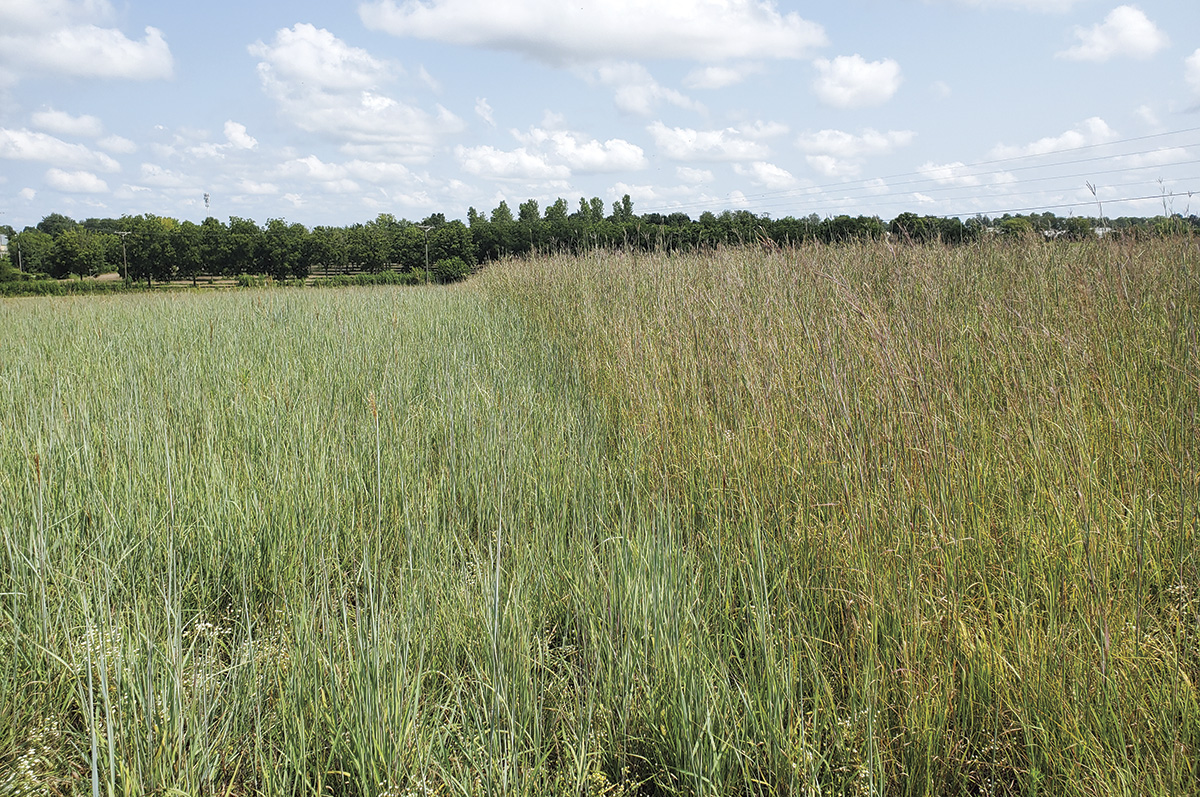
Pictured is a 4-year-old planting of native perennial warm-season grasses in northwestern Arkansas. On the left side is an indiangrass-little bluestem mix, and on the right side is a big bluestem-indiangrass mix planted for research purposes. Image by Dirk Philipp.
Grazing management
Native warm-season grasses will need to be grazed at a height of “between the top of your [cowboy] boot and below your hip.” Credit for this quote goes to someone else, but this basically means managing canopies between 15 to 30 inches from the soil surface. When stocked on big bluestem in May, cattle will literally devour the stand and may rapidly graze too low before you even have time to move the animals; thus, the 15-inch minimum grazing height is a reasonable safeguard.
What’s more, the rate of plant regrowth is related to the remaining leaf area after a grazing event. If grazed too low, especially in spring during the very first stocking cycle, recovery will be exponentially slowed. You should not leave cattle unsupervised for long on native grass pastures. Monitor grazing heights closely, and move them once the minimum target height is in reach.
A big bluestem mix may be stocked multiple times until around four weeks before the average fall freezing date to allow sufficient leaf and root mass accumulation after the last grazing event of the season. Every year is different, and if summer rains remain scarce, you may fit one or, at a maximum, two rotations into your native pasture summer grazing. Likewise, be sure to stock (again) in a timely manner when stands are still vegetative, implement relatively high stocking densities to move them diligently through the grazing cells and don’t let them linger, because that would result in trampling of plant crowns, increased defecation, spoiling of surrounding grazeable forage and slow regrowth. One of my most impressionable experiences working with native grass has been the observation that they are very traffic sensitive. Avoid driving around on native grass pastures with equipment; instead, be strategic with fence setup, moving animals and going on foot – getting your steps in for the day.
Regarding forage quality, native perennial warm-season grasses are certainly not winter annuals, but nutritive values are more than sufficient for a positive economic outcome. Average daily gains have been shown to fall between 1.5 and 2.5 pounds per acre based on replicated experiments conducted across the southern U.S. using systems and native grass species. Such gains require proper stocking techniques appropriate for native grass management for your location.
Establishing and maintaining healthy, productive stands of native perennial warm-season grasses requires long-term commitment and passion. Start small, and plan for a full two years before you can start grazing. Since successful plantings of natives will easily last for decades, this initial period is short in comparison with the long-term benefits.
Native grasses are optimally planted into a well-prepared, well-settled, clean and weed-free seedbed in spring that requires prep work the entire year prior. The biological establishment process itself isn’t necessarily slower than with other perennial grasses, but native grasses are more sensitive to competition during the establishment year due to their uneven emergence.
We have observed very good and even seedling emergence from mixes when soil temperature, day length and soil water status fall perfectly in line, but this is seldom the case. One full growing season of weed control and disking (where possible) prior to the establishment year is necessary, and it may have to be repeated during the prep year, depending on the type of undesired plants you need to control.