Winter is beginning to loosen its grip, but hay markets remain steady and cautious as producers wait for clearer spring signals. Feeding demand is still firm, and prices hold moderate and uneven, shaped by wide quality gaps and a slow export pace.

Moisture patterns remain mixed: The Midwest and Northeast stay locked in dryness, the Southeast continues to lean on supplemental feeding and the West watches snowpack closely as early deficits persist in the Pacific Northwest and Great Basin.
With roughly one‑third of hay acreage still drought‑affected, the market enters March in a holding pattern – selective buying, careful inventory management and a close eye on late‑season storms that will set the tone for early spring.
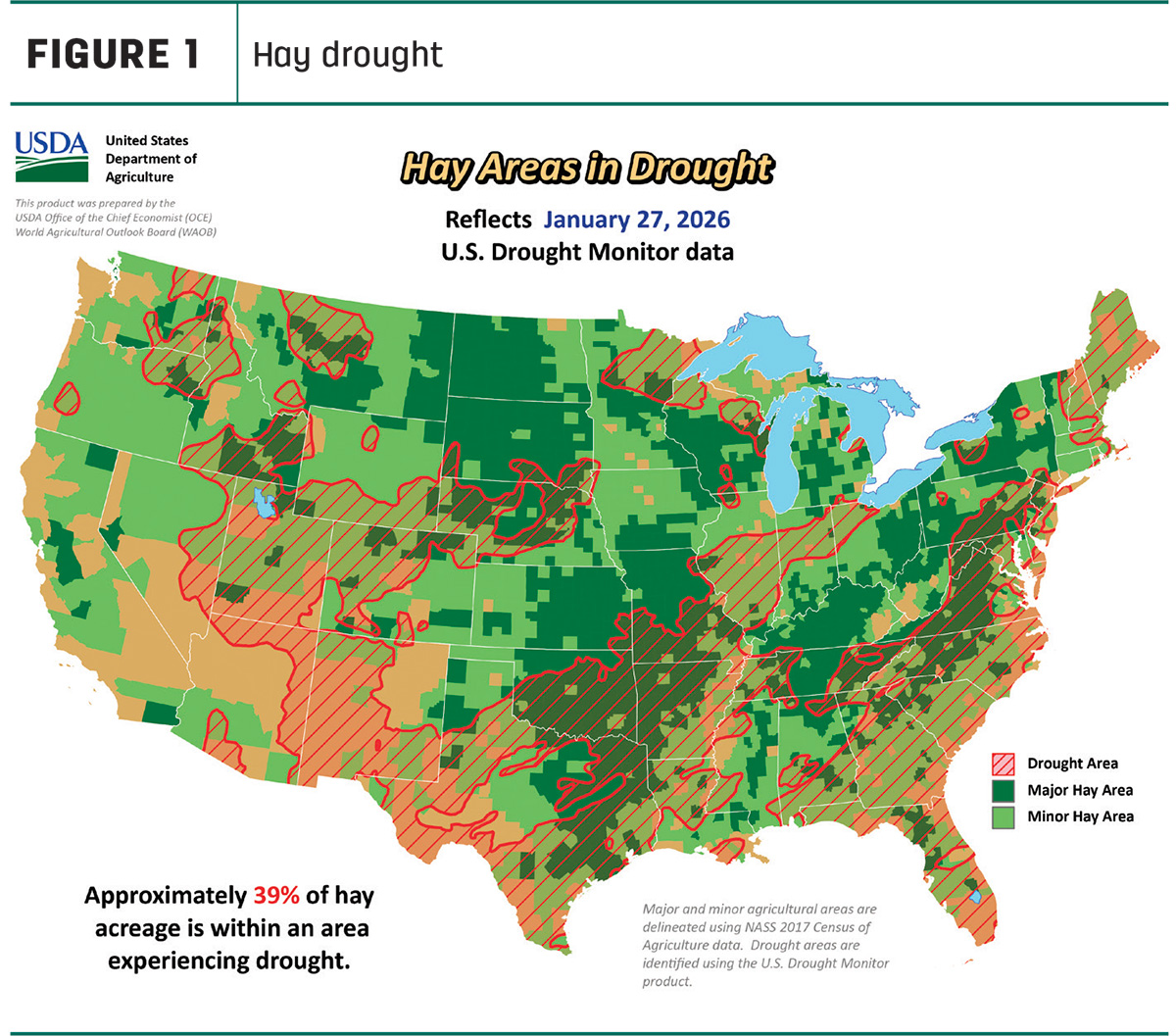
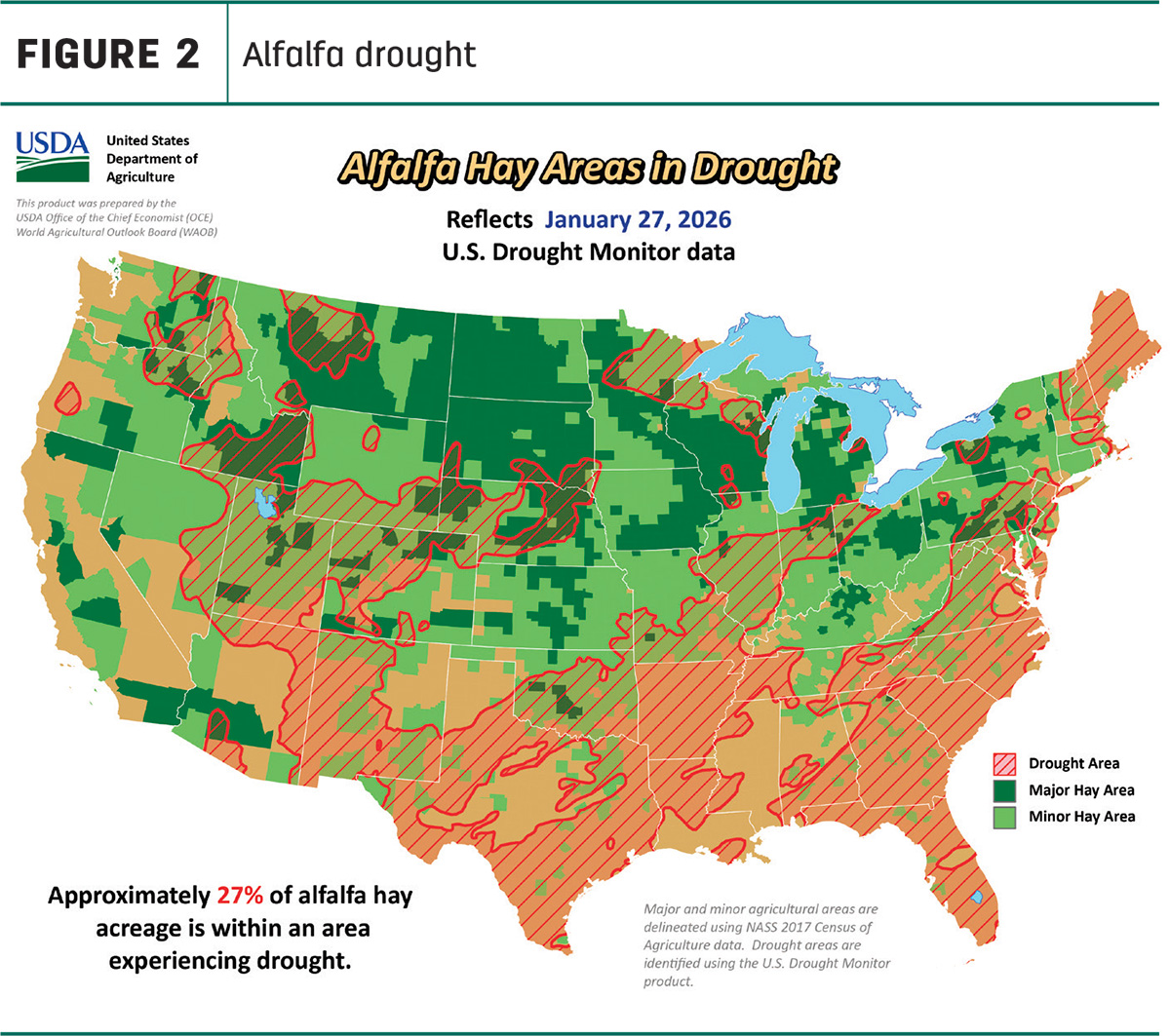
As of Jan. 27, approximately 39% of U.S. hay-producing acreage (Figure 1) was considered under drought conditions, a decrease of 3% from a month earlier. The estimate of alfalfa hay-producing acreage (Figure 2) under drought conditions increase to 27%, 2% less than a month earlier.
A snapshot of hay prices
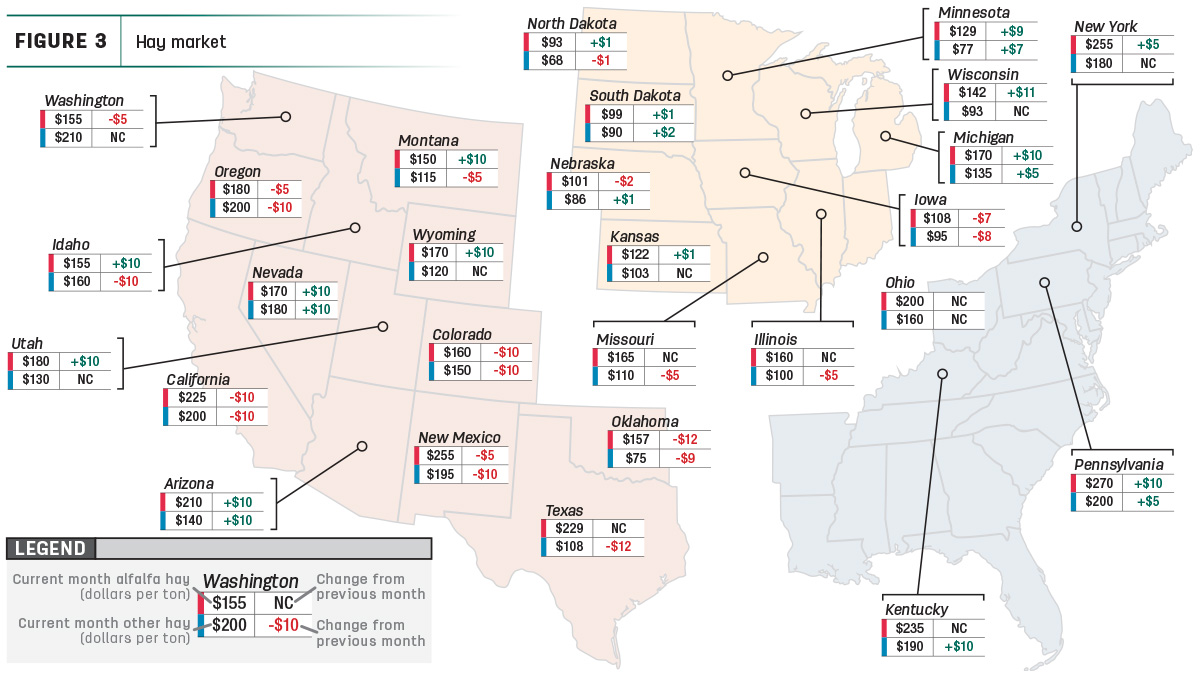
USDA price data for 27 major hay-producing states is mapped in Figure 3, illustrating the most recent monthly average price and one-month change. The lag in USDA price reports and price averaging across several quality grades of hay may not always capture current markets, so check individual market reports elsewhere in Progressive Forage.
Dairy hay
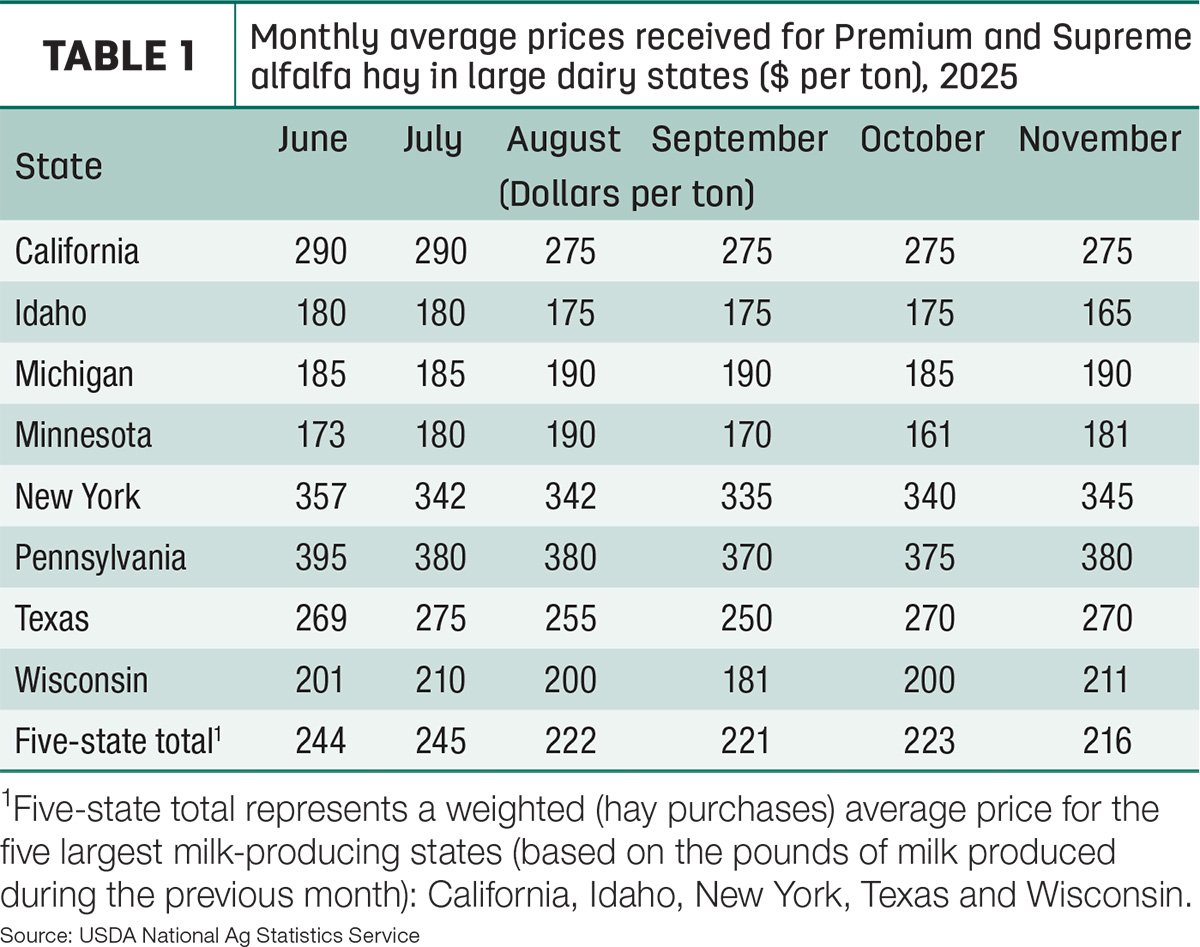
The top milk-producing states reported an average price of $211 per ton for Premium and Supreme alfalfa hay in December 2025, a $5 decrease from November 2025 (Table 1). The average price was $19 lower than November 2024.
Alfalfa
The U.S. average price for all alfalfa hay increased $2 in December to $161 per ton. Compared to a month earlier, prices were lower in seven of 27 major forage states, with the largest declines in California, Colorado, Iowa, Nebraska, New Mexico, Oklahoma and Oregon. Prices were up in 13 states including Arizona, Idaho, Kansas, Michigan, Minnesota, Montana, Nevada, New York, North Dakota, Pennsylvania, South Dakota, Utah and Wisconsin.
With few exceptions, year-over-year alfalfa hay prices were down substantially, with the U.S. average down $3 compared to December 2024.
Other hay
At $128 per ton, the December 2025 U.S. average price for other hay was down $6 from November. Prices decreased in 14 of 27 major hay-producing states, with the largest month-to-month decrease in California, Colorado, Idaho, Illinois, Iowa, Missouri, Montana, New Mexico, North Dakota, Oklahoma, Oregon, Texas, Washington and Wisconsin. Increases were recorded in 10 states including Arizona, Kentucky, Michigan, Minnesota, Nebraska, Nevada, Pennsylvania, South Dakota, Utah and Wyoming.
Expanding the timeline, the December 2025 U.S. average price for other hay was $20 less than a year earlier.
The gap between average U.S. alfalfa and other hay prices was about $33 per ton in December.
Exports
At deadline, November 2025 exports held steady, with buyers remaining selective as currency pressure, freight costs and uneven dairy margins shaped demand. Movement stayed close to fall levels, reflecting a cautious global tone heading into winter.
At 151,290 metric tons (MT), November exports of alfalfa hay decreased. China was the top buyer, importing 60,766 MT during the month, about 40% of the total. November shipments to Japan also maintained a somewhat steady eight-month trend with an increase at 29,903 MT, 20% of the total for November.
Exports of other hay increased to 83,729 MT in November. As usual, Japan and South Korea led buyers in the other hay category: Japan purchased 37,008 MT during the month, or about 44% of the total, followed by South Korea’s 30,782 MT, 36% of the total.
U.S. exports of most categories of alfalfa cubes and meal were lower in November, totaling about 5,247 MT. Japan imported about 65% of the total.
Regional markets
Regional hay markets remain steady as winter winds down, with most areas reporting adequate supplies and only selective premiums for top‑quality alfalfa. Beef demand stays conservative as producers stretch feed budgets, while freight and fuel costs continue to influence delivered prices. Interest rates are still tempering forward contracting and regions are watching late‑season weather and inventory drawdown as they prepare for early‑spring buying.
Midwest: In Nebraska, compared to the last report, all reported hay sales sold steady except for grass hay rounds, which traded lower. Demand is mostly light to moderate on all classes.
In Kansas, interest in hay varied across regions, with some areas reporting increased inquiries, though no notable changes in pricing or movement were observed. However, some parts of the state have seen an increase in grass hay movement, as many producers burned through supplies during the recent cold snap.
In Illinois, comparable alfalfa in small squares sold higher. Mixed grass in large rounds sold lower. Trade was active with good demand.
In Iowa, all grades of hay and bedding are weak. Nicer weather in the trade area has diminished the demand and increased the supply being offered. Trade is slow to moderate with light to moderate demand.
In Missouri, hay demand is light to moderate and being outweighed by the current supply. Prices are mostly steady.
In South Dakota, light to moderate demand for all types of hay. Plentiful hay supplies and lack of snow is really keeping a damper on the hay market. High testing dairy hay is harder to find; best outlet for that type of hay is from out of state.
East: In Alabama, hay prices are steady. Trade moderate with moderate supply, with good demand.
In Tennessee, trade for hay was active in November and December, with moderate demand throughout the state for all classes of hay. Dry conditions throughout the state shortened the grazing and growing season, increasing demand and trade activity for stored hay, with some cooperators noting they are already sold out for the season.
Southwest: In California, trade activity and demand is steady.
In Oklahoma, due to the snowstorm, movement has picked up; movement has been slow to steady over the past couple of weeks.
In Texas, hay prices remain steady with good demand.
Northwest: In Montana, hay sold mostly steady. Hay supplies continue to tighten across the state. Hay supplies in northern and western Montana are extremely tight and many producers are trucking hay in from central and southern Montana. Most producers in western and northern Montana report they are sold out of hay for the season. Some central Montana hay producers are starting to report that they are sold out of hay as well. Hay across the state has seen increased demand due to tighter supplies. Demand for round bales is very good as many ranchers report that they are hard to find. Hay in rounds continues to bring a premium to hay in squares. However, some ranchers are starting to buy hay in squares as round supplies are very tight.
In Utah, demand is moderate. There has been some good demand for feeder hay and grain hay mixes. A couple more farms sold out of their 2025 crop. There doesn't seem to be a lot of inventory sitting out across the state as the demand throughout the year has almost matched the supply. Grain hay mixes supplies are very light in the state with having high demand all winter. Dairy and export-quality hay seems to have moderate supplies in the state with dairies not buying as much hay right now as they normally do, and some hay presses in surrounding states have been shutting down.
In Idaho, demand for good-quality alfalfa is light and very light on Premium and Supreme-quality alfalfa. Grain hay has had moderate demand but light supplies. There is lots of hay moving down the highways from previous contracts and agreements, but there hasn't been a lot of new sales.
In Washington-Oregon, all grades of hay steady in a light test. Trade remains slow with light to moderate demand.
In Wyoming, most hay sales sold steady, instances higher on some large square bales in the eastern side of the state. Demand was moderate. Bulk of the contacts that contribute to this report are sold out of hay. Some still have some loads of alfalfa and teff grass left to sell in small and large squares. Some producers believe that with the exceptionally warm and dry weather, the hay market could spike soon.
In Colorado, trade activity light on moderate demand. Prices are mostly steady across all hay types.
Other things we’re seeing
- Dairy: Milk supplies are leveling off as earlier culling trims herd size, while steady cow productivity keeps volumes from slipping further. Cheese and butter prices are inching off winter lows, but Class III and IV values remain subdued, leaving margins compressed despite softer feed costs. Export interest is steady, yet domestic demand is still sluggish, limiting any meaningful price recovery. Producers head into spring with disciplined herd management and cautious optimism as markets search for firmer footing.
- Cattle: Cattle supplies stay tight, keeping prices supported as feedlot placements remain below last year. Feeder numbers are still limited, and uneven moisture continues to slow herd rebuilding. Cow retention holds, but high input costs and cautious sentiment keep expansion muted. Strong cattle values help, yet producer margins remain narrow heading into spring.
- Fuel: National average fuel prices were slightly higher to start February, according to the U.S. Energy Information Administration (EIA). The U.S. retail price for regular-grade gasoline averaged $2.87 per gallon on Feb. 2, up 1.4 cents from the previous week and 21.5 cents lower than the same week a year earlier. The average U.S. on-highway price of diesel was $3.68 per gallon, up 5.7 cents from the prior week and 2.1 cents more than early February 2025.
- Trucking: Spot flatbed prices were higher to start February, averaging $2.57 per mile nationally, according to DAT Trendlines. Regionally, average spot prices per mile were: Southeast – $2.74, Midwest – $2.80, South – $2.55, Northeast – $2.48 and West – $2.29.
- Other costs: The January 2026 prices paid index edged up 0.3% to 141.8, with higher livestock and machinery costs outweighing continued softness in energy and forage markets. The index is now 1.6% above year‑ago levels, reflecting steady pressure from animal‑related inputs despite easing fuel prices.
- Total feed prices: Total feed costs were mostly steady in January, with firm feed grains and complete feeds continuing to carry the pressure. Hay, forages and supplements remain soft, and easing energy prices offer only limited relief. Ration management stays front‑of‑mind as producers move toward spring with feed markets still holding firm.
- Interest rates: USDA Farm Service Agency (FSA) interest rates for direct farm operating loans (4.625%) held steady and direct ownership loans (5.75%) were lower for February.