Markets open with the first real signs of new‑crop potential, but confidence remains measured as drought persists across key hay regions. Early cuttings are just beginning in the southern tier, with isolated pockets of good quality, yet most producers remain cautious. Movement is steady to light, demand firm and prices mostly unchanged, still defined by wide quality spreads and selective buying.

Moisture patterns continue to diverge: The Midwest and Northeast see only modest improvement from April storms, the Southeast slowly transitions out of supplemental feeding, and the West faces another season shaped by a patchy snowpack – adequate in the southern Rockies and Southwest but thin across the Pacific Northwest and Great Basin. With roughly one‑quarter to one‑third of hay acreage still drought‑affected, markets focus on first‑cutting yields, early‑summer supply signals and the durability of spring moisture.
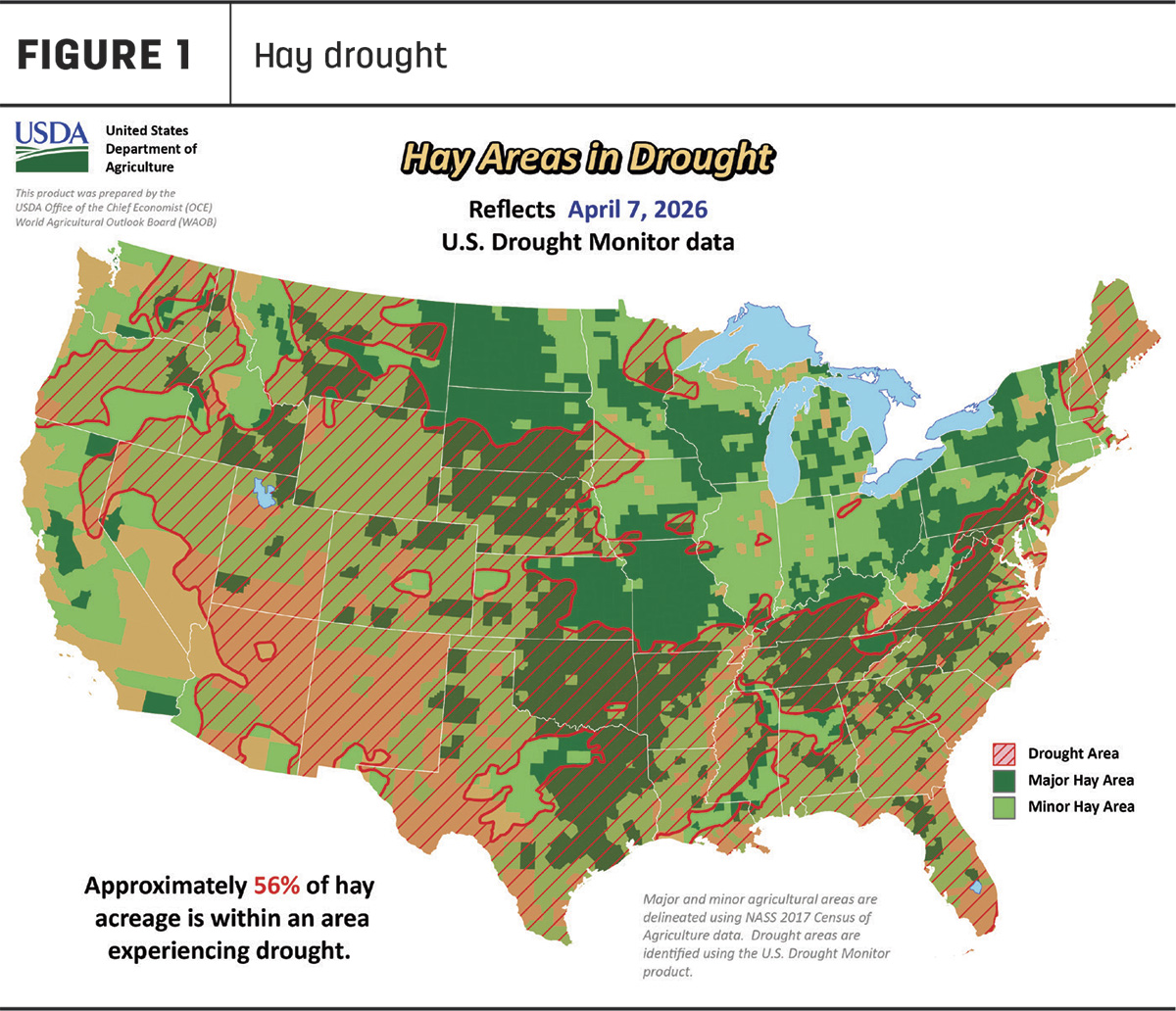
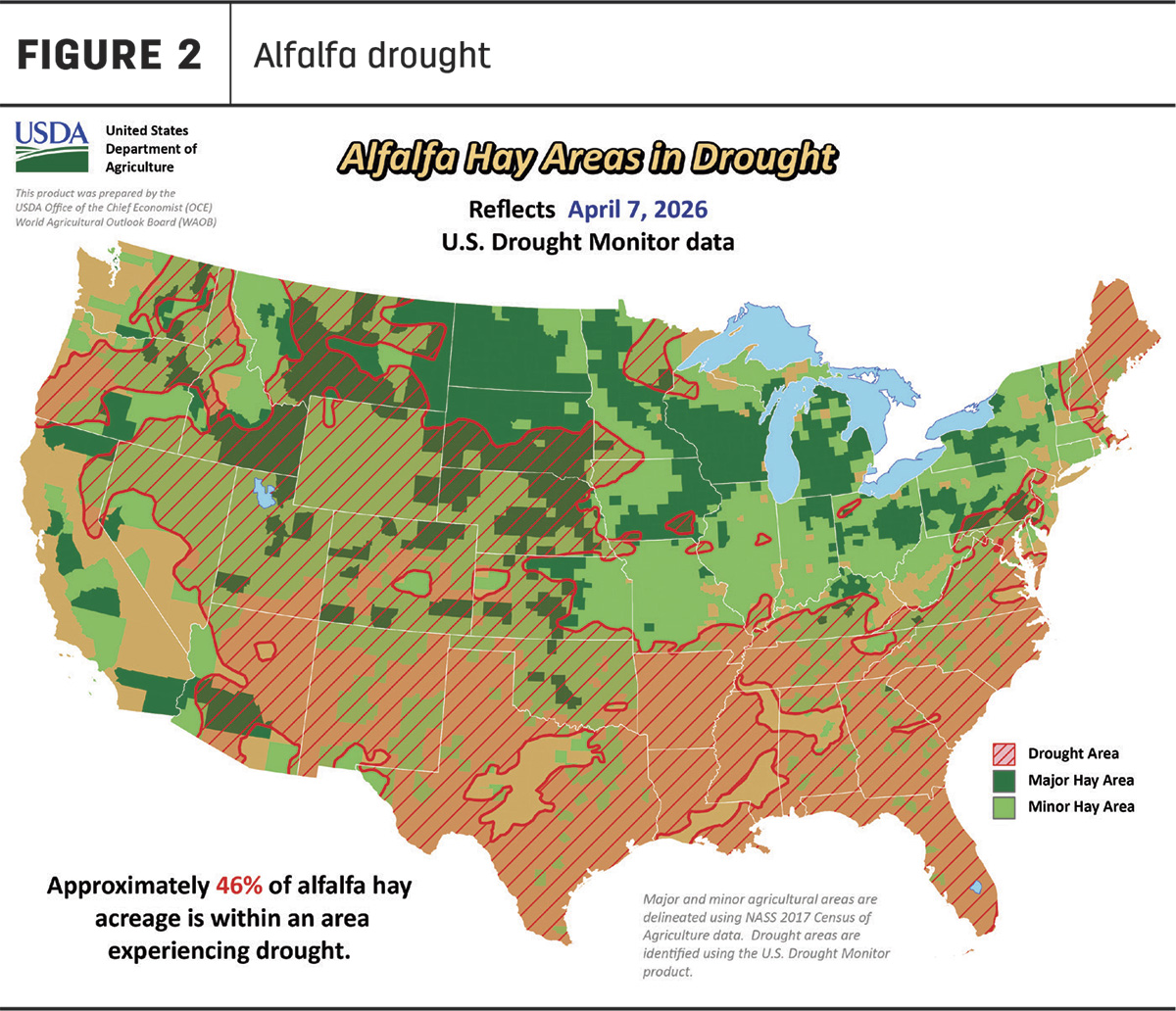
As of April 7, approximately 56% of U.S. hay-producing acreage (Figure 1) was considered under drought conditions, an increase of 5% from a month earlier. The estimate of alfalfa hay-producing acreage (Figure 2) under drought conditions increased to 46%, 4% more than a month earlier.
A snapshot of hay prices
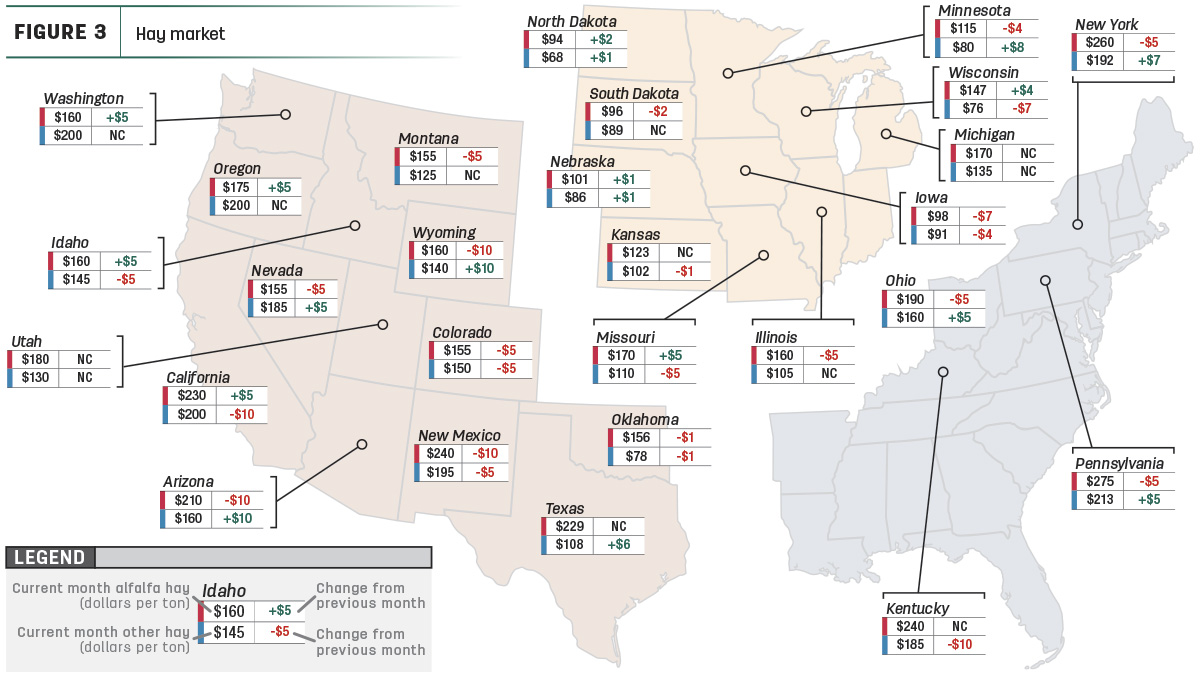
USDA price data for 27 major hay-producing states is mapped in Figure 3, illustrating the most recent monthly average price and one-month change. The lag in USDA price reports and price averaging across several quality grades of hay may not always capture current markets, so check individual market reports elsewhere in Progressive Forage.
Dairy hay
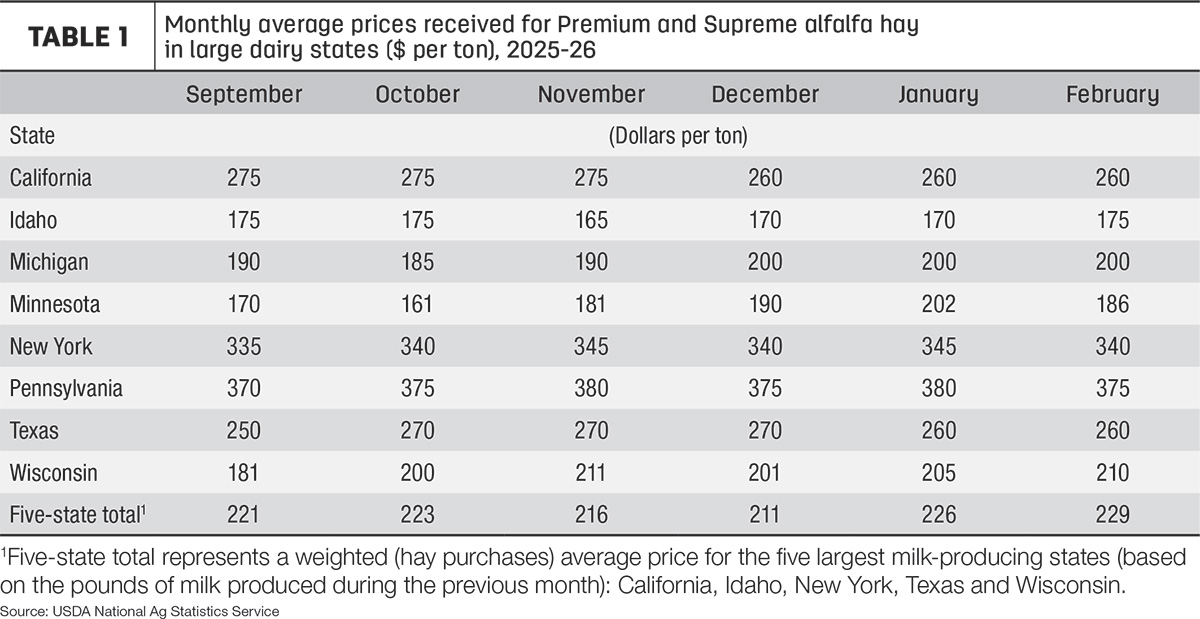
The top milk-producing states reported an average price of $229 per ton for Premium and Supreme alfalfa hay in February 2026, a $3 increase from January 2026 (Table 1). The average price was $14 lower than February 2025.
Alfalfa
The U.S. average price for all alfalfa hay decreased $1 in February to $159 per ton. Compared to a month earlier, prices were lower in 14 of 27 major forage states, with the largest declines in Arizona, Colorado, Illinois, Iowa, Minnesota, Montana, Nevada, New Mexico, New York, Ohio, Oklahoma, Pennsylvania, South Dakota and Wyoming. Prices were up in eight states including California, Idaho, Missouri, Nebraska, North Dakota, Oregon, Washington and Wisconsin.
With few exceptions year-over-year alfalfa hay prices were down, with the U.S. average the same compared to January 2025.
Other hay
At $139 per ton, the February 2026 U.S. average price for other hay was up $8 from January. Prices decreased in 11 of 27 major hay-producing states, with the largest month-to-month decrease in California, Colorado, Idaho, Iowa, Kansas, Kentucky, Missouri, New Mexico, Oklahoma, Utah and Wisconsin. Increases were recorded in 10 states including Arizona, Minnesota, Nebraska, Nevada, New York, North Dakota, Ohio, Pennsylvania, Texas and Wyoming.
Expanding the timeline, the February 2026 U.S. average price for other hay was $8 less than a year earlier.
The gap between average U.S. alfalfa and other hay prices was about $20 per ton in February.
Exports
At deadline, February 2026 exports held steady, reflecting selective buying as currency pressure, freight costs and uneven dairy margins continued to shape global demand. Overall movement tracked close to late‑fall and early‑winter levels, signaling a cautious tone as key markets waited for clearer spring supply signals.
At 138,775 metric tons (MT), February alfalfa hay exports decreased. China remained the top buyer at 54,078 MT, accounting for about 39% of total shipments. Sales to Japan decreased at 29,255 MT, and shipments to Saudi Arabia decreased to 21,742 MT – representing just over 21% and 16% of the month’s total, respectively.
Exports of other hay increased to 80,280 MT in February. As usual, Japan and South Korea led buyers in the other hay category: Japan purchased 35,665 MT during the month, or about 44% of the total, followed by South Korea’s 25,767 MT, 32% of the total.
U.S. exports of most categories of alfalfa cubes and meal were lower in February, totaling about 6,610 MT. Japan imported about 61% of the total.
Regional markets
Regional hay markets remain steady with adequate supplies and only selective premiums for top alfalfa. Movement is slow but improving, and freight and fuel continue to shape delivered prices as early moisture and tightening inventories guide May buying strength.
- Midwest: In Nebraska, compared to the last report, central and eastern areas round bales of alfalfa and prairie grass hay sold steady, ground and delivered hay steady, and alfalfa pellets sold steady. Demand was good.
In Kansas, demand has picked up slightly as buyers remain concerned about drought conditions and limited rain in the forecast. Forage is available, though much of it is lower quality. Alfalfa stands have experienced notable pest pressure.
In Illinois, comparable hays in small squares traded steady, comparable hays in large packages sold mostly higher. Trade was active with good demand.
In Iowa, alfalfa and grass firm on higher quality. Trade active with good buyer attendance. Demand good.
In Missouri, compared to the last sale, the supply was lighter and the attendance was down by half. Most classes of hay sold steady with exception to the round bales of alfalfa.
In South Dakota, there is good demand for grass hay, light to moderate demand for alfalfa. Good interest from beef cattle operations looking to buy grass hay, not near the interest in buying alfalfa. Large dairy operations continue to feed haylage, which is keeping the alfalfa market under some pressure.
- East: In Alabama, hay prices steady. Trade and supply moderate, with moderate demand.
In Tennessee, current hay stores remain limited, with most of last season’s crop sold or in use. Difficulty transporting hay from out of state was noted, with availability of trucking capacity being the limiting factor.
- Southwest: In California, trade activity is slow with light demand. Export hay is slow while dairy hay demand is light. Retail hay demand is steady.
In Oklahoma, movement is steady. Hay is becoming a needed forage in some parts of the state due to Oklahoma being so dry; there is some rain in sight, but it has been limited by drought and wind.
In Texas, hay prices remain steady with good demand. In the Panhandle, supplies were tight with slow activity, while in the south, first cutting was baled and sold out.
- Northwest: In Montana, hay is trading mostly steady to slightly higher as supplies in central and western Montana tighten further. Buying has increased from ranchers preparing for drought and those needing feed until turnout, which has pulled inventories down.
In Utah, more farmers sold out of their 2025 crop. There doesn't seem to be a lot of inventory sitting out across the state as the demand throughout the year has matched the supply. Most producers say they only have a few loads left or they are sold out. Utah is mostly out of feeder hay, which is making ranchers and feedlots buy higher-quality hays to feed. Feeder and higher-testing hay prices are going up throughout the state.
In Idaho, demand for all types of hay is moderate. Movement is slow and people are saying that they are having a hard time finding hay for their needs and in their price range. Most producers in Idaho are sold out, and the hay that is moving down the highways is hay sold from previous contracts.
In the Washington-Oregon region, all grades of hay steady in a light test. Trade remains slow to moderate with light to moderate demand.
In Wyoming, small square bales of hay sold steady. Sun-cured alfalfa pellets sold higher. Demand was moderate to good.
In Colorado, trade activity light on moderate to good demand. Prices are mostly steady on horse hay trades.
Other things we’re seeing
- Dairy: Milk output remains steady as earlier culling keeps herds balanced. Cheese and butter markets are firming, but Class III and IV prices stay sluggish, leaving margins tight. Export interest is steady, domestic demand uneven, and producers maintain disciplined herd management heading into summer.
- Cattle: Cattle supplies stay tight, supporting prices as feedlot placements lag last year. Feeder numbers remain limited, moisture uneven and herd rebuilding slow. Cow retention holds, but high costs and caution keep expansion muted and margins narrow heading into early summer.
- Fuel: National average fuel prices were significantly higher to start April, according to the U.S. Energy Information Administration (EIA). The U.S. retail price for regular-grade gasoline averaged $4.12 per gallon on April 6, up 13 cents from the previous week and 87.7 cents higher than the same week a year earlier. The average U.S. on-highway price of diesel was $5.64 per gallon, up 24.2 cents from the prior week and $2 more than early April 2025.
- Trucking: Spot flatbed prices were significantly higher to start April, averaging $3.17 per mile nationally, according to DAT Trendlines. Regionally, average spot prices per mile were: Southeast – $3.42, Midwest – $3.40, South – $3.12, Northeast – $3.13 and West – $2.76.
- Other costs: The March prices paid index edged higher as livestock, machinery and fuel costs firmed, keeping the index above year‑ago levels. Producers enter May with persistent cost pressure and little relief across most non‑feed expenses.
- Total feed prices: Total feed costs were mostly steady in February, with firm feed grains and complete feeds continuing to support the index. Hay, forages and supplements stayed soft, and easing energy prices offered only limited relief. Producers enter May with ration management still central as feed markets hold firm.
- Interest rates: USDA Farm Service Agency (FSA) interest rates for direct farm operating loans (4.75%) stayed the same and direct ownership loans (5.75%) decreased for April.