Early spring brings more daylight but not yet more certainty, as drought metrics tick upward and hay markets continue to move cautiously. Movement remains moderate, demand seasonally firm and prices mostly steady, still shaped by wide quality gaps and selective buying.

Moisture patterns remain uneven: The Midwest and Northeast see limited relief from long‑running dryness, the Southeast shows incremental improvement but continues to rely on supplemental feeding, and the West enters April with a mixed snowpack – adequate in the southern Rockies and Southwest but below normal across the Pacific Northwest and Great Basin.
With roughly one‑quarter to one‑third of hay acreage still drought‑affected, the market settles into a transitional phase – tight inventories, measured contracting and close attention to April storms that will influence first‑cutting timing and early‑summer supply confidence.
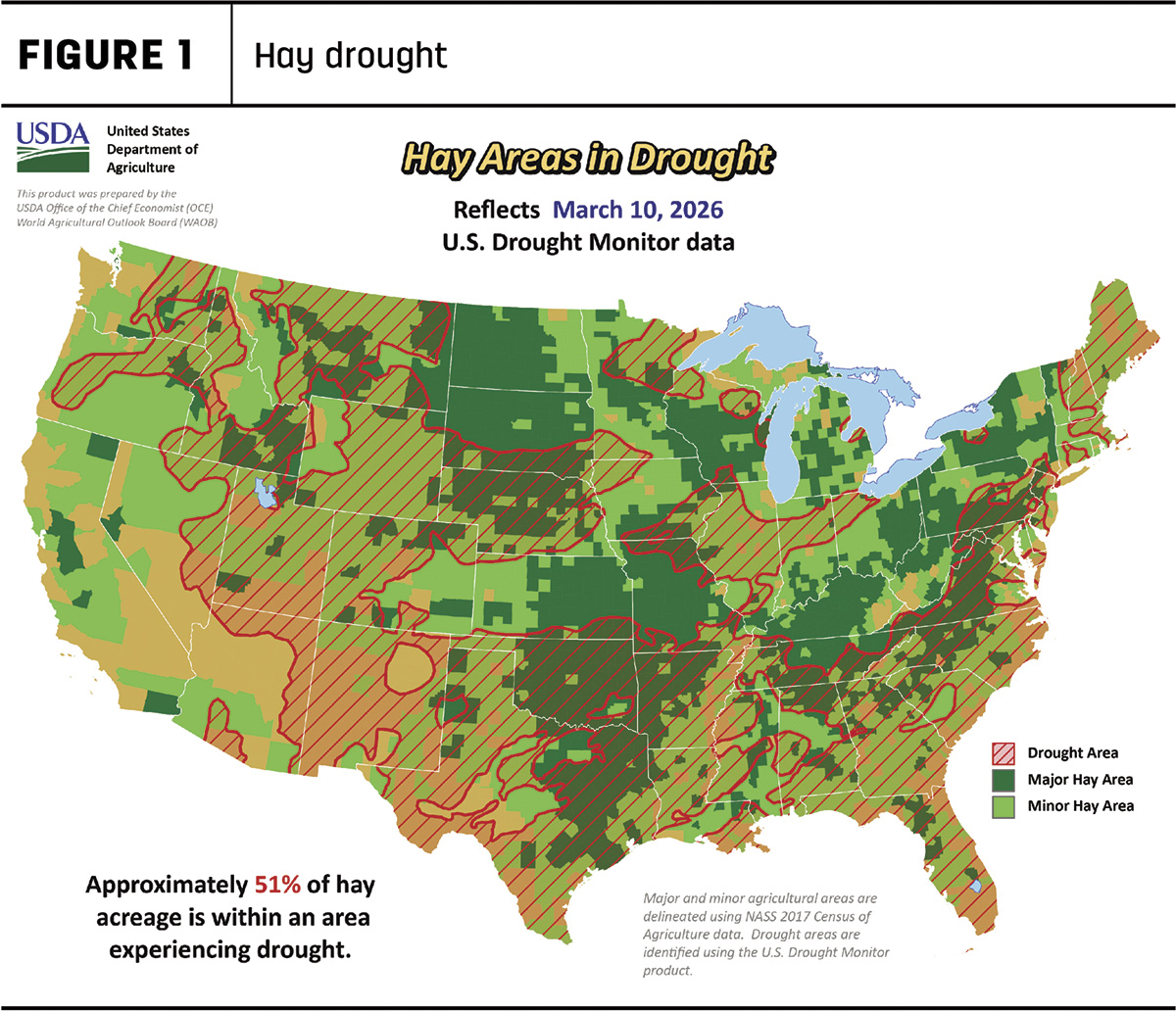
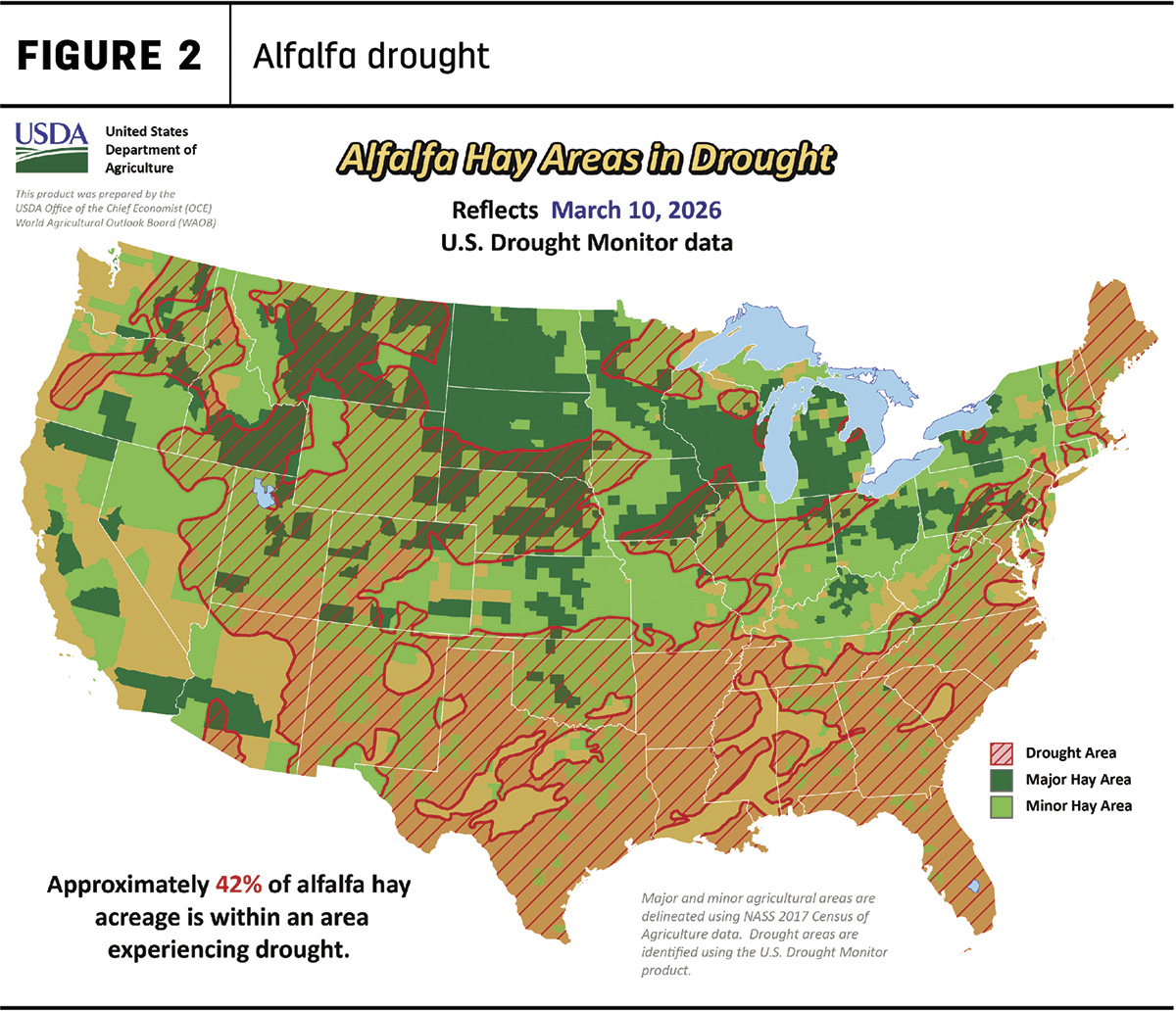
As of March 10, approximately 51% of U.S. hay-producing acreage (Figure 1) was considered under drought conditions, an increase of 7% from a month earlier. The estimate of alfalfa hay-producing acreage (Figure 2) under drought conditions increased to 42%, 12% more than a month earlier.
A snapshot of hay prices
USDA price data for 27 major hay-producing states is mapped in Figure 3, illustrating the most recent monthly average price and one-month change. The lag in USDA price reports and price averaging across several quality grades of hay may not always capture current markets, so check individual market reports elsewhere in Progressive Forage.

Dairy hay
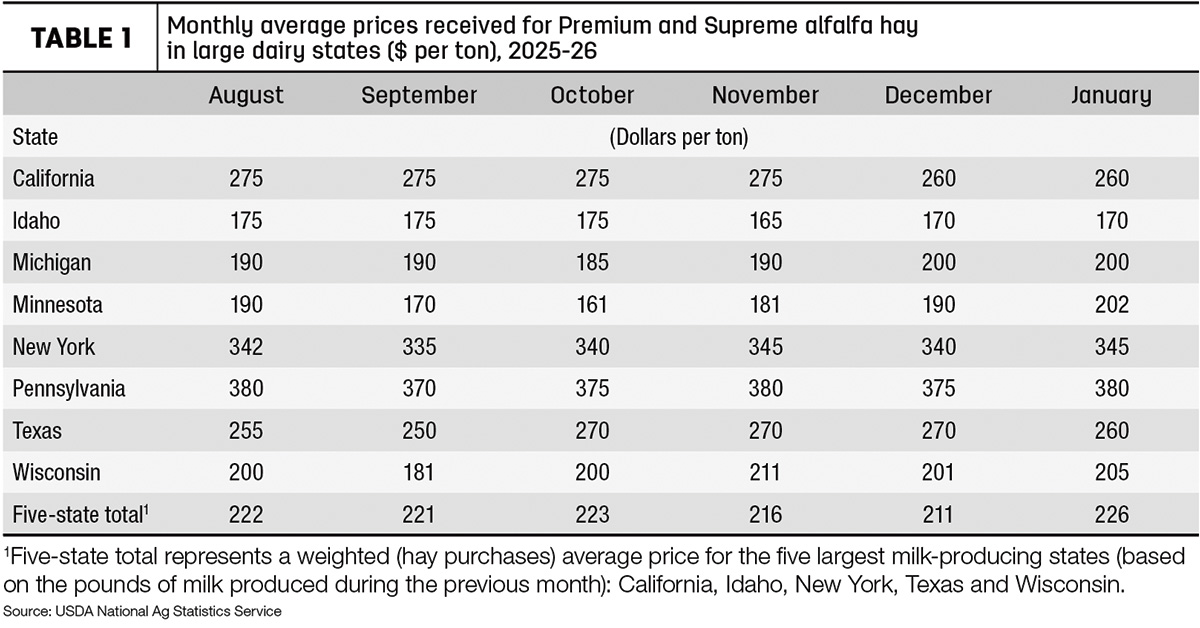
The top milk-producing states reported an average price of $226 per ton for Premium and Supreme alfalfa hay in January 2026, a $15 decrease from December 2025 (Table 1). The average price was $16 lower than January 2025.
Alfalfa
The U.S. average price for all alfalfa hay decreased $1 in January to $160 per ton. Compared to a month earlier, prices were lower in 11 of 27 major forage states, with the largest declines in Iowa, Minnesota, Nebraska, Nevada, New Mexico, North Dakota, Ohio, Oregon, South Dakota, Utah and Wisconsin. Prices were up in seven states including Arizona, Illinois, Kansas, Kentucky, Montana, New York and Pennsylvania.
With few exceptions, year-over-year alfalfa hay prices were down substantially, with the U.S. average down $1 compared to January 2025.
Other hay
At $131 per ton, the January 2026 U.S. average price for other hay was up $3 from December. Prices decreased in nine of 27 major hay-producing states, with the largest month-to-month decrease in Idaho, Minnesota, Nebraska, North Dakota, Ohio, South Dakota, Texas, Utah and Wisconsin. Increases were recorded in 13 states including Arizona, California, Colorado, Illinois, Iowa, Kentucky, Missouri, Montana, New Mexico, New York, Oklahoma, Pennsylvania and Wyoming.
Expanding the timeline, the January 2026 U.S. average price for other hay was $13 less than a year earlier.
The gap between average U.S. alfalfa and other hay prices was about $29 per ton in January.
Exports
At deadline, January 2026 exports held steady, with buyers remaining selective as currency pressure, freight costs and uneven dairy margins shaped demand. Movement stayed close to late‑fall levels, reflecting a cautious global tone heading into spring.
At 159,867 metric tons (MT), January alfalfa hay exports decreased. China remained the top buyer at 47,885 MT, accounting for about 30% of total shipments. Sales to Japan continued their steady eight‑month trend at 34,495 MT, while shipments to Saudi Arabia held relatively stable at 35,937 MT – representing just over 21% and 22% of the month’s total, respectively.
Exports of other hay increased, to 79,515 MT in January. As usual, Japan and South Korea led buyers in the other hay category: Japan purchased 38,773 MT during the month, or about 48% of the total, followed by South Korea’s 28,290 MT, 35% of the total.
U.S. exports of most categories of alfalfa cubes and meal were lower in January, totaling about 7,852 MT. Japan imported about 68% of the total.
Regional markets
Regional hay markets remain steady, with adequate supplies and only selective premiums for top‑quality alfalfa. Movement is slow but consistent, and freight and fuel continue to shape delivered prices. Regions are watching early‑season moisture and inventory drawdown to gauge how quickly buying may firm as turnout approaches.
- Midwest: In Nebraska, compared to the last report, big round bales of alfalfa sold mostly steady. Grass hay sold fully steady. Ground and delivered hay steady. Demand was moderate.
In Kansas, hay movement remains slow but steady, with more loads headed toward southwest Kansas after recent wildfire losses. Statewide grass hay supplies are adequate, and demand is steady, with hauling patterns reflecting targeted relief support.
In Illinois, hay is lower across the board. Trade was moderate with moderate to good demand.
In Iowa, alfalfa is steady to firm on improved quality being offered. Grass steady to weak. Trade active with good demand.
In Missouri, hay prices continue to be mostly steady; there are many new listings of hay being offered as producers try to clean out inventory before the new growing season. Supply is moderate to heavy, and demand is moderate to light.
In South Dakota, demand is light as mild winter conditions have reduced hay usage, leaving large volumes of lower‑quality carryover across the region. Dairy buyers remain price‑resistant, relying more on alternative feed ingredients to meet protein needs.
- East: In Alabama, hay prices steady. Trade and supply moderate, with moderate to good demand.
In Tennessee, no new update was available, and earlier reports indicated some sellers were already sold out for the season.
- Southwest: In California, trade activity is slow with light demand. Export hay is slow while dairy hay demand is light. Retail hay demand is steady.
In Oklahoma, movement is steady. The drought will remain steady, and don't expect much movement in the next few weeks.
In Texas, hay prices remain steady with good demand.
- Northwest: In Montana, hay is trading mostly steady to slightly higher as supplies in central and western Montana tighten further. Buying has increased from ranchers preparing for drought and those needing feed until turnout, which has pulled inventories down.
In Utah, movement is slightly lower but demand remains moderate. Feeder hay and grain hay mixes are in strong demand and increasingly scarce as more producers sell out. Statewide inventories are thin, with most sellers down to a few loads or already out. Grain hay mixes are especially limited after heavy fall and winter use, and producers are concerned about water supplies heading into the next growing season.
In Idaho, demand is strong across all hay types, with feeder hay especially scarce. Sellers report more calls and several have sold out, pushing some buyers toward higher‑quality hay as feeder supplies thin. Recent snowfall helped the water outlook slightly, but drought concerns persist and overall supplies remain low.
In the Washington-Oregon region, all grades are steady in a light test, with slow to moderate trade and demand. Timothy and orchardgrass remain steady to firm for retail buyers.
In Wyoming, demand was good, especially from out-of-state buyers, with hay going almost to the East Coast.
In Colorado, trade is light with moderate to good demand, and horse hay prices are mostly steady. Feedlot and dairy interest is stronger than a month ago. Farmers are still weighing alfalfa standing offers as recent fuel and fertilizer increases slow decisions.
Other things we’re seeing
- Dairy: Milk output is steady as earlier culling keeps herds balanced, and spring conditions support consistent production. Cheese and butter markets are edging firmer, but Class III and IV values remain subdued, keeping margins tight. Export interest is steady, domestic demand cautious, and producers continue disciplined herd management while waiting for clearer signs of recovery.
- Cattle: Cattle supplies remain tight, keeping prices supported as feedlot placements stay below year‑ago levels. Feeder numbers are still limited, and uneven moisture continues to slow any meaningful herd rebuilding. Cow retention holds, but high input costs and cautious sentiment keep expansion muted. Strong cattle values help, yet producer margins stay narrow as spring moisture and forage prospects remain uncertain.
- Fuel: National average fuel prices were significantly higher to start March, according to the U.S. Energy Information Administration (EIA). The U.S. retail price for regular-grade gasoline averaged $3.50 per gallon on March 9, up 48.7 cents from the previous week, 43.3 cents higher than the same week a year earlier. The average U.S. on-highway price of diesel was $4.86 per gallon, up 96.2 cents from the prior week and $1.28 more than early March 2025.
- Trucking: Spot flatbed prices were significantly higher to start March, averaging $2.76 per mile nationally, according to DAT Trendlines. Regionally, average spot prices per mile were: Southeast – $2.95, Midwest – $3.11, South – $2.69, Northeast – $2.70 and West – $2.36.
- Other costs: The February prices paid index inched higher as livestock and machinery costs increased enough to offset softness in forage categories. Rising fuel prices added pressure, keeping the index above year‑ago levels and reinforcing steady inflation across animal‑related inputs. Producers enter April facing persistent cost pressure and limited relief across most non‑feed expenses.
- Total feed prices: Total feed costs remain mostly steady as firm feed grains and complete feeds continue to drive the index. Hay, forages and supplements stay soft, and easing energy prices offer only limited relief. With markets holding firm and spring feeding still active, ration management remains a priority for producers heading into April.
- Interest rates: USDA Farm Service Agency (FSA) interest rates for direct farm operating loans (4.75%) increased and direct ownership loans (5.875%) increased for March.