Canadian dairy farmers are navigating a season of unusual pressure. Feed prices fell sharply in 2024 and 2025, yet overall input costs remain stubborn. Labour shortages continue to challenge daily operations. The 2026 farmgate price increase offers some relief, but it is not enough to ease the chronic squeeze between rising expectations for animal welfare, climate accountability and operational efficiency. Across the country, nearly a million dairy cows continue converting carbon, protein and energy into milk each day. Only a fraction of those nutrients becomes saleable milk, and the rest leave through air and manure. This nutritional inefficiency is both an economic loss and an environmental burden, and farmers have long sought better tools to understand it.

Mirror, mirror
A new generation of technology is beginning to provide those tools. Digital twins, once limited to aerospace and advanced manufacturing, are now entering the barn. They are not futuristic novelties. They are practical instruments that help producers extract more value from the information already flowing through their farms.
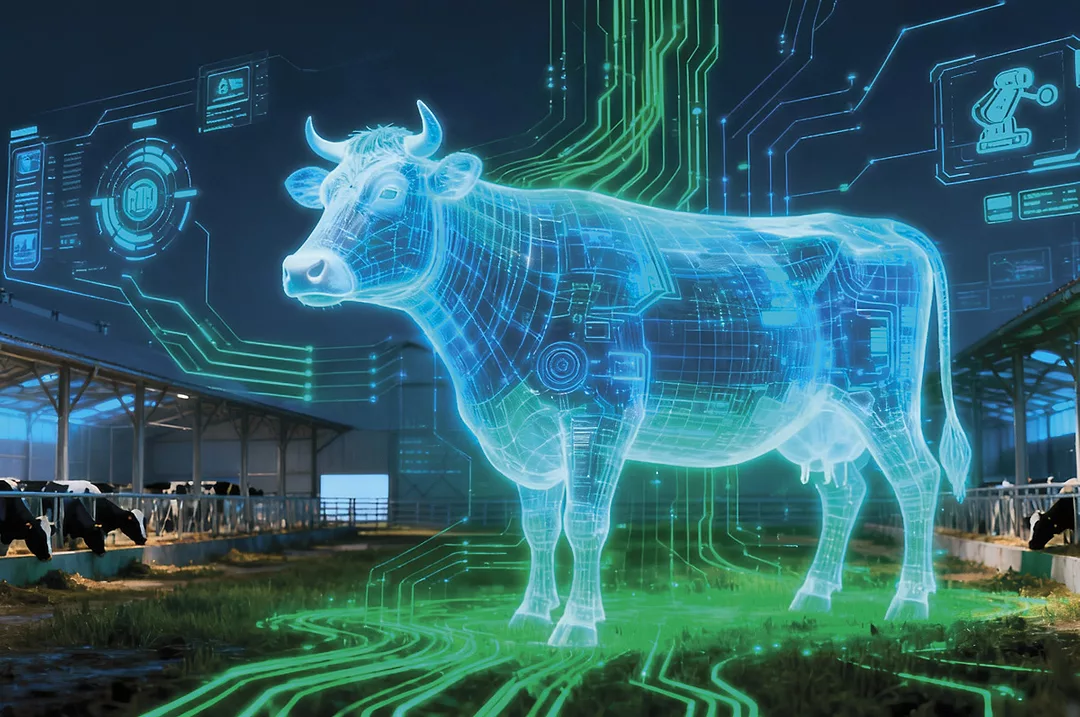
A digital twin is a continuously updated virtual version of a real system. In dairy, that system might be an individual cow, a milking robot or the entire barn. The twin mirrors the real-time state of the animal or equipment it represents. When a cow walks to the feedbunk, her virtual counterpart records it. When rumination patterns shift, when milk flow changes slightly or when temperature rises in the calf barn, the twin integrates those signals. Rather than analysing data in isolation, a digital twin unifies behaviour, health, nutrition and environmental conditions into a single, coherent picture.
Canadian dairy barns are already rich with data. Automated milking systems track thousands of data points each day. Sensors record temperature, humidity, airflow, activity and rumination. Rumen boluses monitor internal physiology. Cameras are increasingly used to observe posture, gait and body condition. Digital twins allow these streams to work together instead of living in separate dashboards. Once connected, they reveal patterns that are almost impossible to see with the human eye alone.
Minimizing risk
At the MooAnalytica research group at Dalhousie University, we are developing digital twin systems that bring precision nutrition into everyday practice. The idea is simple. If a virtual version of each cow reflects her physiology and behaviour accurately, we can simulate how she would respond to potential ration changes before those changes are made in the real barn. The digital twin becomes a safe testing ground for decisions that could otherwise carry financial or animal health risks.
Our work integrates three main elements:
- Computer vision models: These models are trained on thousands of hours of on-farm video and continuously track eating behaviour, locomotion, posture and body condition changes. These observations offer a real-time picture of how each cow interacts with the ration she is offered.
- Mathematical models: These models are adapted from nutrient-flow frameworks and estimate how feed ingredients are transformed inside individual cows into milk, heat, body reserves or emissions.
- Simulation engines: These engines layer the two aforementioned models together, allowing farmers and nutritionists to explore “what if” scenarios. What if forage digestibility improves by a few points? What if the protein source changes? What if the energy balance of fresh cows is adjusted earlier in lactation? The digital twin predicts the likely consequences, providing confidence before changes are implemented.
Nutrition
One area where this integration is especially powerful is nutrition. Feeding cows efficiently has always been a balancing act between maximizing income over feed cost (IOFC) and protecting animal health. But rations, even expertly formulated ones, inevitably interact differently with each cow. Age, genetics, body condition, lactation stage, social status and recent health history all influence how an animal uses the nutrients she eats. Digital twins make these invisible differences visible.
The value is not confined to ration reformulation. Digital twins excel at identifying inefficiencies that sap profitability. A cow whose time at the bunk shortens gradually, or whose chewing patterns change subtly, may be entering a period of metabolic stress. A group whose feed efficiency decreases slightly during a stretch of humid weather may be experiencing early heat strain. These patterns rarely appear in conventional data summaries but are striking within a digital twin.
Anticipate health events
Health detection benefits from the same synergy. Many of the costliest diseases in dairy, including mastitis and metabolic disorders, present subtle early signs long before clinical symptoms. Research suggests the economic impact of mastitis exceeds $600 per cow per year, with much of that cost tied to delayed detection. Digital twins can identify the earliest indicators of trouble, such as a shift in resting time, a slight drop in milk partitioning, a change in activity rhythm or a mild elevation in udder temperature. These early alerts allow farmers and veterinarians to intervene before major losses occur. In an industry where skilled labour is hard to find and harder to retain, early detection functions as a force multiplier for herd managers.
Computer vision further strengthens this advantage. Our imaging tools track gait changes that signal early lameness, detect posture shifts that can indicate discomfort, and assess body condition score frame by frame. When these real-time observations flow directly into a digital twin, each cow’s health profile becomes richer, more detailed and more predictive. Decisions that once depended on sporadic observation now rest on continuous monitoring that does not interrupt the natural rhythm of the herd.
Environmental impact
Digital twins also open new possibilities in environmental management. Methane emissions remain a focal point in discussions about climate commitments. Through our DairyAir Canada platform, which integrates satellite-based methane data from NASA, the European Space Agency (ESA) and the Japan Aerospace Exploration Agency (JAXA), farms can now benchmark emissions without installing additional sensors. When these atmospheric data streams are combined with digital twin models that track nutrition, manure output and barn environment, a comprehensive emissions profile emerges. Producers can test how ration ingredients, feed additives, bedding choices or housing strategies might influence methane intensity. Instead of relying on generic recommendations, farms can make evidence-based adjustments aligned with their own herds and management systems.
The same simulation approach applies to manure management. Digital twins can model how manure flows through the farm system, how storage conditions influence methane release and how anaerobic digestion systems might perform under different conditions. This unlocks a clearer understanding of whether biogas production is financially viable for a particular operation and how it might integrate with the farm’s broader energy use.
Improving animal welfare and productivity
What makes digital twins compelling is not just the technology itself but the way it supports both productivity and welfare. A growing body of evidence links better animal welfare with stronger farm performance. Stressed or uncomfortable cows produce less milk, breed less successfully and require more interventions. Digital twins help farmers detect welfare concerns early, adjust environments proactively and maintain consistency in a labour-constrained world. They also give producers clearer visibility into what is actually happening in the barn, reducing the uncertainty that can make modern dairy farming stressful.
For dairies of any size
Because digital twins use existing sensors and equipment, they scale well across farm sizes. Large farms benefit from the efficiency of unified data. Smaller family farms gain access to advanced insight tools that were once the domain of industrial operations. A 50-cow farm can now achieve the same level of precision in feeding and health management as a 500-cow operation. This democratization of technology levels the field and ensures that innovation does not depend solely on scale.
Connecting on a cow level
The promise of digital twins lies in their ability to move the industry toward true individualization. Instead of managing groups by averages, each cow is understood as an individual with her own nutritional requirements, behavioural tendencies and health risks. The digital twin does not replace the farmer’s judgment – it strengthens it. Revealing patterns that are difficult to see and testing strategies before implementation gives producers confidence rooted in both experience and evidence.
Canadian dairy farming is entering a period where economic, environmental and social pressures converge. Digital twins offer a way to navigate these pressures with precision rather than guesswork. They help farmers refine management in a manner that respects biology, strengthens profitability and supports the welfare of animals under their care. The barn has always been a place of intricate complexity. Digital twins make that complexity visible, measurable and actionable.
Your cow already has a digital twin waiting to be built – what can she tell you?What can a digital twin do for your highest-producing cow?
- Virtual model: Mirrors real behaviour and feed use
- Real-time data: Behaviour + intake + milk + environment all feed a metabolic machine
- Smarter feeding, earlier detection: Test ration changes safely, catch health shifts sooner
- Sustainability gains: Improved nutrient capture and reduced methane emissions