Alfalfa is an important crop for many dairy producers in the Northeastern United States. When managed properly, alfalfa can bring in large quantities of high-quality and high-protein home-grown forage without the need for extra nitrogen fertilizer.


Nutrients such as nitrogen (N) and phosphorus (P) require careful management from an environmental standpoint. But what about potassium (K)? Alfalfa is known as a consumer of large amounts of K. Potassium deficiency in alfalfa shows up as white spots around edges starting with the older leaves. Because of its role in photosynthesis, leaf stomata functioning (water management), protein synthesis, and various plant enzyme activities, K is key to the management of stress such as droughts, diseases, and harsh winter conditions. Given K is not of direct environmental concern, its application is mostly governed by balancing agronomics and economics. When is enough indeed enough? How would we know?
CROP UPTAKE
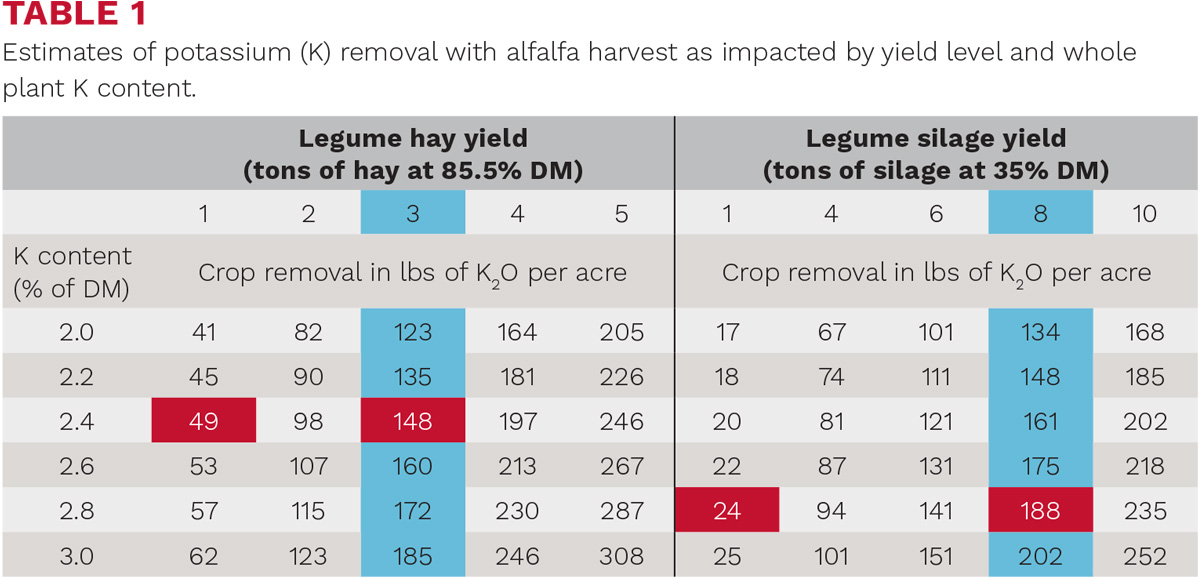
The Dairy One Feed Composition Library shows an average K percentage of 2.4 percent for legume hay and 2.8 percent for legume silage, averaged across 20 years. If we use 2.4 and 2.8 percent as reasonable estimates, this translates to crop removal values of 49 pounds K2O per ton of dry hay, and 24 pounds K2O per ton of haylage (Table 1). For average yields of about three tons of dry hay and eight tons of haylage, as reported by New York State Agricultural Statistics for 2024, estimated K2O removals with harvest amount to about 150 pounds of K2O/acre for dry hay and a little less than 200 pounds of K2O/acre for haylage. Values can vary quite a bit for individual fields and farms. Forage analysis and accurate yield determination are essential to get good estimates of crop removal.
SOIL SAMPLING
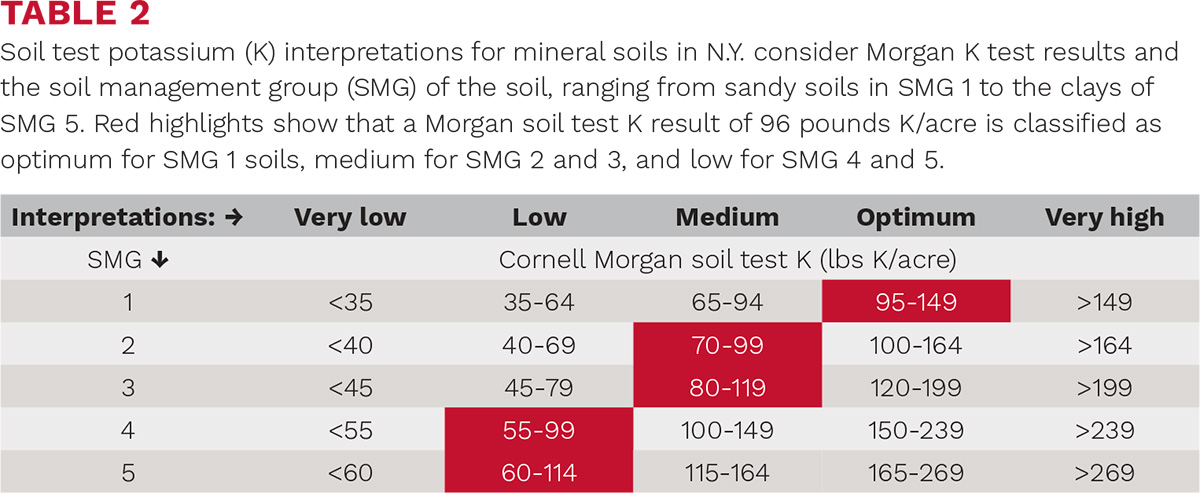
How can we figure out how much K is needed for an alfalfa crop? The answer is: sample the soil. Soil sampling results, combined with science-based interpretations (crop response trial databases) can give us an idea about the K supply in the soil. In N.Y., our land-grant university guidelines for K are based on the Morgan soil test, a sodium acetate extraction. In N.Y., soil K supplying power of the soil series is also considered, which can differ quite dramatically among the over 600 soil types in the state, primarily depending on the percentage of illitic clay in the soils. Sandier soils have low K supplying power (little illitic clay, low cation exchange capacity or CEC), while clay soils can hold onto and supply more K to the crop. As a result, interpretations may range substantially (Table 2).
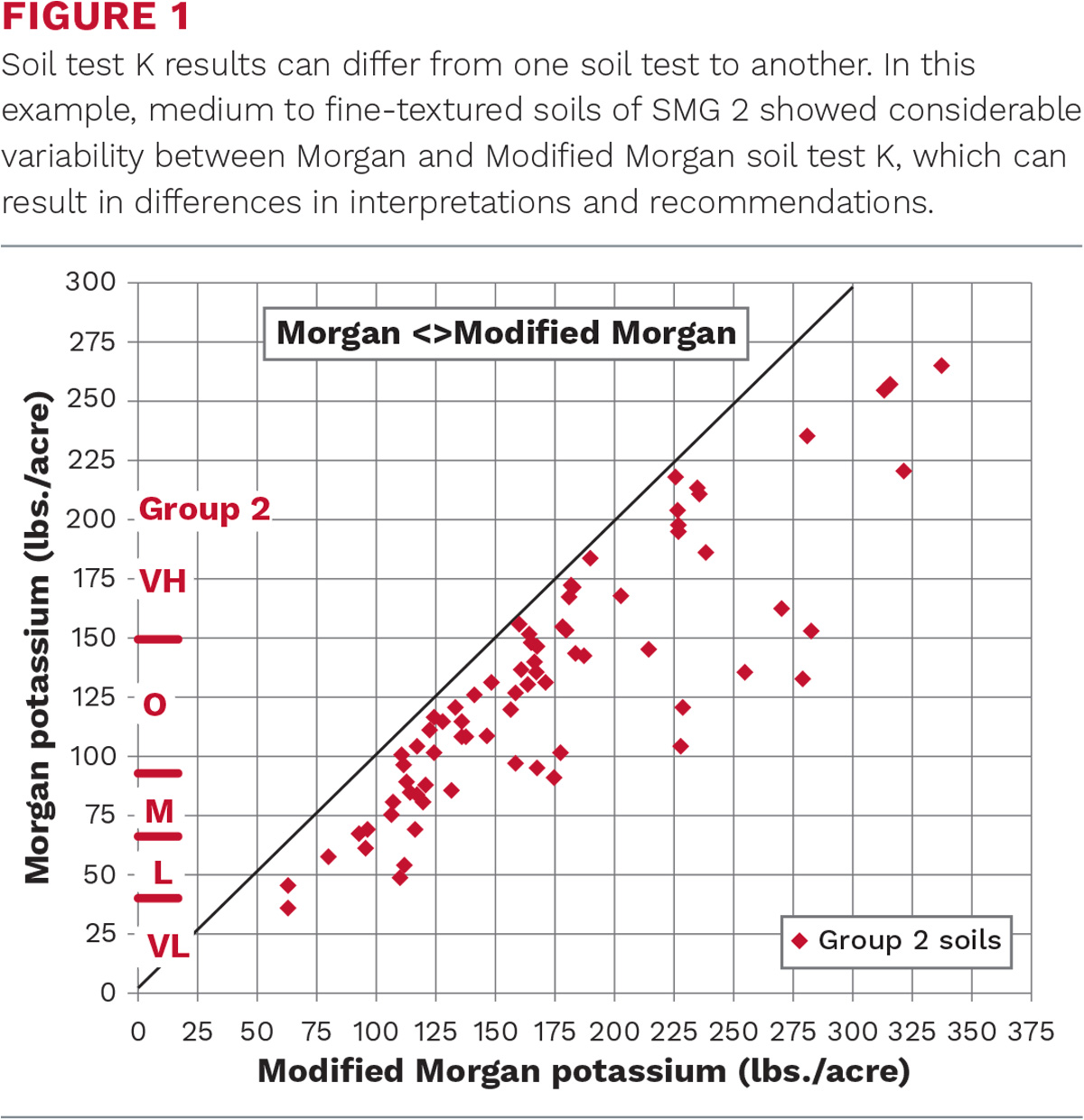
Potassium guidelines from other states might be based on other soil test chemistries such as Modified Morgan, Mehlich-1, or Mehlich-3, and matching your soil test with the test that the university recommendations are based on will be important. Each test gives somewhat different results. For example, a N.Y. study comparing Morgan and Modified Morgan for silt soils (SMG 2) showed meaningful differences (Figure 3).
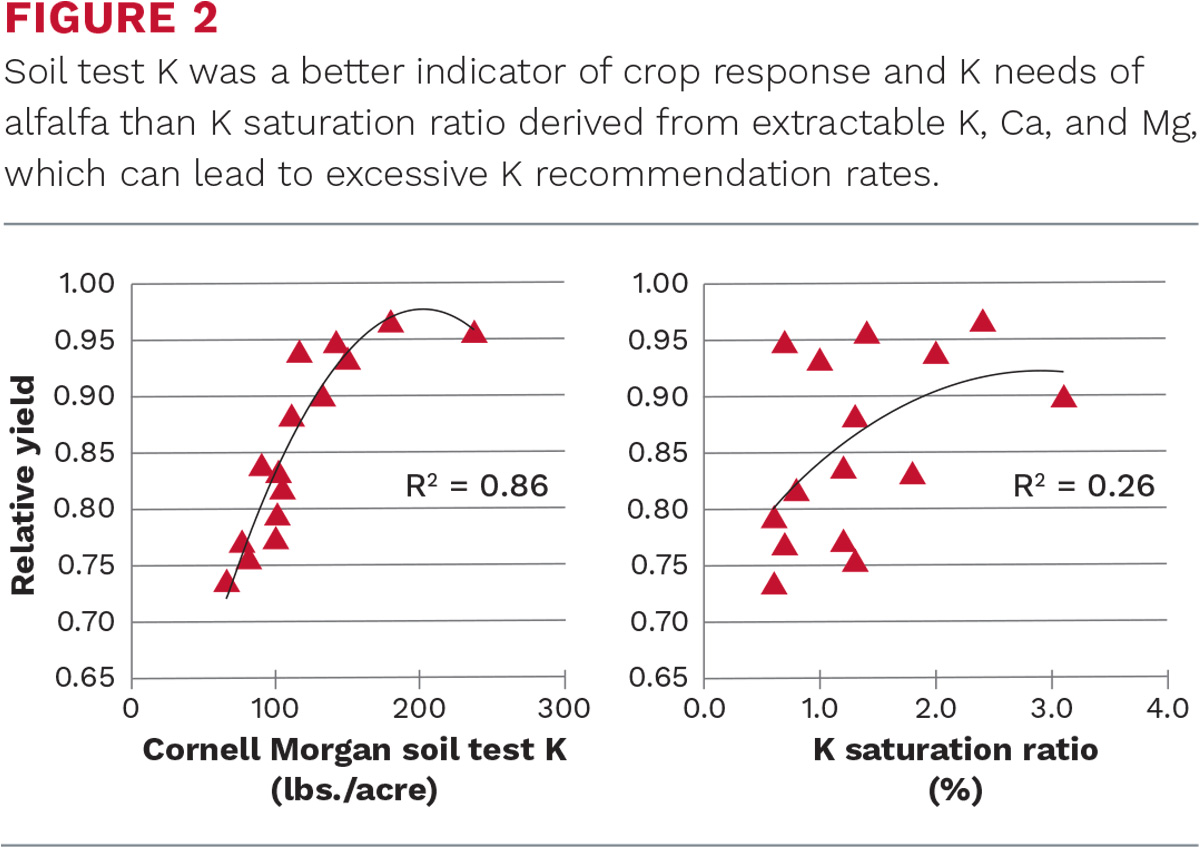
Another, often asked question is, what about K saturation ratio? Research done across 15 locations in N.Y. showed soil test K to be a better predictor of K needs than percent K saturation. Part of the problem is that K saturation is typically not measured but rather derived from extractable K, calcium (Ca), and magnesium (Mg), where percent K saturation is determined by dividing extractable K by the sum of extractable K, Ca, and Mg (as an estimate of the CEC of the soil). The problem is this approach results in artificially low K saturation levels in calcareous soils, where extractable Ca from free calcium carbonate might not actually be plant- available and the sum of K, Ca, and Mg does not accurately reflect the CEC of the soil. This can result in high K recommendations, considerably beyond what the crop really needs.
IMPACT OF UNDER OR OVER-APPLICATION
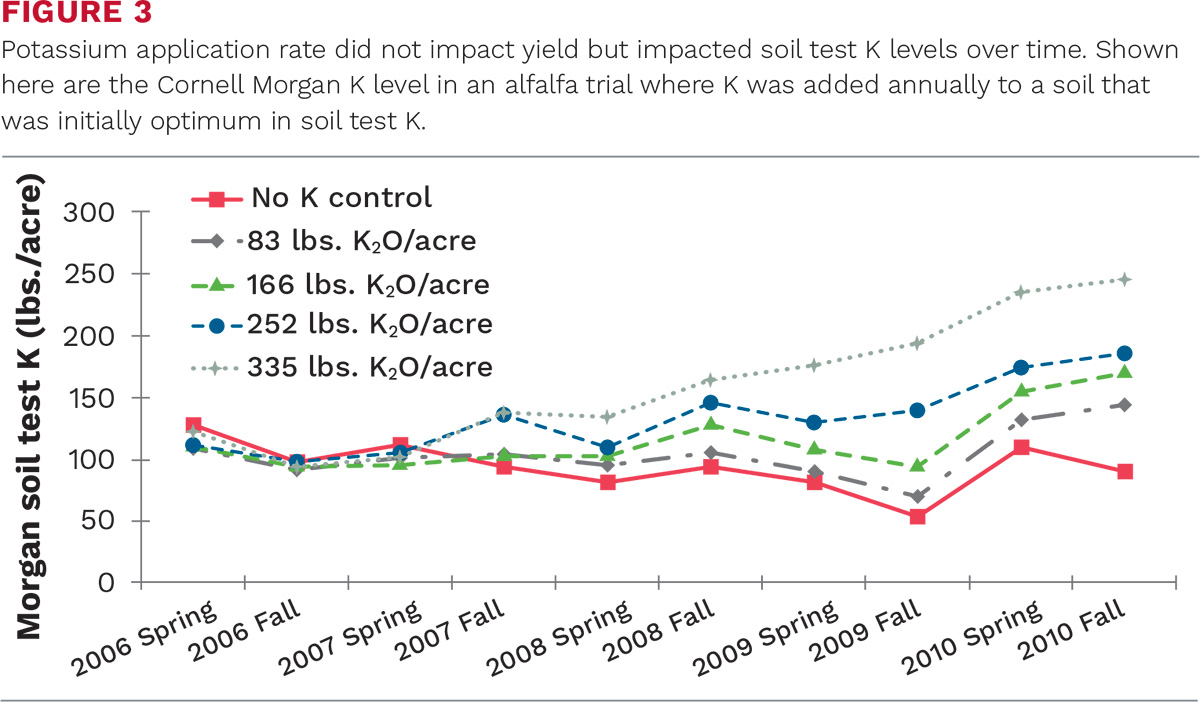
Another question often raised is what happens with soil test K over time? We investigated this with alfalfa trials at the Musgrave Research Farm in Aurora, N.Y. over a five-year period. Annual K application rates ranged from zero in the control treatment to 335 pounds K2O/acre per year, applied at green-up. Across the five years, yield was not impacted by K addition, averaging 4.7 tons/acre (at 85.5 percent DM) for both the control treatment and the highest K application rate. What did change were soil test K levels (Figure 3).
PLANT SAMPLING?
In this same trial in Aurora, N.Y., yield and whole plant K content were not correlated (reflecting the lack of a yield response) but increased with K addition from 1.6 percent in no-K plots to two percent for the plots that had received four annual additions of 335 lbs. K2O/acre. Tissue K content (the top six inches at third cutting) for individual plots ranged from a low of 1.3 percent to a high of 3.1 percent, also reflecting that excess K is taken up by the plant. This additional K uptake, while not needed to increase yield, is called luxury consumption. A direct comparison of tissue K and whole plant K content across all plots in the study showed a slope of 1.01 with an R2 of 0.60, indicating variability between tissue K and whole plant K but also suggesting that K levels in whole plant forage analyses can be used as a first indicator of the potential for a K deficiency or for excess K.
Typically for alfalfa a critical tissue K content of two percent is reported (top six inches), but in the study in Aurora there was no crop response to K even though whole plant K content did not reach two percent and yields were good. While the results here question the validity of two percent as a critical tissue level and more research on the topic of tissue testing is needed, it should be clear that a whole plant (forage sample) analytical result that exceed two percent indicate that additional K is really not needed. Enough is enough. More is not better in this case, as more simply means the plant will take up more, increase its K content without increasing yield, and then you end up removing that K again with harvest, negatively impacting economic returns. Soils will accumulate K over time with excess K addition, but K can also be leached over time, especially in sandier soils that cannot hold on to excess K very well, further impacting economic returns.
MORE IS NOT ALWAYS BETTER
In summary, if you wonder about the need to add K for your alfalfa crop, test the soil for extractable K, compare results to land-grant university guidelines, and then occasionally look at your forage samples to see if extra K was really needed. Your forage sample will tell you!
 |
This article appeared in PRO-DAIRY's The Manager in March 2026. To learn more about Cornell CALS PRO-DAIRY, visit PRO-DAIRY. |