In New York (N.Y.) and dairy regions with similar climates, interest in dairy farms producing a proportion of their own grains has varied over time but has always been present.

Home-grown grains can be viewed as a strategy to control feed cost and inventory, buffer growing season variability through flexible forage or grain harvest, or benefit from economies of scale. While these are valid justifications, careful, farm-specific evaluation is needed to assess their true fit.
With environmentally and economically efficient milk production as the primary goal of any dairy business, any discussion on diversification or adding to the dairy operation should center around how the change will advance sustainable milk production. The debate on home-grown grains largely takes place in regions where home-grown forages are the basis of environmentally and economically sustainable milk production. If adding grain production is going to be a net benefit, it cannot come at the expense of the forage system or other critical farm processes.
ECONOMICS
Feed is the highest input cost on a dairy farm. Purchased grain and concentrates, combined with the costs of home-grown forages and grain, are estimated to make up 40 to 60 percent of total operating expenses. Conscious of this, dairy farmers and their advisors continuously seek strategies to manage feed costs effectively.
The Cornell Dairy Farm Business Summary (DFBS) provides the opportunity to track trends and evaluate the outcomes of different management strategies. According to a 2018 to 2023 DFBS trend analysis report, grain production on N.Y. dairy farms has increased in recent years. Milk production base programs implemented in 2020 by co-ops to limit milk supply, practical limits on herd expansion or land acquisition, land availability combined with no plans to grow the herd, or a general interest in grain production are some reasons that may have motivated some dairy operators to begin growing grain as part of their business.
A recent analysis of DFBS data evaluated trends on the same group of 124 farms from 2021 to 2024. While individual farm performance is influenced by several factors, this large dataset of farms allows grouping by common characteristics and broader trends can be studied.
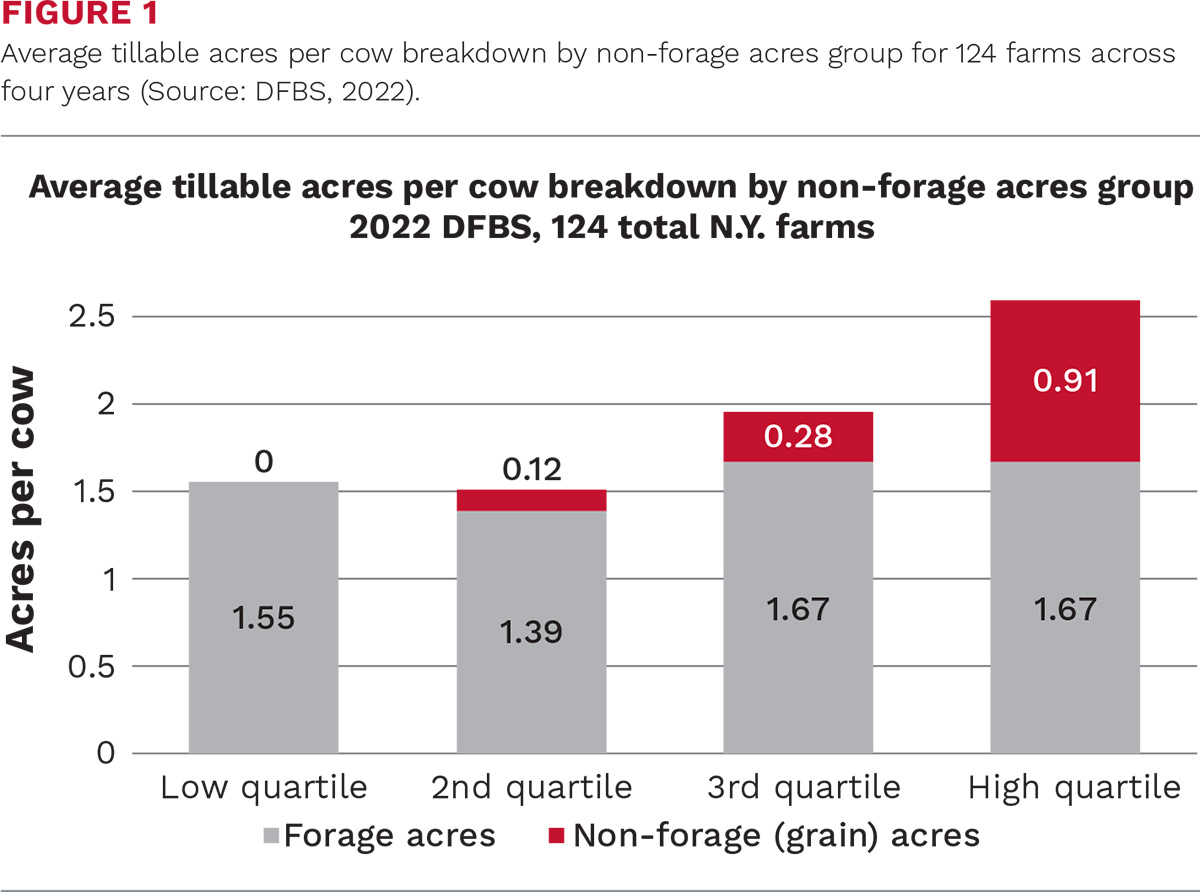
For this analysis the farms were grouped into four quartiles based on tillable non-forage (grain) acres per cow (Figure 1).
- The lowest quartile averaged around 1.5 tillable acres per cow, all of which were forage acres.
- The second quartile also averaged around 1.5 acres per cow, with most acres in forage production and a very small amount in non-forage (grain) production.
- The third quartile averaged just under 2.0 acres per cow, with some additional non-forage acres beyond forage needs.
- Farms in the highest quartile averaged over 2.5 acres per cow, with almost 1.0 acre of that in non-forage production.
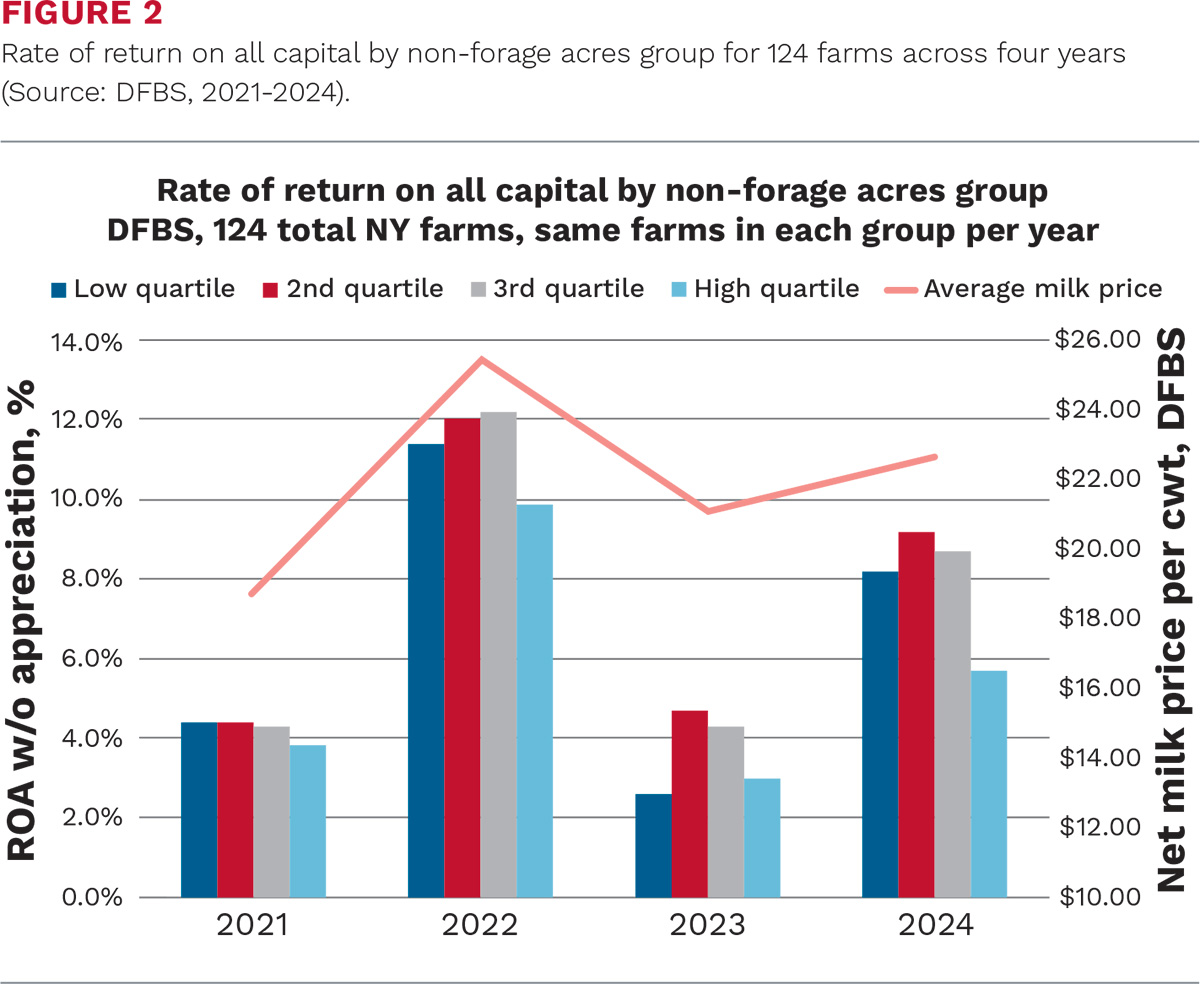
A full report with additional detail is available in the Cornell Dyson Extension Bulletin archives. Here, the focus is on the profitability measure, Rate of Return on all Capital, sorted by quartile (Figure 2). The two middle groups achieved the highest rate of return without appreciation in almost all years, while the lowest and highest quartiles had lower average rates of return. With this calculation considering asset value of the farm, the highest quartile group’s rate of return is impacted partially by higher investment levels, with income spread across a larger asset base.
AGRONOMIC AND ENVIRONMENTAL MANAGEMENT
The DFBS data suggest some benefits for quartiles two and three, with farms that have some “flex acres” for grain production but are not heavily invested in the grain business. As stated, variability in performance between farms does exist, but this concept of flex acres aligns with key management considerations for nutrient management, climate resilience, and overall farm success.
Flex acres that do not require significant structural investment to become grain operations offer farms a buffer for forage inventories. With increasingly erratic weather patterns in our growing season, year-to-year variation in forage productivity is a growing challenge for farms, particularly those with fewer tillable acres per cow. For these farms, the priority should be optimizing forage inventory (including carryover) before seeking opportunities to market extra acres or crops.
Critical evaluation is also needed of how extra acres are managed. In some cases, home-grown grain production may be successful. However, there are several critical points between a successful crop in the field and a valuable feedstuff. On-farm harvesting, processing, and storage all present risks, and any reductions in nutritional value or shrink losses in our feeding programs are problematic. Higher-value ingredients have an even higher cost for each percentage point of shrink or decline in nutritional value. Additionally, home-grown grains often show greater variability in nutritional profile relative to purchased ingredients with a guaranteed analysis. This variability can add challenges for ration formulation and meeting milk production goals, particularly in high-producing herds.
When resources are not in place for top-notch storage and utilization of home-grown grain crops, marketing grain off farm, even at marginal returns, is often a better strategy.
Recycling manure nutrients through crop production on dairy farms offers many benefits, provided balance is maintained between manure nutrient supply, acreage, and crop productivity. Analyses from the Cornell Nutrient Management Spear Program’s Nutrient Mass Balance program indicates that farms with similar acreage and cow number characteristics to the lowest DFBS quartile can meet the threshold for maintaining feasible whole-farm nitrogen and phosphorus balances if managed carefully. These farms have the land base to recycle manure nutrients and produce a high percentage of home-grown feed but have limited buffer to weather extremes or other challenges.
Flex acres may be a viable alternative to exporting manure nutrients for farms working to address any nutrient imbalances. However, crop type utilized for flex acres can present challenges. Corn grain and soybeans are the most common options, but both affect crop rotations, pest pressure, and nutrient cycling. Adding corn grain acres into rotations already trending towards more corn acres relative to perennial hay crop acres (reflecting higher corn silage diets) can increase the consecutive years of corn on a given field, which could exacerbate pest management and soil health challenges and lead to yield decline over the years. Adding a legume such as soybeans can aid in pest management and overall rotation success but have different nutrient requirements that will impact nutrient balance planning for flex acres.
CONSIDERATIONS
The feasibility and success of home-grown grain production as part of the dairy farm business depends on many factors, including land availability, farm goals and lifestyle factors, and ability to expand the herd, to name a few. Furthermore, the focus should be on optimizing forage inventory and quality while considering the agronomic and environmental impacts of acreage changes before any consideration to grain production.
In the DFBS analysis, while it is important to acknowledge the range in performance and the many factors affecting how a practice fits into an individual dairy business, farms limited in forage acreages as well as those with acreage well beyond what is needed for forage production tended to show lower financial performance than farms with sufficient forage acres plus some “flex acres.” These observations suggest that in the Northeast and similar growing environments, having these flex acres can be a risk management strategy.
RESOURCES
Dairy Farm Business Summary and Analysis Program: cals.cornell.edu/pro-dairy/our-expertise/business/dfbs
Dyson extension bulletins: dyson.cornell.edu/outreach/extension-bulletins/
Nutrient Management Spear Program fact sheets. (128 and 132 are referenced): nmsp.cals.cornell.edu/guidelines/factsheets.html
Homegrown feed for dairy farms in N.Y.: blogs.cornell.edu/whatscroppingup/2022/06/14/homegrown-feed-for-dairy-farms-in-new-york/
 |
This article appeared in PRO-DAIRY's The Manager in March 2026. To learn more about Cornell CALS PRO-DAIRY, visit PRO-DAIRY. |