A visit to any grocery store these days and you’ll see the words “high protein” plastered across every aisle. From yogurt cups to cereal and snacks, the consumer shift toward foods high in protein is impossible to miss. This trend is influencing how milk is valued at the farm level, with protein becoming more financially valuable. As dairy farmers prepare for the pricing changes, they will need to adjust both genetic strategies and on-farm practices to capture the new opportunity.

In this article, we take a genetic perspective on milk components for the Holstein breed, recognizing that genetics sets the foundation for what a herd can produce. While genetics determine potential, it is important to remember that nutrition and management decide how much of that potential is expressed.
Genetic trends for Fat Yield and Protein Yield
To evaluate genetic progress for Fat Yield and Protein Yield over the past 30 years, we analyzed December 2025 data for registered Canadian Holstein females. Figure 1 presents the average genetic values, Parent Averages (PA) and Estimated Breeding Values (EBVs), by birth year for 305-day Fat Yield and Protein Yield. These values are expressed as deviations from the average genetic evaluation for all cows born during the base period. Take note of the different scales for the two traits; the scale for Fat Yield is on the left axis while the scale for Protein Yield appears on the right. Both scales have been standardized so that each line represents one standard deviation. For example, one standard deviation for Fat Yield is 31 kilograms, while one standard deviation for Protein Yield is 22 kilograms.
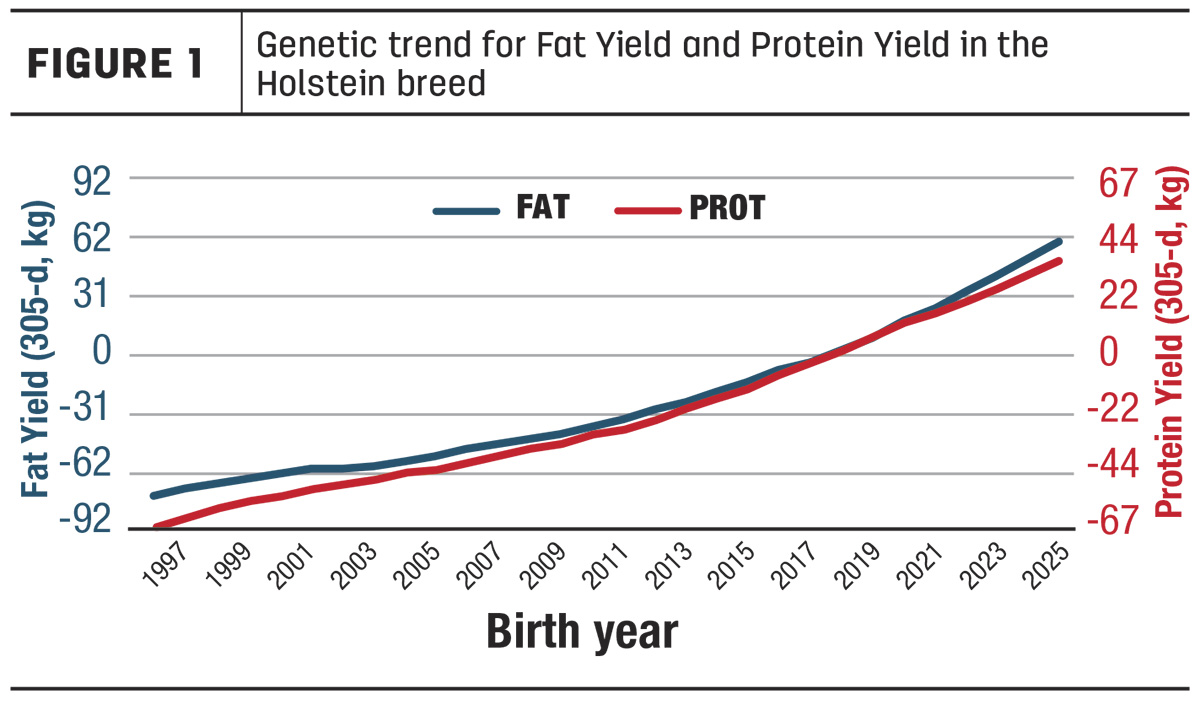
In 2025, the generic merit for Fat Yield reached 55.5 kilograms relative to the base group at zero, while Protein Yield reached 34.2 kilograms above the base group. While both traits have improved substantially over the past 30 years, their curves have begun to diverge in recent years. Over the last five years, the Holstein breed has achieved 20% more genetic progress in Fat Yield compared to Protein Yield. This widening gap along with consumer demand has prompted industry messaging to place greater emphasis on increasing Protein Yield while stabilizing Fat Yield. With this direction in mind, how can genetics support progress toward a balanced improvement?
Although these trends represent the Holstein breed average and individual herds will differ, the overall message is clear: Genetics remains a powerful tool for improving milk components. Both Fat and Protein Yield have a moderate heritability of 26%, meaning that they are influenced by genetic selection. Additionally, a genetic correlation of 64% exists between Fat and Protein Yield – indicating that we can improve both traits simultaneously. This will need to be considered depending on your herd goals, especially for herds where Fat Yield is already high.
It is important to remember, however, that genetic change is a long-term investment. The breeding decisions made today will not appear in a herd’s bulk tank for roughly five years or more, once daughters are born, raised and enter the milking herd. For this reason, the industry must be forward-thinking in breeding programs instead of reactive, ensuring that selection decisions align with long-term production and profitability goals.
Guiding breeding decisions for protein
There are several tools available to evaluate a herd’s Protein Yield and make informed breeding decisions. It is important to establish a clear goal for your herd as although genetic improvement is gradual, it is permanent and cumulative. Therefore, having a defined target helps ensure that selection and mating decisions made today contribute to the herd’s performance years down the road.
As with most traits, there will be variation in the Protein Yields of a herd’s heifers and cows. Genomic testing remains one of the best tools to accurately sort animals and thus effectively tailor reproductive strategies. Either national selection index, Lifetime Performance Index (LPI) or Pro$ can serve as a first sort for animals in the herd prior to diving into the evaluations for milk components or additional traits of interest. From there, sexed semen can be used on your best genomic females to multiply the top end of your herd while beef semen can be used on those of lower genetic value. When planning matings, it is also important to consider undesirable genetic conditions and haplotype frequencies as well as inbreeding levels, ensuring that genetic progress does not compromise herd health. The freely available Lactanet Genetics website can be used to sort animals in your herd for a variety of traits and provides inbreeding levels and Parent Averages for various matings while helping to manage undesirable genetic conditions and haplotypes.
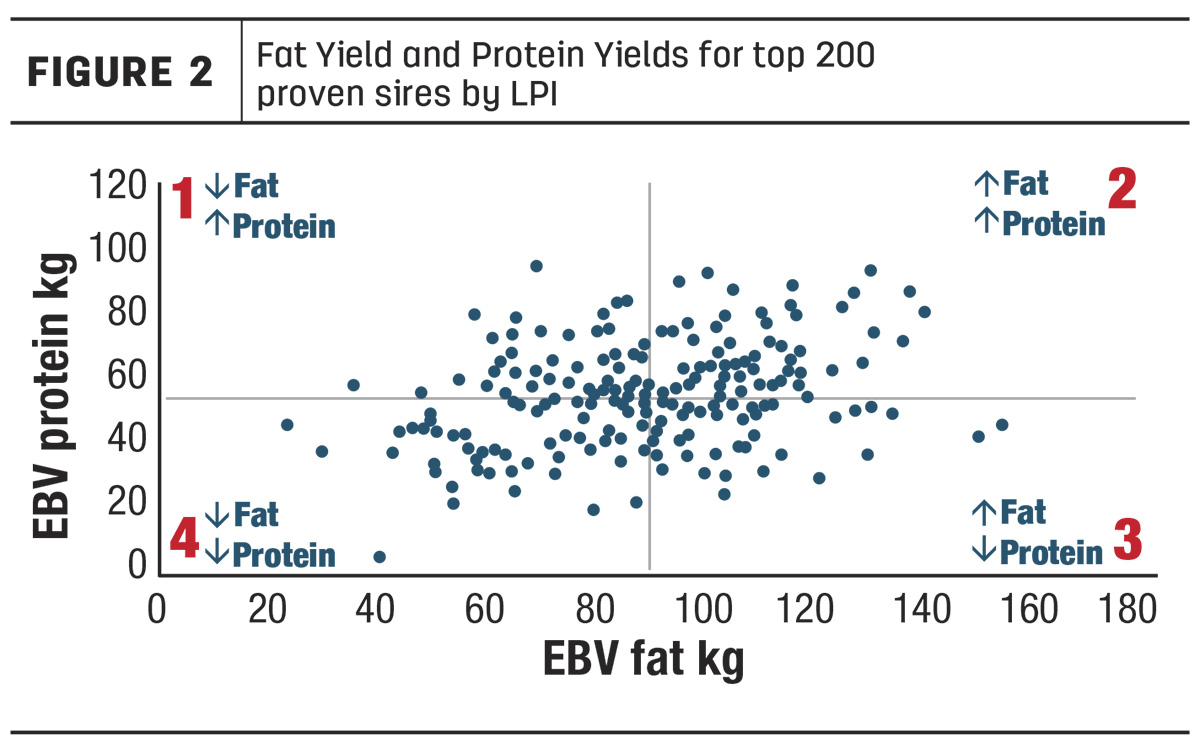
The Production subindex within the Lifetime Performance Index (LPI) places a 60% weighting on Fat Yield and a 40% weighting on Protein Yield for the Holstein breed. While Fat Yield currently receives a greater emphasis, there are still numerous top-ranking sires that excel in Protein Yield. Figure 2 shows the distribution of Fat Yield and Protein Yield evaluations for the Top 200 Holstein Proven Sires by LPI based on December 2025 data. Each quadrant separates sires according to their evaluations for Fat Yield and Protein Yield. For example, quadrant one shows bulls that are lower for Fat Yield but higher for Protein Yield, demonstrating that strong genetics for Protein remains readily available even under the current index weightings. We are also consulting with breed associations and the Genetic Evaluation Board in March 2026 on the ideal weighting of Fat Yield and Protein Yield within the LPI. As the value of protein increases at the farm level, it is important that selection indexes reflect economic realities and industry priorities. Stay tuned for future communications.
Genetics provides a strong foundation for positioning herds to benefit from evolving milk pricing structures. While fat and protein have both shown gains of the past 30 years, the growing gap between them highlights the need for greater emphasis on protein in selection and breeding decisions. By combining genomics, strategic heifer and sire selection and clearly defined goals, producers can make progress that will support both herd performance and future profitability.
References omitted but are available upon request by sending an email to the editor.