In the ever-evolving dairy industry, genetic selection plays a crucial role in shaping the future of herd productivity, efficiency and profitability. Modern breeding approaches leverage advanced selection tools to enhance desirable traits, improve herd health and optimize economic returns. Understanding the principles of genetic selection and the value of selection indexes is key to making informed breeding decisions that yield long-term benefits.

The evolution of genetic selection in dairy cattle
Traditional cattle selection relied heavily on visual assessments, pedigree knowledge and performance records. While these methods contributed to incremental genetic improvements, they lacked precision in predicting an animal’s true genetic potential. The advent of genomic testing revolutionized dairy cattle breeding, allowing producers to evaluate cattle at the DNA level. By analyzing thousands of genetic markers, breeders can now make data-driven decisions with increased accuracy and efficiency.
Key components of a successful breeding strategy
A well-designed breeding program focuses on multiple factors that influence herd performance:
- Genetic control – Understanding pedigree information and maintaining genetic diversity ensures sustainable progress while minimizing inbreeding.
- Adaptation – Features such as hybrid vigor, heat tolerance, disease resistance and behavior contribute to overall herd resilience and efficiency.
- Performance metrics – Traits like milk production, fertility and health are critical indicators of long-term profitability.
Indexes in action
The information received from the genomic testing of dairy females contains several data points. Trying to determine the best and the worst points can quickly become complex. Intensely focusing on a limited number of traits can relieve that complexity, but makes it more difficult to drive progress outside of those focus areas.
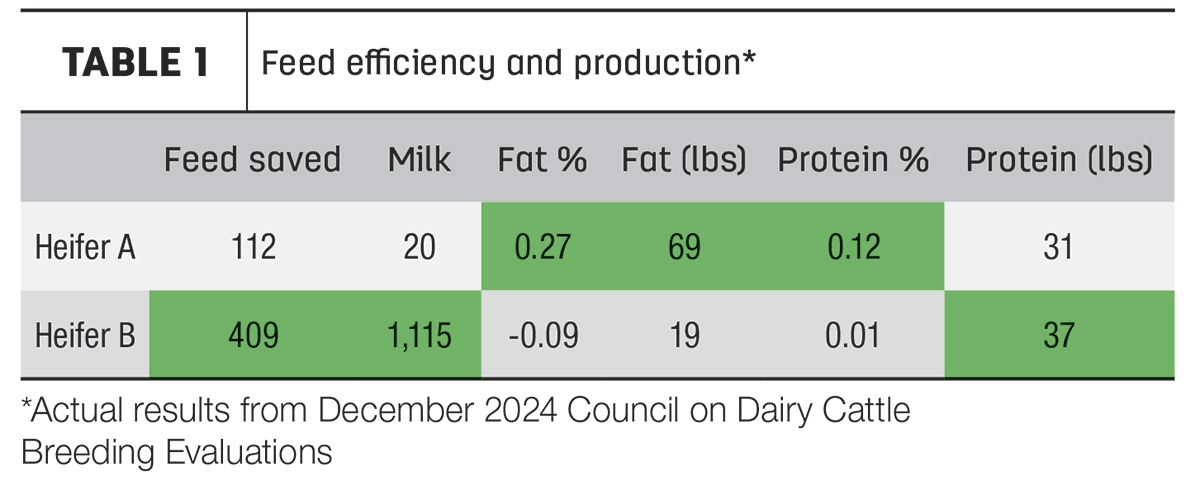
From Table 1, each heifer has a few advantages over the other heifer. Heifer A possesses more genetic potential for fat-rich milk due to her higher predicted transmitting abilities (PTAs) for Fat % and Fat (pounds). However, Heifer B has the genetic potential for higher overall milk production with better feed efficiency. Who brings more genetic value to the operation? Is this enough information on which to base a selection decision? It is difficult to say.
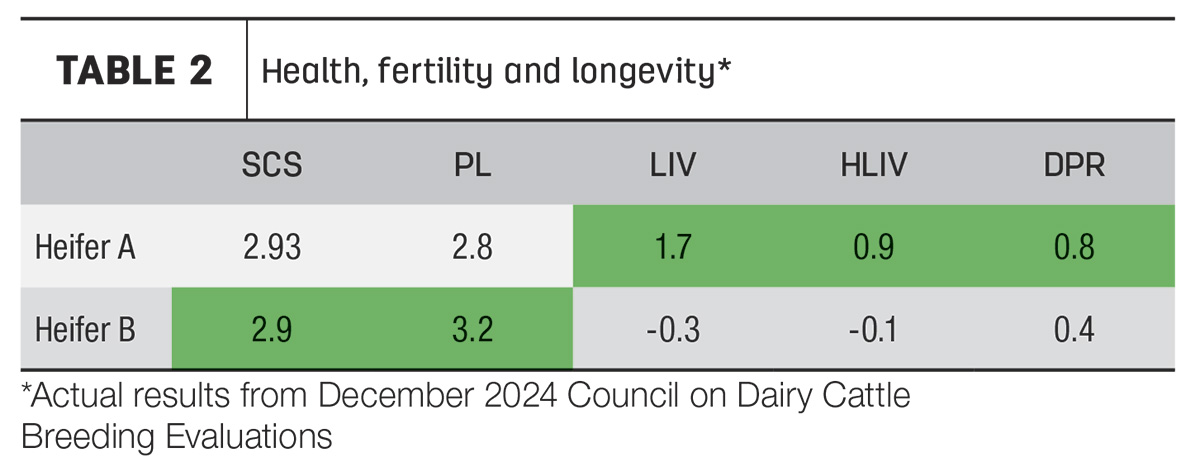
Table 2 shows the PTAs for Somatic Cell Score (SCS), Productive Life (PL), Livability (LIV), Heifer Livability (HLIV) and Daughter Pregnancy Rate (DPR). Heifer A has more favorable genetic potential for Livability and fertility. Heifer B is slightly better for udder health and longevity. With the data in Table 1 and Table 2, is it any clearer who will bring more genetic value? Are there additional traits that should be considered during this decision-making process?
Genetic selection indexes are designed to help answer those questions. Indexes use mathematical formulas, placing relative emphases on a broad range of traits to create a balanced single number that represents the value an animal’s genetic potential brings.
Commonly used indexes are the merit indexes from the Council on Dairy Cattle Breeding (CDCB). These indexes rank dairy animals based on their overall genetic merit for economically significant traits. Within each index, traits are assigned a dollar per predicted transmitted ability (PTA) unit. These values are multiplied by an animal’s PTA for each trait using an economically weighted formula, generating a total dollar value that reflects its overall genetic merit. These indexes, tied to economics, create a much clearer picture of how an animal’s genetic potential contributes to the success of a dairy operation. Table 3 shows the Net Merit (NM$) and Fluid Merit (FM$) results for Heifer A and Heifer B.
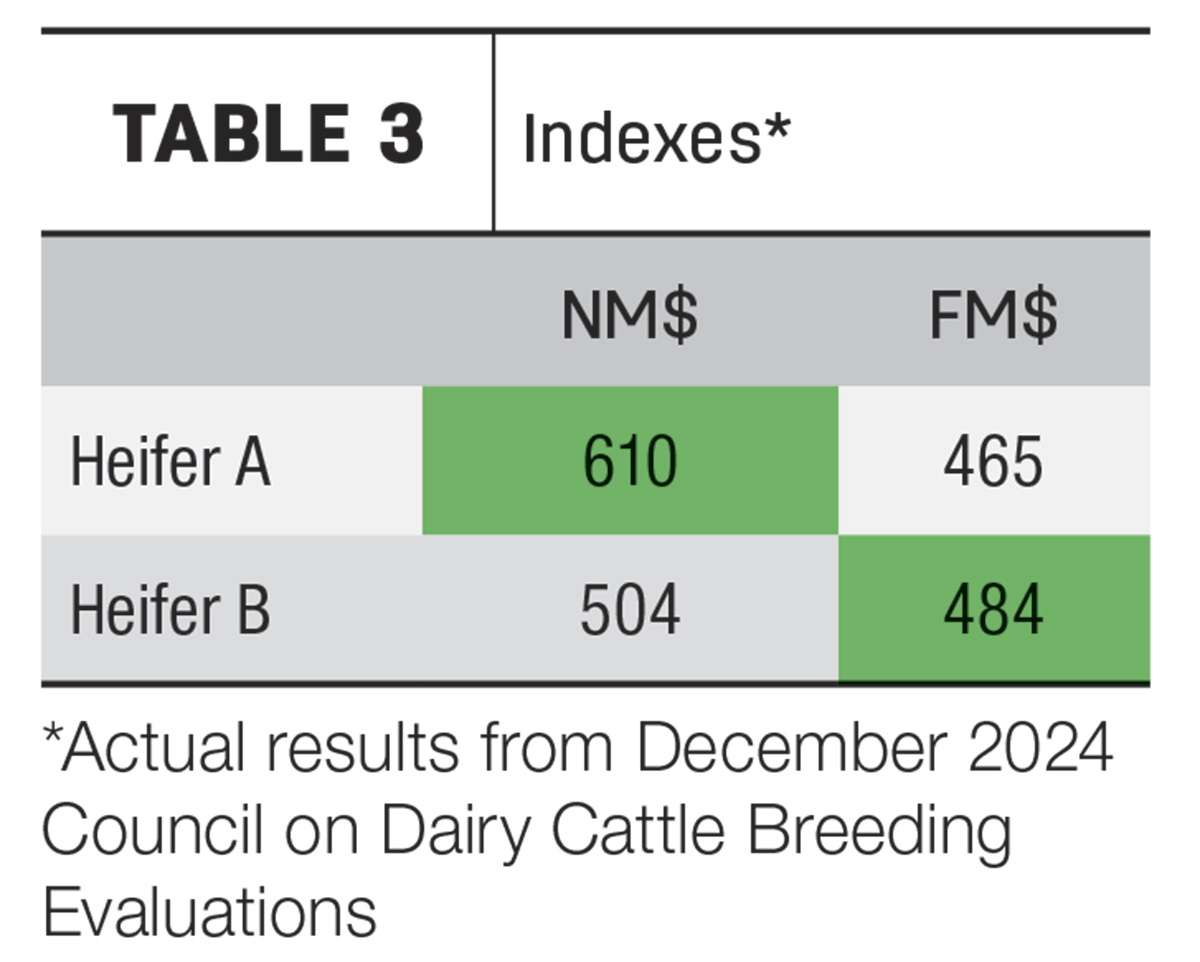
As seen in Table 3, there is no finite answer to whether Heifer A or Heifer B is the superior animal, genetically speaking. The answer is dependent on how a dairy producer manages his or her herd and how milk is marketed. As the name suggests, Fluid Merit (FM$) assigns a higher dollar value to PTA Milk, making Heifer B a better choice for a herd that finds itself in a market driven by fluid milk pricing. In a market where components have a stronger influence over pricing, Heifer A is the better choice, as is reflected in her higher Net Merit (NM$) value. Because profitability is not solely driven by production, both indexes factor in traits related to reproduction, health and other important categories. This ensures a more robust picture of how each animal’s genetics bring value to the herd.
The power of genetic selection indexes
Genetic selection indexes provide a comprehensive framework for selecting the best-performing animals. The variety of indexes available makes it possible for producers to breed and select the animals best suited to meet their specific needs. The implementation of genetic selection indexes yields measurable improvements in herd efficiency and profitability, including:
- Optimized genetic progress: By consistently selecting high-index animals, breeders can accelerate the rate of genetic improvement, leading to a more efficient, profitable and resilient herd.
- Enhanced disease resistance: Genetic progress in health traits leads to lower incidences of mastitis, lameness and metabolic disorders, reducing veterinary costs and improving animal welfare.
- Extended longevity: Cows selected through advanced indexes tend to remain productive for more lactations, reducing replacement costs and increasing lifetime profitability.
Genetic indexes are indispensable tools for dairy producers aiming to enhance herd performance and profitability. By integrating traditional expertise with genomic advancements, breeders can make more informed decisions that yield sustainable improvements. Embracing genetic selection ensures a brighter future for dairy operations, unlocking the full potential of every animal in the herd. As technology continues to evolve, leveraging selection indexes will remain a cornerstone of successful dairy breeding strategies.