


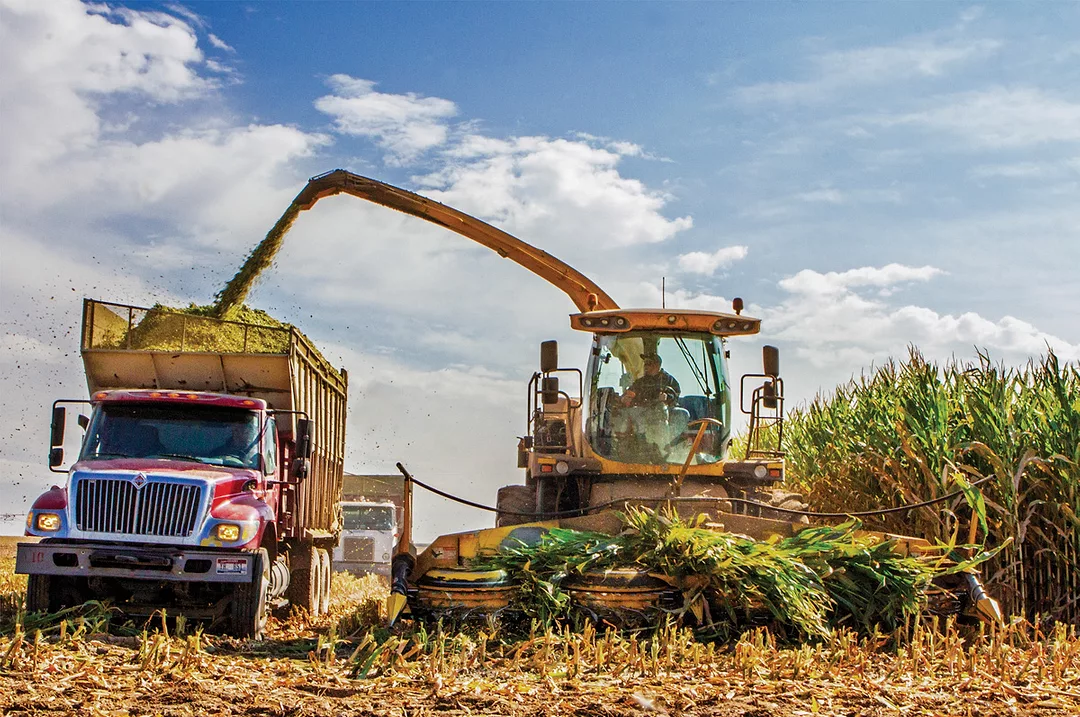
Each year, our company collects and analyzes samples of the U.S. corn crop for mycotoxin presence and risk to livestock production. Samples of corn silage and corn grain are analyzed with liquid chromatography-tandem mass spectrometry (LC-MS/MS) technology for 54 individual mycotoxins and then calculated for how they may pose risk to various livestock and poultry species. Geographic regions of lower, moderate and higher risk are identified, and a reasoning of how and why these levels of different mycotoxins and risks are explained for livestock producers, nutritionists, veterinarians and feed manufacturers.

The 2025 corn crop started with great fanfare with predicted record yields. The western Corn Belt received near-record rainfall in July and then turned hot and dry into fall. The climatic conditions of heat and humidity were a perfect environment for the corn diseases southern rust and tar spot. Although these diseases do not produce mycotoxins, they do put severe stress on the plant and predispose it to infestation from fusarium and aspergillus molds that can readily produce a variety of mycotoxins. Further stress to the crops was generated by a windstorm.
Corn silage
Five hundred corn silage samples contained 5.5 mycotoxins per sample, with 99% of the samples containing two or more mycotoxins. Fusaric acid was found in 95.6% of the samples, while type B trichothecenes were identified in 90.8%. Both are produced by fusarium molds, and deoxynivalenol (DON) represents the greatest portion and risk in the type B trichothecenes group. DON and fusaric acid can act synergistically to magnify the negative impact to ruminants on dry matter intake (DMI), milk production, starch and fiber digestion, conception rate, embryo health, gut wall integrity, lower gut microbiome, liver function and immune response. The levels of DON increased into mid-harvest and then remained high until finish, while fusaric acid remained at a moderate level throughout the harvest.
Other mycotoxins present, but occurring less frequently, were fumonisin, type A trichothecenes (T-2/HT-2), other penicillium and other aspergillus. The risk equivalent quantity (REQ), our company’s calculation of mycotoxin risk from all of the mycotoxin present, was 165.5, which is a higher risk. The risk of corn silage was 77% moderate and higher risk to dairy cows, 90% moderate and higher risk for calves, and 68% moderate and higher risk for beef cattle. The percentages of moderate and higher risk samples steadily increased from August through December. The mycotoxin risk in corn silage was greater in the western Corn Belt for 2025 than it was in 2024.
Corn grain
Corn grain samples followed a similar pattern to corn silage. Fusarium produced were the most occurring, with fusaric acid and emerging mycotoxins being in 92% of the samples, type B trichothecenes in 81% and fumonisin in 71%. Concerning levels of mycotoxins analyzed at maximum levels were type B trichothecenes at 14,485 parts per billion (ppb), fumonisin at 22,625 ppb and emerging mycotoxins at 8,219 ppb. These mycotoxins can impact feed intake, digestion, conception rate, gut wall integrity, respiratory health, gut microbiome, liver function and immune response. There was on average 6.5 mycotoxins per sample, with 98% containing two or more mycotoxins.
REQ values were greater for swine with 65% at moderate and higher risk due primarily to the DON and fumonisin levels. Although at lesser occurrence, zearalenone at a maximum level of 1,191 ppb poses reproductive risk to swine. Risk to poultry was less with 60% of the samples at a moderate or higher risk. This is primarily due to poultry being less sensitive to DON, except for turkeys.
High-moisture corn
High-moisture corn samples had an average of 7.2 mycotoxins per sample, with a mycotoxin profile similar to corn grain, except that type B trichothecenes were the most-occurring group, being in 93% of the samples. Type B trichothecenes, type A trichothecenes and zearalenone had average levels of 1,488 ppb, 398 ppb and 1,194 ppb, respectively. Although high-moisture corn is at a relatively low inclusion rate into a total mixed ration (TMR), these levels will still add significant levels of mycotoxins into a TMR. Impacts may be to DMI, milk production, rumen microbiome, starch digestion, conception rate, embryo and fetal health, gut wall integrity, lower gut microbiome, liver function and immune response.
Feeding 2025 corn feedstuffs
Corn products produced in 2025 will present challenges to livestock and poultry production. Although the mycotoxin risk varies by region and within region, it is highly recommended for producers to test for mycotoxins, from how many mycotoxins are present to which mycotoxins are present. This must be known to accurately assess the risk. Blending and inclusion rates will be methods to lower risk but not eliminate the risk in total. The adage of “no mycotoxin has a safe level“ is true, as multiple mycotoxins at a lower risk may still pose risk to overall animal health and performance. There may be lost efficiency and performance that a producer cannot see by just walking the livestock daily.
Storage will be another key factor. Lower-dry-matter feeds such as silage and high-moisture grain contain plentiful moisture for mold to grow. This will not only increase dry matter loss but also provide an environment that can generate additional mycotoxins. As these feedstuffs are exposed to oxygen, the risk for mycotoxin production increases.
Even though corn grain is stored at a lower moisture level, there can still be leaking at storage facilities, variation within the grain and unideal aeration. Once a mold begins to respirate, it can produce enough moisture to sustain itself and grow. This is an opportunity for increased mycotoxin content. Also, fines and damaged kernels are a prime source of mycotoxins.
Finished feeds and TMRs
Finished feeds and TMRs are a complex mixture of feedstuffs, of which all can contribute to mycotoxins. This can result in a complex “cocktail” of mycotoxins that can act additively and synergistically to impact animal health and performance. Since Jan. 1, analysis of finished feeds and TMRs have shown increased risk versus the same time period for 2025. The risk identified for ruminants has been primarily due to DON, and the risk is on an increasing plane. Poor DMI, lost milk, poor rumen function, inconsistent manure and lower conception rates have been identified.
Risk identified for swine have been low feed intake, poor conception rate, fewer pigs born, lost gain and feed efficiency, respiratory health issues and poor group uniformity.
Again, it is highly recommended to test all feedstuffs and TMRs for mycotoxins to know exactly how to assess the risk for efficient livestock and poultry health and performance. Producers need to keep in mind that many areas, particularly in the western Corn Belt and Upper Midwest, will be feeding higher mycotoxin risk than was fed in 2025.



