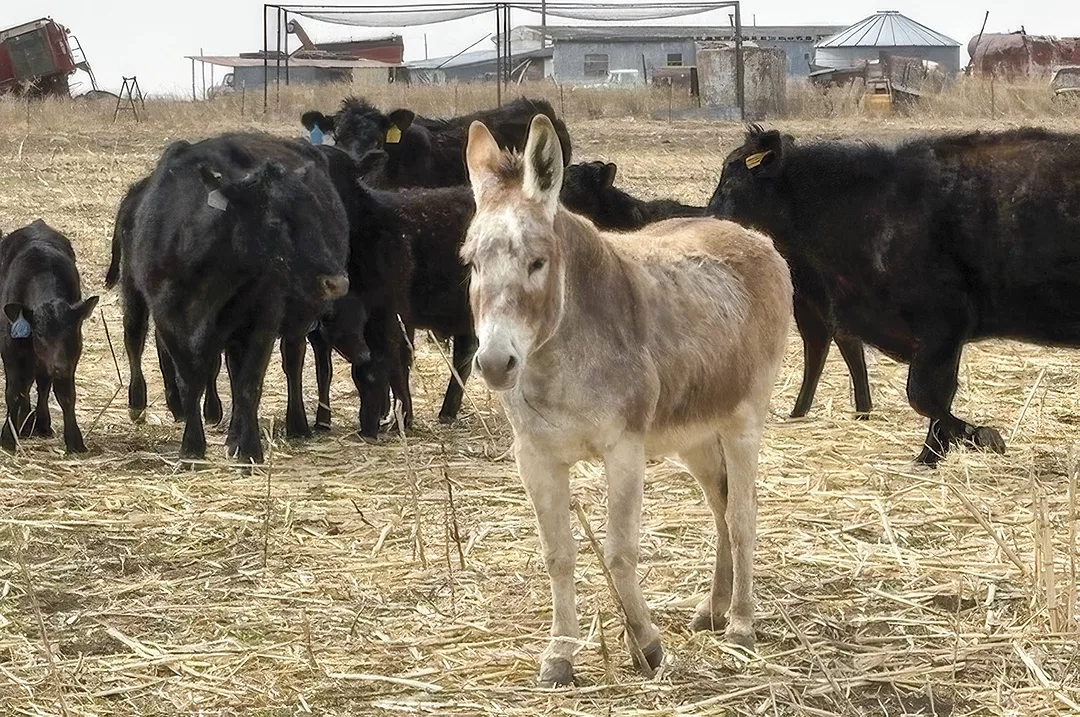
Ranchers are stymied when their ranch dogs fail to protect the herd. Border collies instinctively herd cattle; however, guardian dogs are bred to protect sheep, goats or cattle from predators. Learn which dog breeds excel as guardians, what their jobs entail and why jennies and some llamas are effective as guardian animals.

Bonding is key
Bill Costanzo, Texas A&M AgriLife guardian dog program specialist in San Angelo, Texas, has worked on two research projects to train guardian dogs. During the first study, he trained them to protect sheep or goat herds.
Recently, Costanzo developed best practices for training dogs to bond with cattle and identifying breeds that work best. “I wanted guard dogs that tended to stay close to the herd,” Costanzo explains. “To guarantee the best chance of the dogs bonding with cattle, I purchased Maremma sheepdog pups from a reputable breeder.”
Once the pups were settled, they headed to two 100-foot-by-100-foot bonding pens. Borrowing 10 calves from Sul Ross University, Costanzo placed five calves with two pups in each pen. “These calves were 300 to 400 pounds, used to being handled and weren’t skittish,” Costanzo explains.
When training to guard sheep and goats, puppies enter the bonding pen. “This time we were concerned because we didn’t want the pups to get stepped on or kicked by the calves,” Costanzo explains. “For 10 days, we had them penned next to the big round bale, where cattle ate. The pups could see, smell and hear the cattle, and the cattle could sniff the pups through the wire panel.”
When the pups were 6 months old, Costanzo moved the two calf groups and dog pairs to two 200-acre training pastures. “We monitored the dogs and cattle with GPS trackers,” Costanzo recalls. “The pups stayed with the original set of calves until January 2026. Sul Ross University needed its cattle; we gradually replaced them with AgriLife calves.”
One set of dogs would not stay with the AgriLife cattle. “It took them time to rebond with new animals,” Costanzo explains. “The other set of pups were fine. Now, they are all back in the pasture waiting to go to cooperating producers.”
The best cattle guardian dogs depend on the type and number of predators. Breeds used in the Lone Star State include the Akbash, Anatolian shepherd, Maremma sheepdog and Karakachan. In the Texas Big Bend region, ranchers deal with mountain lions or bears and run larger, more aggressive Kangal shepherds with their sheep, goats and cattle, as do ranchers in other states.
Dogs are excellent guardians because they are proactive, regularly scent-marking their territory and barking at threats. Breeds such as the Maremma sheepdogs patrol their pasture, although they tend to stay near the herd. If the predator ignores scent marks and barking, dogs will kill it or die trying. Dogs also work in teams. A rancher can add dogs until predation stops or reaches a level acceptable to the operation.
“The biggest drawback is feeding the dogs,” Costanzo explains. “It’s hard to know if the dog will work out. Success can take years. You put a lot of money, time and effort into that animal. Sometimes, at two years, you know they aren’t working out; they are too human-friendly or don’t stay with the herd.”
Breeds such as the Great Pyrenees and Anatolian shepherds roam, leaving their herds alone and at risk. They do well on pastures of 1,500 acres or larger. Costanzo says there is a place for llamas or donkeys, although they work differently from livestock guardian dogs.
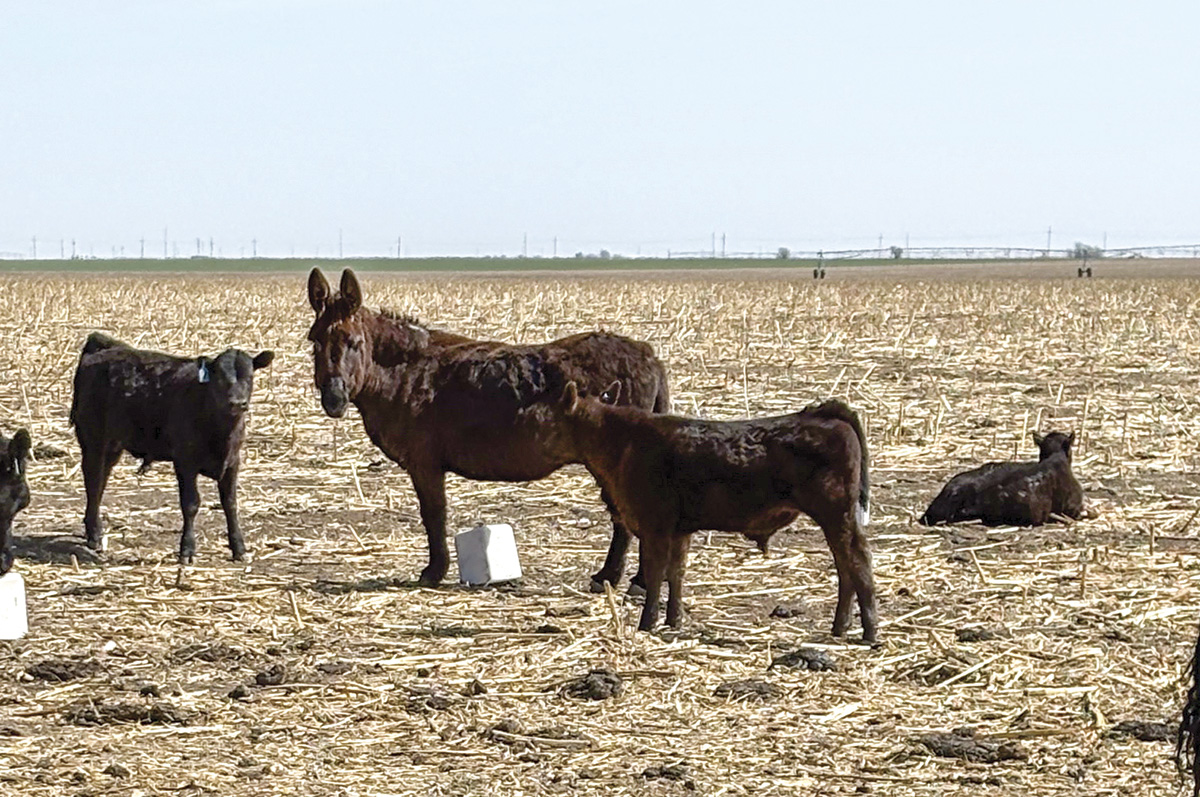
Ruby has a nearly black winter coat with a buffalo robe texture. Ruby, like many jennies, is partial to calves and protects them from packs of coyotes, the main predators around her Texas Panhandle ranch. Image by Andrea Z. Woolley.
Loyal, vigilant companions
Rancher Andrea Z. Woolley and her husband, Gary, raise Angus cattle near Spearman in the Texas Panhandle. Woolley got her first donkey, Ruby, in 2017 and her second, Rosie, in 2018. She says both girls have exceptional instincts to watch and guard the cattle from area coyotes. “They hate predators, like dogs, coyotes or foxes,” Woolley explains.
Each jenny guards her own herd and pasture. For instance, if Ruby sees a coyote, she brays and runs after it. She has run through an electric fence chasing a pack of three coyotes that were trying to get one of “her” calves. The mama cow had left a young calf in the pasture while she went for a drink. “Ruby ran the coyote pack off, then returned and moved the calf to the center of the cow herd,” Woolley recalls.
Rosie spotted a coyote coming after one of “her” calves and chased it out of the cornstalks along with several cows running behind her for backup. One night, Woolley and her husband moved stray calves off the road to join the herd until they located the owners. Immediately after the Woolleys moved the three calves into the pasture, Rosie realized one of “her” calves had been wandering with the strays. She grabbed “her” calf, shook him by the neck like a mother would, then returned him to the herd. Rosie ignored the two strangers.
Female jennies aged 2 or older are terrific guardians. However, if two or more jennies are together in the same pasture, they protect each other, disregarding the cattle. Male donkeys or jacks are ornery and tend to lack the instinct to care for a herd.
“There are many advantages of owning a guard donkey,” Woolley explains. “The donkey stays within the fence. They don’t roam as much as dogs, and they tend to live longer. Pick a larger jenny that can defend against predators. They have a unique ability to assess problems and respond, safekeeping the herd. My girls are loyal, vigilant companions. They patrol pastures and stock day and night, and are invaluable to my outfit. They form a strong bond with the cattle under their care, especially young calves, and lead the herd when we change pastures.”
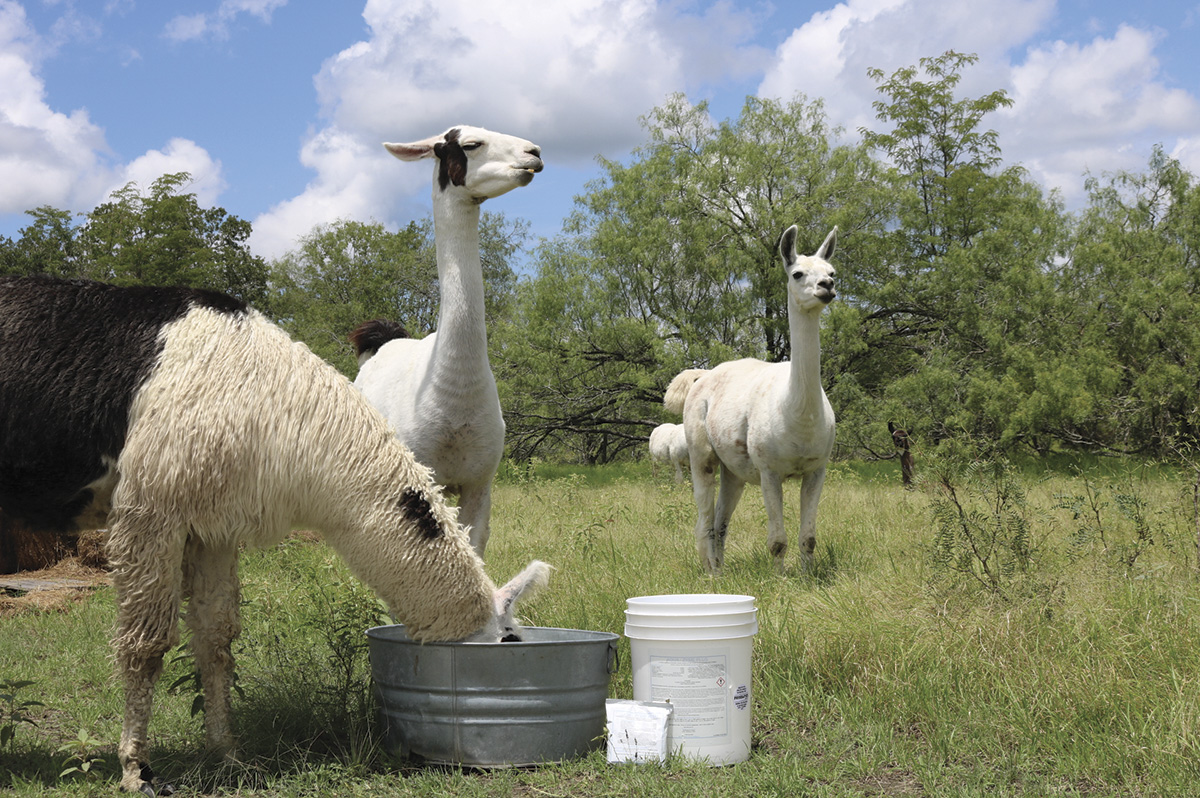
Two of these llamas have been shorn and are watching over the unshorn black and white llama as it eats. Llama wool is prized by knitters. Image provided by Kristin Salome, Shear Joy.
Llamas may have a place as guardians
Krystin Salome, based near Anderson, Texas, shears llamas every spring across the Lone Star State. She also raises llamas and reports they work best as guardian animals for sheep and goats because they tend to eat the same plants, have comparable nutrition requirements and “speak the same language.”
Llamas and cattle behave and communicate very differently. “They don’t usually bond, so a llama is less inclined to protect anything but itself,” Salome explains. “If a llama runs off a scout coyote in defense of itself, then the cattle herd benefits, but it wasn’t because the llama felt an instinct to protect cows.”
Related to camels, llamas have different nutritional and mineral needs than cattle. Llamas’ wool coats should be shorn once a year to prevent matting and skin issues, and their nails and teeth should be trimmed annually. Ranchers should also check for parasites, such as the barber’s pole worm.
“I don’t think it’s wise to place a llama with cattle as a guardian,” Salome explains. “There are situations where ranchers have great success. However, I think that’s due to luck and the self-preservation skills of llamas, rather than the compatibility of llamas as guardians for cattle.”
Native to South America, llamas are intelligent, observant, curious and attentive to pasture activities. Salome says those traits make them more situationally aware than some species, keeping them on guard. “We recommend getting the same sex guardian llama as the bulk of your herd,” Salome advises. “Males for male herds, females for female herds. They work best in pairs or threes of the same sex.”
For more information about livestock guardian animals, ranchers can consult with their extension service.