Milk is a commodity business. Unless there is government protection, commodity businesses move toward optimization, cost reduction and scale. That pattern shows up across industries; there are very few backyard oil wells, and you do not see many small, local steel mills anymore. In commodity markets, the price is set by the market, not negotiated at the consumer level, so producers have to compete on cost and volume.

When I advise producers on growth, I focus on two levers that work together: scale and efficiency. Most U.S. dairies understand the value of scale to minimize fixed costs per cow. What sometimes gets overlooked is that a more efficient cow can either represent a substantial increase in revenue or a meaningful decrease in cost. Subsequently, growth may not only come from adding cows; it can also be achieved by marginally improving the yield to feed intake efficiency of your existing herd through technological adoption.
Scale is the path forward
The U.S. agricultural system does not offer the protectionist buffers found in some other markets. Over roughly the last 20 years, the number of U.S. dairy farms has fallen from around 70,000 to around 20,000, even though the national herd has stayed relatively stable at roughly 9.2 million head.
Meanwhile, the U.S. has increased its total milk yield by roughly 20%-30% over that same period, with the same number of cows and a fraction of the farms. That means the industry has gotten dramatically more efficient – better cows, better management, better technology.
Where will growth and consolidation end? We are not there yet. Producers who want to keep up with market evolution need a competitive plan for reaching operational scale. They need to be able to grow consistently, reliably and with stability, and to be positioned to continue growing. Producers who do not want to grow will need a niche market or a partnership model that can compete on cost. Co-ops and alliances among smaller operators are one path, but for the commodity dairy farmer who stays small and unprotected, it is hard to see a path beyond the next generation.
Equipment that lasts through generational change
Transgenerational equipment should be working effectively when the next generation of your dairy operation is ready to begin. A farm that grows with equipment that will fall short of its growth plan in five to 15 years did not build lasting scale; it mildly rented its growth. When growth needs to happen again, that operation must first replace what it already bought before it can actually expand. This is a painful experience for those who have gone through it.
While replacing equipment in 12-15 years may sound acceptable and could be financially feasible on paper, issues with that parlor often begin long before its expected lifespan is complete. When throughput becomes inconsistent, maintenance becomes constant and bottlenecks appear and your assumed scale fails to materialize, you may have infrastructure designed for 10,000 cows, but your parlors may only allow you to milk 8,000 or 9,000 efficiently. So you thought you were growing for 10,000, but you only grew for 8,000, and you inherited a new set of costs, stoppages and operational frictions.
That is what happens when farmers invest in cheap infrastructure. It does not last for the next generation, so you can end up spending twice: once to replace the bottleneck you installed and again to expand. Worse, the bottleneck starts costing you in throughput, labor and maintenance long before the expected replacement date.
That is why transgenerational investments matter. You want an operation that runs smoothly and predictably so you can spend more time on strategic herd management and profitability, not on technical emergencies.
As you scale an additional 5,000 cows, the last thing you need to worry about is equipment. You have 5,000 new animals to manage and operate. Your farm’s first-year execution has a massive influence on return on investment (ROI). The next 20 years are about frictionless efficiency and adaptability. Hardware must back you up, not slow you down.
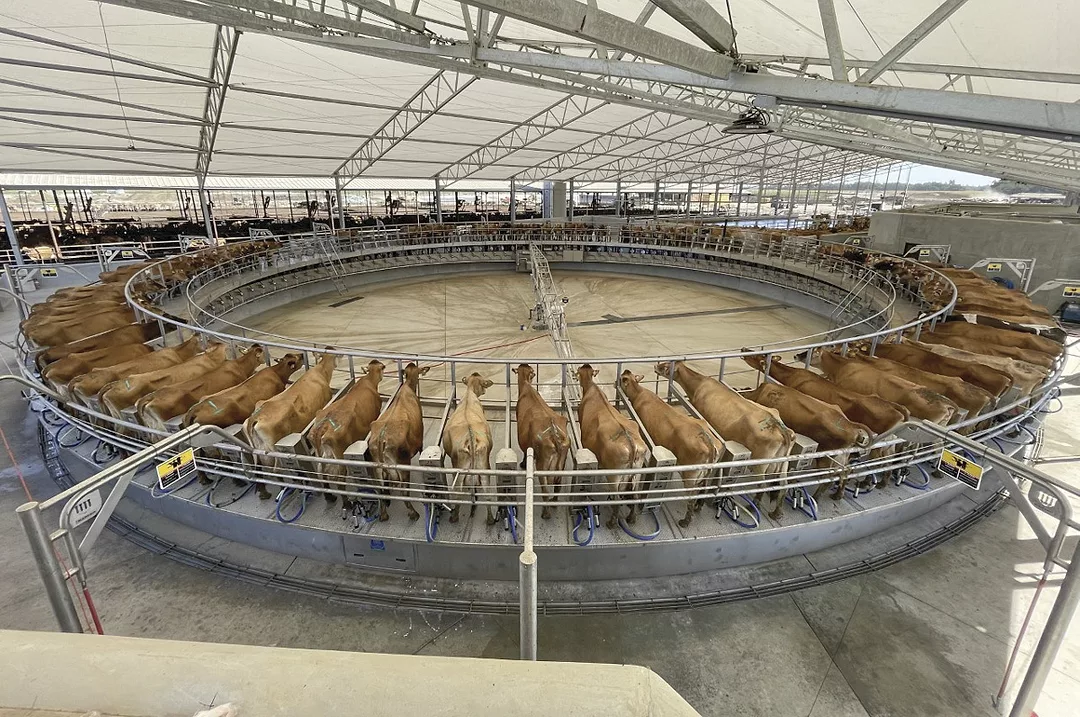
Even though the equipment itself can be impressive, and farmers understandably enjoy talking about it, the truth is that the art of milking lives in strategic herd management. You should not be thinking about your equipment on a day-to-day basis. A dairy should be able to add new parlors over time and still have the first one running. And with the newest magnetic levitation technology for rotary milking, a rotary can keep running without beam changes and without greasing or roller issues. It can, quite literally, smoothly spin forever.
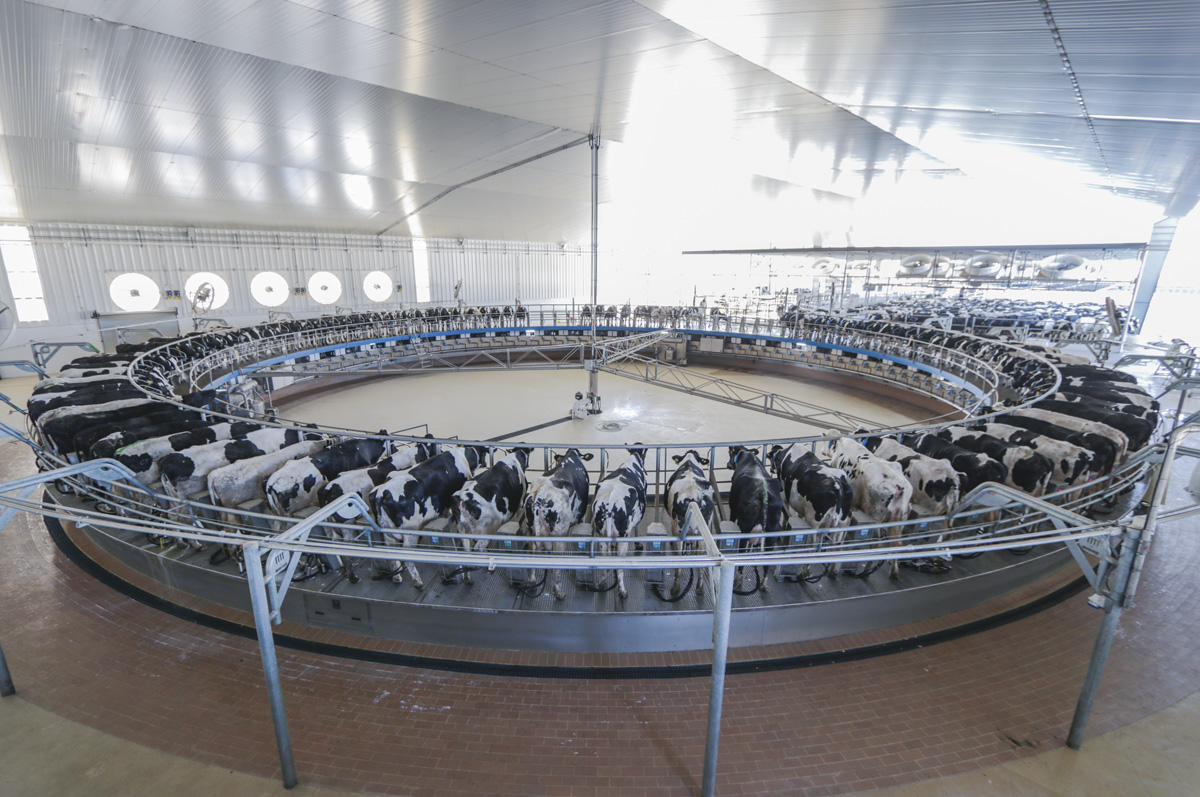
A dairy should be able to add new parlors over time and still have the first one running. Image courtesy of Madero Dairy Systems.
Herd efficiency as an alternative path to growth
Consider a 5,000-cow herd averaging 80 pounds per day. That herd has several paths to increase net profits:
- Add more cows producing 80 pounds a day. This is a heavy capital expenditure that can strain facilities, labor and throughput.
- Work on genetics, nutrition and reproduction to raise average cow yield. It is easier said than done, but good management and good data can help you achieve this progressively over time.
- Cut fixed costs through automation and overhead reduction. This is feasible but risky, since cutting fixed costs usually means gambling on technology.
- Reduce per-cow variable costs, especially feed. If you can calculate individual cow feed cost per day, not just herd averages, you can select, group and manage cows for profit per head, not just pounds of milk.
This list could be endless, especially with the herd creativity of the modern American dairy farmer.
The primary focus for improving general efficiency should be to reduce hundredweight (cwt) direct cost. Fixed costs become more diluted as dairies scale. But scale is only a platform. The goal is to reach a level of throughput and fixed-cost dilution that gives you the operational smoothness to focus on the real value driver: specific individual-cow marginality, profitability and feed efficiency.
For decades, the industry improved production by measuring individual cow output. When daily production per cow became measurable, U.S. milk production began an acceleration that dwarfed the gains of the prior 60 years. The lesson is clear: the moment we can identify a specific variable at the cow level, we can select and manage for it.
The next stage of strategic management is measuring individual cow costs, especially feed intake and feed cost, so producers can manage each cow’s marginality, not just herd averages. New technologies now make this possible.
It is also a sustainability win. Less feed per pound of milk means less manure and fewer emissions per unit of output.
The two halves of the equation
From an efficiency standpoint, the best technologies are the ones that enable individual-cow precision and strategic management to optimize profitability and improve marginality. From an operational standpoint, scale requires equipment that offers peace of mind and transgenerationality, so that with a one-time investment, producers are positioned to keep growing without constantly fixing bottlenecks.
These two halves work in concert. Reliable, long-lasting infrastructure frees producers from the daily distraction of managing equipment failures. That operational calm is not a luxury; it is a precondition for strategic herd management work where the real returns live. When your parlor runs without friction, you can dedicate your attention to the metrics that drive profitability: individual feed efficiency, cow-level cost analysis, genetic selection for margin, niche and value-added milk products, and precision grouping.
The U.S. dairy industry has arrived at its position of global strength by producing more milk with the same number of cows across a fraction of the farms. It did so not by choosing between scale and efficiency, but by pursuing both. The producers who will thrive in the next generation are those who build scale on infrastructure that endures and then turn their full creative energy toward making every cow in the herd as profitable as she can be.