When farmers talk about soil health, cover crops often rise to the top. They keep biology active, protect soil from erosion and cycle nutrients without relying solely on purchased inputs. But for many growers – organic, regenerative or simply input‑conscious – the question remains: Can cover crops meaningfully suppress weeds without sacrificing yield?

That question drives Erin Silva’s work at the University of Wisconsin – Madison. Speaking during a recent GreenCover Seeds webinar, she summarized more than a decade of research on interseeding, roller‑crimping and diversified cover crop strategies. Her message: Cover crops are not just a soil health tool – they are a weed management tool that can replace or significantly reduce tillage and herbicide use.
As she notes, “Cover crops are really the foundation of regenerative ag systems – bringing those living roots in the soil, bringing that diversity, bringing those sugars and those compounds to feed our soil biology.”
Why cover crops matter for weed management
Silva’s team studies how cover crops influence every stage of the weed life cycle. Their effects include:
- Physical suppression: Mulch blocks sunlight and prevents emergence.
- Allelopathy: Cereal rye releases compounds that inhibit small‑seeded weeds.
- Competition: Cover crops occupy space, light and nutrients.
- Biological predation: Residue supports insects and small mammals that consume weed seeds.
- Reduced seed return: Fewer mature weeds mean fewer seeds entering the soil.
These mechanisms support organic and conventional systems by reducing tillage, herbicide passes and pressure from resistant species.
Interseeding in 30‑inch and 60‑inch corn
Silva’s team has evaluated interseeding in both row widths to suppress weeds, build soil health and, where possible, support livestock integration.
60‑inch rows: More space, more biomass
Wider rows increase light penetration and allow diverse mixtures to thrive. Four mixes were compared with a standard cultivated 30‑inch organic system.
Key findings
- Brassicas dominated early biomass and shading.
- Legumes contributed little biomass.
- Weed suppression was strongest in high‑brassica mixes.
- Yields were 27% lower than 30‑inch rows in a drought year.
- The drought‑year yield drag highlights a recurring theme: Cover crop‑intensive systems are powerful but sensitive to moisture stress.
Silva emphasized the importance of designing mixes around function: “Because we weren’t using any herbicides and were relying entirely on weed suppression, having high amounts of brassicas was really important.”
30‑inch rows: Interseeding without yield loss
Annual ryegrass, red clover and oilseed radish – alone and in mixtures – were seeded at V3. In the upper Midwest, V3 provides enough sunlight for establishment without compromising corn growth.
Findings
- Mixtures produced more biomass than single species.
- Two cultivation passes were eliminated.
- Corn silage yields were unchanged.
“It was really exciting to see cover crops established in these interseeded systems – it allows us to do less soil disturbance in organic systems,” said Silva.
Roller‑crimping: A no‑till system for soybeans
Roller‑crimping cereal rye ahead of soybeans has become a signature regenerative practice in the Upper Midwest. Silva’s team has been a national leader in refining the system.
How it works
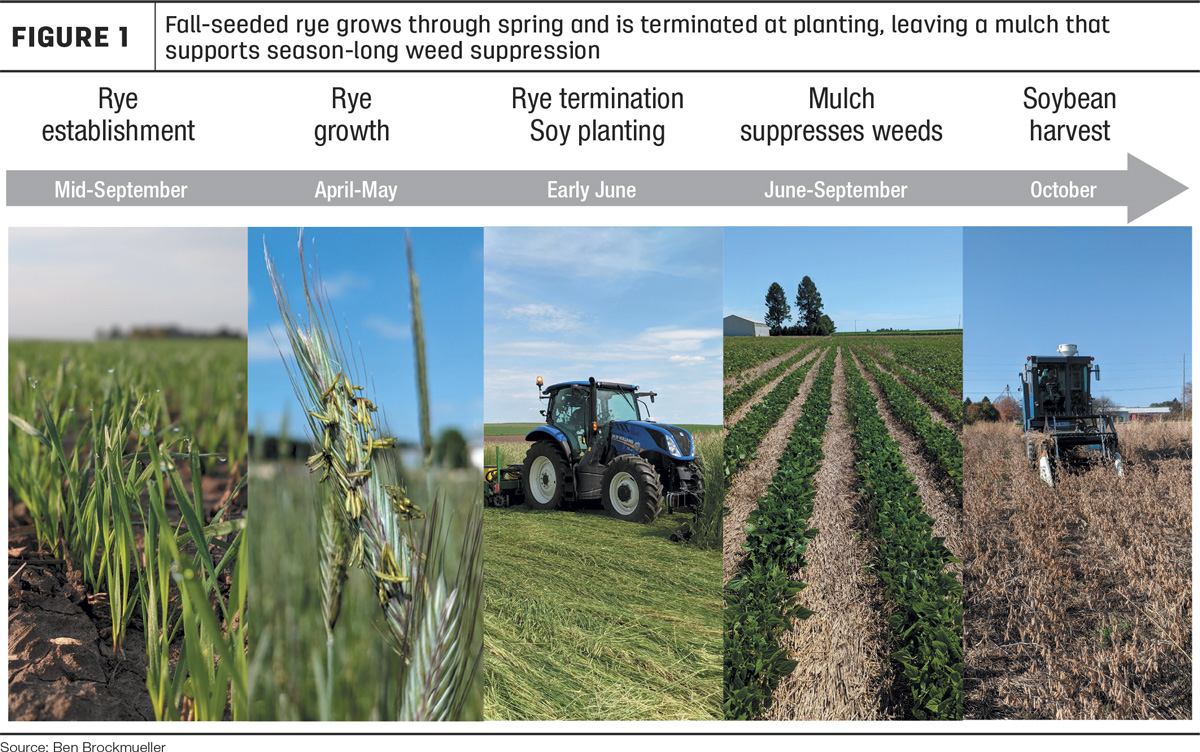
- Plant rye early in fall.
- Allow it to reach anthesis in spring.
- Roller‑crimp in early June.
- Plant soybeans into standing rye or immediately after.
The resulting mulch provides season‑long weed suppression without herbicides.
Performance across years
Long‑term organic soybean yields range from 40 to 60 bushels per acre, competitive with tilled organic systems. In some years, roller‑crimped beans outperform tilled beans when moisture is adequate and rye biomass is high.
Drought years tell a different story. In 2022 and 2023, dry conditions widened the yield gap because rye competes for early moisture before conserving it later.
“You can just see the power of that cover crop that rye was able to prevent weed seeds from germinating, creating a really clean mat for the combine,” said Silva.
On‑farm data
To compare research station and real‑farm conditions, Silva’s team collected on‑farm data:
- Soybean yields ranged from 20 to 65 bushels per acre.
- Weed suppression varied widely, driven almost entirely by rye biomass.
- Target biomass for herbicide‑free suppression is 10,000 pounds per acre.
“Especially when we’re not using herbicides, we want that rye biomass closer to 10,000 pounds per acre,” explained Silva.
Producers who consistently hit that biomass target achieved clean fields and strong yields.
Where cover crops pay
Even with higher rye seeding rates (2 to 3 bushels per acre), roller‑crimping often pencils out because of reduced field passes. Eliminating multiple cultivation passes saves labor and fuel.
Silva’s team calculated breakeven yield losses:
- At $20 soybeans: Up to 5 bushels per acre.
- At $30 soybeans: Up to 3 bushels per acre.
- Many years exceed these thresholds.
Planting soybeans into standing rye
Farmers often ask whether soybeans can be planted earlier – before rye reaches anthesis – to avoid June planting.
Silva’s team tested:
- May 19 (full heading)
- May 27 (early anthesis)
- June 2 (mid‑anthesis)
Soybeans planted too early suffered more mechanical damage during crimping.
“The earlier planting dates had a bit of damage – the June 2 planting date had the least amount of damage,” said Silva.
Planting just ahead of crimping is possible, but pushing too early increases risk.
What does this mean for farmers?
Silva’s research offers a road map for farmers looking to reduce tillage, cut herbicide use or build more resilient systems.
Key recommendations:
- Match cover crop mixes to goals: Brassicas for weed suppression, legumes for nitrogen (N), mixtures for resilience.
- Prioritize early fall rye planting: Biomass is the strongest predictor of weed suppression.
- Use interseeding to reduce passes: In 30‑inch corn, V3 interseeding can eliminate two cultivation passes.
- Expect moisture sensitivity: Cover crop‑intensive systems require caution in drought.
- Evaluate rye biomass each spring and adjust expectations or weed control plans accordingly.
Reduced‑tillage corn: A tougher challenge
Reduced‑tillage corn has been far more challenging than soybeans. Organic corn typically yields 180 to 200 bushels per acre, but roller‑crimped corn often tops out near 150.
Early attempts to pair hairy vetch with winter rye caused N tie‑up, so the team shifted to vetch-oat mixes. Legume living mulches such as red clover, alfalfa and yellow‑blossom sweet clover have shown inconsistent results, especially in dry years. Nitrogen timing remains a major limitation: Even with legumes, N is not reliably available when corn needs it.
An inter‑row mower has improved management by allowing earlier termination of vetch and better control of regrowth, but it has not increased yields.
Overall, weed suppression is strong; N availability and competition remain the barriers. Progress continues but reduced‑tillage corn remains more complex to optimize than soybeans.
“It’s such an exciting field to be working in,” said Silva. “There is so much we can think about in terms of how to recreate what we see in nature and how to emulate it.”